



“We Automate Our Deliveries.” Cool. That’s Not a Strategy.
Automation handles tasks. Orchestration handles outcomes. The difference is what you see on the P&L.
Every logistics team we talk to says some version of the same thing: we’ve automated our deliveries. And they mean it. They’ve got route optimization software. Automated dispatch. Driver apps. Notifications that fire the moment a package is out for delivery.
So why are margins still tight? Why are SLA breaches still happening at scale? Why does the operations manager still spend Monday mornings putting out fires that should have been impossible?
Because automation and orchestration are not the same thing. And confusing the two is costing more than most teams realize.
Automation Is a Tool. Orchestration Is a System.
Automation handles repeatable tasks. A rule fires, an action happens. Route gets generated. Notification gets sent. The driver gets assigned. Done.
That’s useful. It removes manual effort from predictable work. But delivery operations are not predictable. A driver calls in sick. A customer isn’t home. Traffic shuts down a corridor. A shipment misses its pickup window. Demand spikes 40% on a Tuesday because of a flash sale no one told the logistics team about.
Automation was not built for any of that. It executes the plan. It does not adapt when the plan breaks.
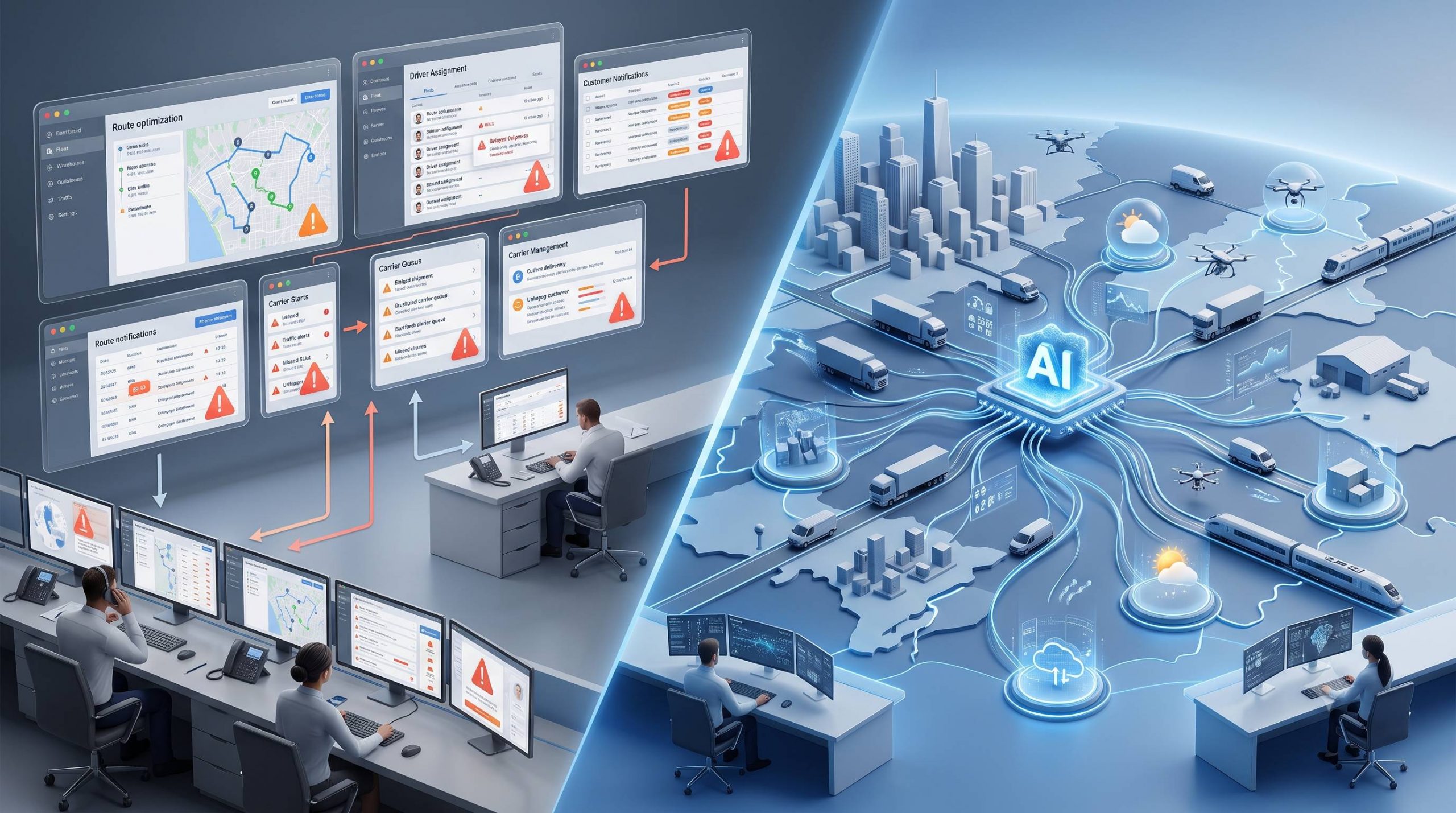
Orchestration does something different. It coordinates decisions across your entire delivery network in real time, weighing fleets, partners, capacity, cost, and customer commitments simultaneously. It doesn’t just execute, it thinks.
What Does It Actually Look Like When It Breaks Down?
Here’s a scenario that plays out in some form at every enterprise doing meaningful delivery volume.
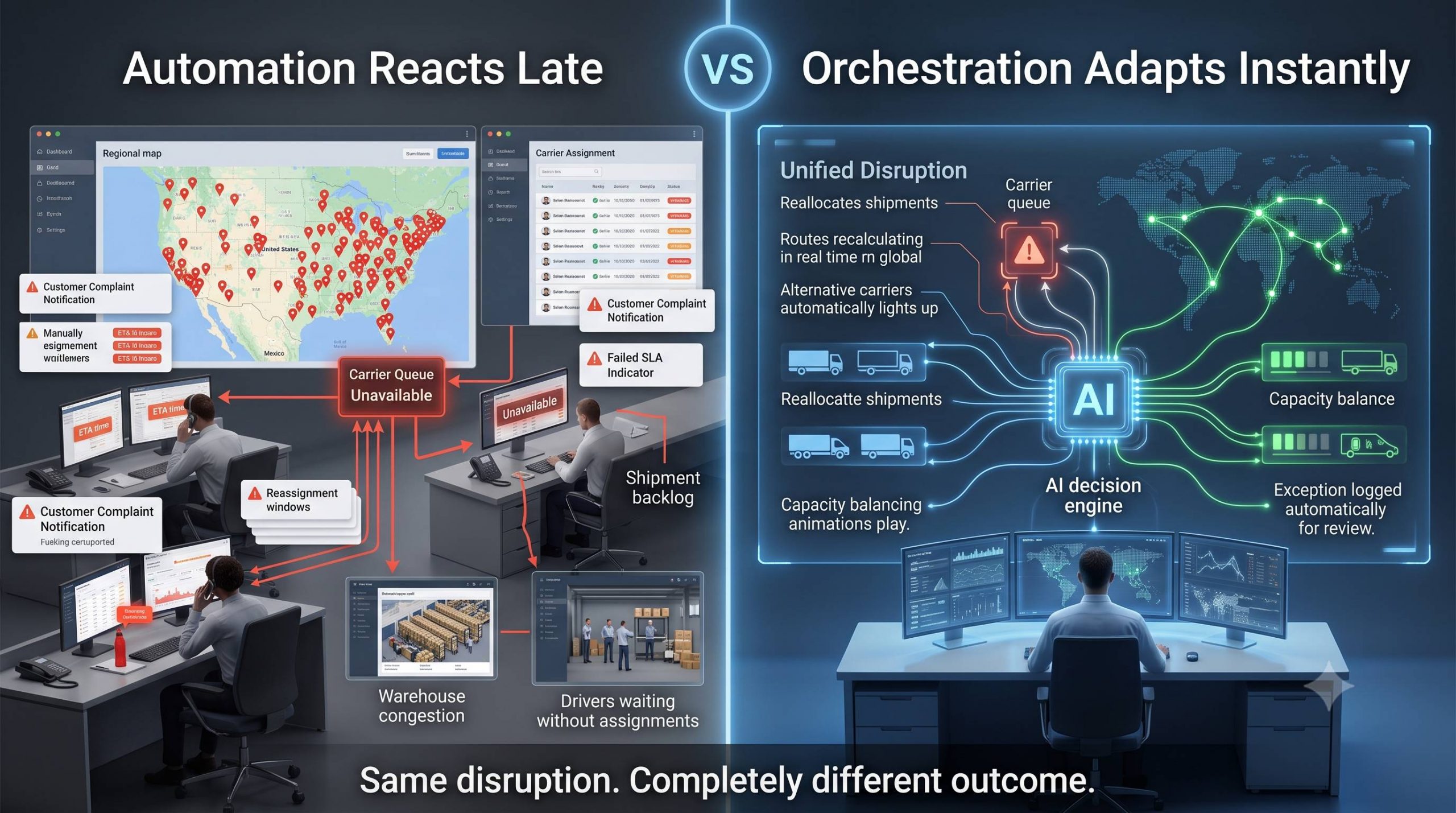
A regional carrier goes down mid-day. Automated systems keep assigning orders to that carrier because the rule says to. By the time someone notices, 200 orders are sitting in a queue that won’t move. The fix is manual. Dispatchers are on phones. Customers are getting delay notifications. The brand takes the hit.
An orchestrated system catches the capacity gap the moment it appears. It automatically shifts volume to the next best available carrier or fleet, recalculates ETAs, updates customers proactively, and logs the exception for the team to review. No one had to make that call. The system already made it.
The difference between those two outcomes is not the quality of the automation. It’s whether there’s an orchestration layer sitting above it.
What Is Logistics Orchestration?
Logistics orchestration is the real-time coordination of delivery decisions across fleets, carriers, routes, and systems, so that every order reaches the right outcome, not just the expected one.
It operates above your existing tools. Above the TMS. Above the route optimizer. And above the carrier integrations. It’s the layer that connects them all and makes decisions when they conflict.
In practice, an orchestration platform knows your SLAs, carrier performance history, cost thresholds, customer delivery preferences, and current capacity across every node in your network. When something changes, and something always changes, it reacts before a human needs to.
Think of it this way. Automation is a very good assistant who does exactly what you tell them. Orchestration is a very good operations director who knows what the business needs and makes calls accordingly.
Why Automation Alone Is Not Enough
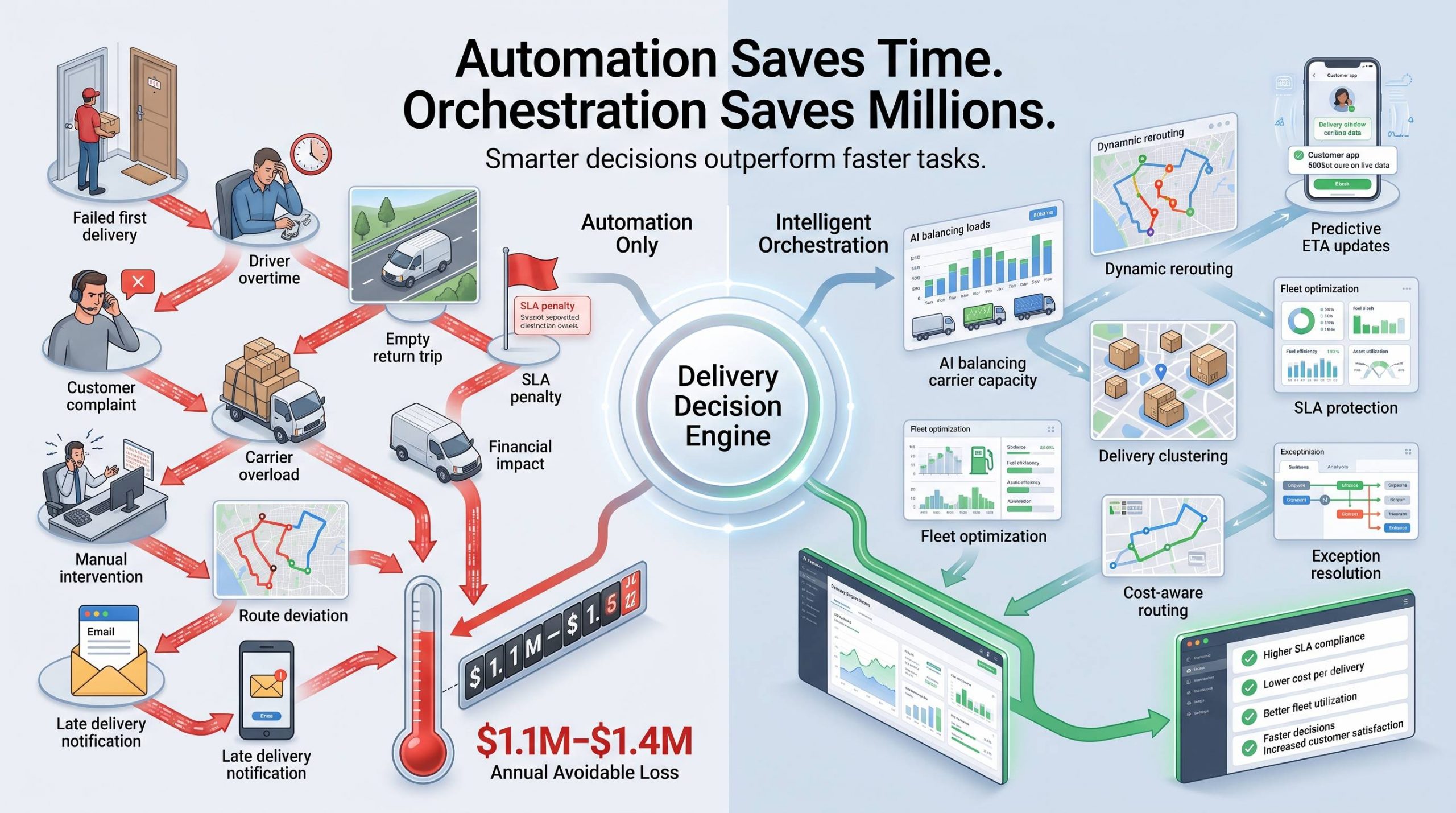
Last-mile delivery now accounts for 53% of total shipping costs. U.S. delivery costs jumped 12% from 2024 to 2025. For a 50-vehicle fleet, avoidable inefficiency from failed redeliveries, SLA penalties, and route failures can total between $1.1 million and $1.4 million annually.
That is not a number you fix by automating more tasks. That is a number you fix by making better decisions, faster, at a scale no human team can match without the right system underneath them.
Automation reduces effort. Orchestration reduces error. Those are different problems with meaningfully different price tags attached.
In 2026, last-mile leadership is no longer about who can promise the fastest delivery. It’s about which network can make the most intelligent decisions, in real time, across the most complexity.
The Companies Getting This Right
The enterprises leading on last-mile performance are not the ones with the most automation tools. They are the ones who have built an orchestration layer that sits above their fleet, their carrier mix, and their fulfillment nodes, and routes decisions intelligently across all of it.
McDonald’s manages delivery across more than 100 countries. The reason that works is not because they have automated individual tasks well. It’s because they have built a system that orchestrates millions of delivery decisions daily without requiring a human to weigh in on each one.
At that scale, automation is table stakes. Orchestration is the edge.
Where to Start
If your operations team is spending more time managing exceptions than improving the system, that is the signal. Exceptions are what happen when automation meets reality without orchestration in between.
The starting point is visibility. You cannot orchestrate what you cannot see. A unified view of your fleet, your carrier performance, and your order status in real time is the foundation everything else is built on.
From there, the question is simple: where are the decisions that matter most still being made manually? And what would it take to make them automatically?
That is the conversation worth having. And it starts with a platform built around orchestration, not just automation.
LogiNext’s platform is built around this exact layer. See how it works for your operation.
17

|

|

|




@LogiNext