




Last Mile Delivery Optimization: How Intelligent Order Batching Improves Efficiency
Last mile delivery optimization is the process of improving how deliveries are planned, assigned, routed, and executed so businesses can deliver more efficiently without compromising customer commitments. And there is a good reason businesses are paying closer attention to it. The last mile can account for up to 53% of total shipping costs, making this final leg one of the most expensive parts of the delivery journey.
One way to respond is through intelligent order batching. Identifying compatible orders and combining them into a single trip when the route, timing, capacity, and customer commitments make sense.
The objective isn’t to batch as many orders as possible. It is to make better delivery decisions in real time, using the drivers and capacity already available.
Key Takeaways
- Last mile delivery optimization is about improving delivery decisions while balancing cost, capacity, route efficiency, and customer commitments.
- Intelligent order batching can consolidate compatible deliveries and reduce unnecessary trips.
- Effective batching considers drive time, traffic, delivery windows, route compatibility, and driver capacity, not just distance.
- Dynamic optimization is especially valuable during peak demand when manual dispatching becomes difficult to scale.
- Last mile delivery software can connect routing, allocation, tracking, ETA prediction, and real time adjustments into one operational workflow.
- The goal isn’t maximum batching. It’s maximum efficiency without compromising the customer promise.
Why Is Last Mile Delivery Optimization So Difficult?
Last mile delivery looks deceptively simple. An order needs to get from point A to point B. Multiply that by thousands of orders, however, and the problem becomes considerably more complicated.
A delivery operation may have multiple drivers traveling through the same neighborhood while nearby orders are being assigned to other vehicles. During peak periods, dispatchers can become overwhelmed trying to decide which orders can be combined without creating delays.
And customers aren’t necessarily demanding the fastest delivery possible at any cost. McKinsey’s 2025 survey of more than 1,000 U.S. consumers found that 90% were willing to wait two or three days for deliveries, particularly when it helped them avoid shipping costs. At the same time, 90% said they were likely to abandon a cart when shipping costs were high.
That creates an interesting optimization problem: businesses need to control delivery costs without letting efficiency undermine reliability.
Several factors make optimization challenging:
Demand changes constantly: Order volumes can spike within minutes.
Routes overlap: Different drivers may be covering nearly identical areas.
Traffic changes: The fastest route at 5:30 p.m. may be very different from the one at 7 p.m.
Customer promises matter: A cheaper route is useless if it causes a late delivery.
Geography varies: A short distance does not always mean a short drive.
Manual decisions don’t scale: Dispatchers cannot evaluate every possible order-driver combination as volume increases.
This is why modern last mile delivery software needs to do more than create routes at the beginning of a shift. It needs to continuously evaluate what is happening across the delivery network.
How Does Intelligent Order Batching Improve Last Mile Delivery Optimization?
Intelligent order batching identifies orders that can be consolidated into a single driver trip without creating unacceptable additional travel or delivery delays.
Consider a simple example.
A driver in Chicago has accepted an order and is already heading toward the restaurant. A second order appears 0.1 miles away, and its drop-off is close to the first customer’s destination. A basic dispatch system may send another driver.
An intelligent system evaluates whether the second order can be added to the existing trip. The decision can consider:
1. Pickup proximity: Is the second pickup realistically close to the driver’s current route?
2. Drive time: How much additional travel time will the second order introduce?
3. Traffic: Are current road conditions likely to make the detour impractical?
4. Delivery sequence: Can both orders be delivered in a sensible order?
5. Customer ETA: Will either customer experience an unacceptable delay?
6. Driver capacity: Can the driver handle the additional order?
If the answer is yes, the orders can be batched. If not, the second order remains a separate delivery. That distinction is critical. Good batching is not about putting more orders into a vehicle. It is about identifying compatible orders.
What Happens Without Dynamic Order Batching?
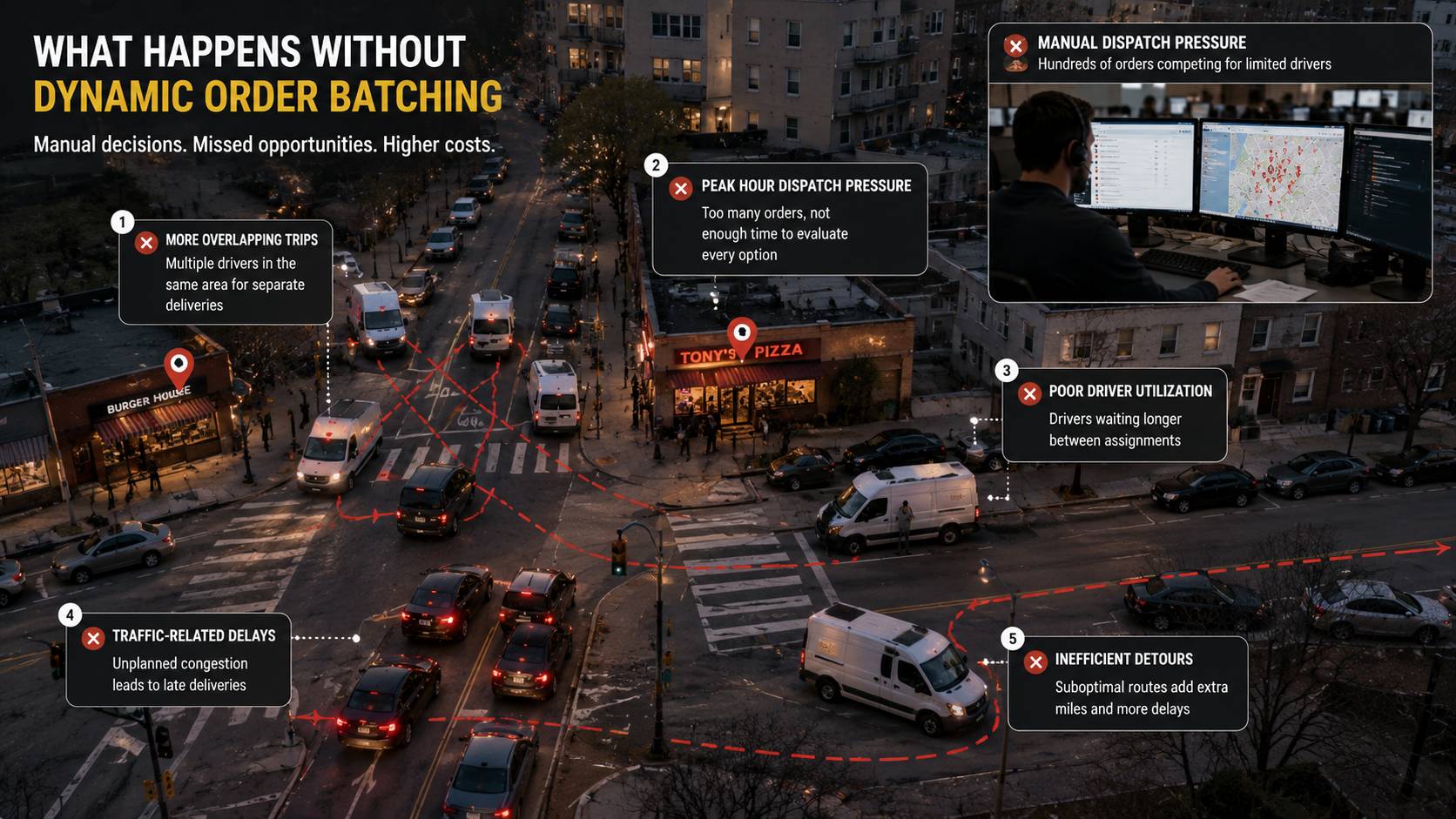
Without automated batching, the inefficiencies become more obvious as delivery volume grows.
1. More Overlapping Trips:
Two drivers may travel through the same neighbourhood for separate orders even when those deliveries could have been consolidated.
2. Peak Hour Dispatch Pressure:
During a dinner rush or promotional spike, dispatchers may have hundreds of new orders competing for limited delivery capacity. Manual stacking becomes slow and inconsistent.
3. Poor Driver Utilization:
Drivers may spend too much time traveling empty between assignments or completing isolated deliveries that could have been combined.
4. Inefficient Detours:
A batch may look logical based on straight line distance, but traffic and actual road conditions can make it completely impractical.
For example, a 0.3 mile detour in San Francisco can behave very differently from a 0.3 mile detour in Phoenix. Distance is a useful input. It shouldn’t be the final decision.
What Are the Benefits of Last Mile Delivery Optimization?
Intelligent order batching doesn’t improve last mile operations through a single metric. It works by making better decisions across the delivery network, from which orders should travel together to how much additional travel a new order would introduce.
The key optimization areas include:
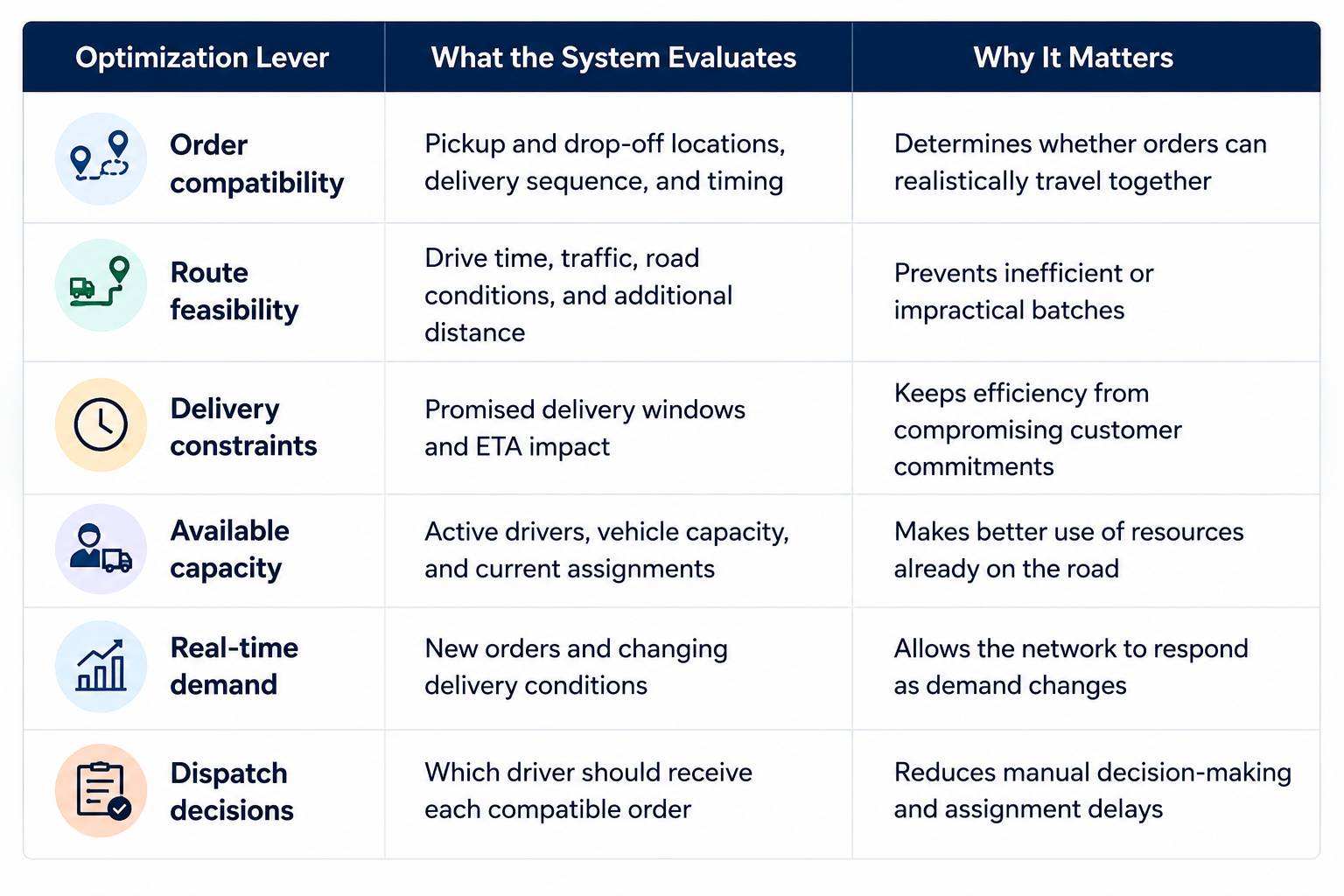
These optimization decisions ultimately translate into broader business outcomes.
Lower Operational Costs
Every delivery trip comes with a cost, from driver time and fuel to vehicle usage. If two compatible orders can be handled within one practical route, the operation can avoid creating a second trip unnecessarily.
The important point is that the savings don’t come from batching everything. They come from avoiding trips that don’t need to happen while still maintaining delivery standards.
Higher Driver Utilization
Better batching can help businesses get more productive capacity from the drivers they already have.
For example, a driver heading toward a pickup may have enough route flexibility to handle a second nearby order. Rather than leaving that order for another driver, the system can evaluate whether it can be added without creating an unreasonable detour.
The result is more deliveries completed within the same driver shift. This is without assuming that adding more drivers is the only way to increase capacity.
More Predictable Delivery Times
Efficiency means very little if it comes at the expense of delivery commitments.
That’s why the batching decision needs to account for the customer’s promised ETA. If adding another order creates too much additional travel time, the system should keep the orders separate.
And reliability matters. McKinsey’s research found that 85% of consumers said they would not shop with a retailer again after a poor delivery experience.
A batch that saves miles but creates a late delivery isn’t optimization. It’s just a cheaper mistake.
Better Peak-Hour Performance
Peak hours are when delivery networks are put under the most pressure. Order volumes rise, drivers become harder to allocate, and dispatch teams have less time to evaluate every possible combination.
Dynamic batching gives the operation another way to absorb that pressure. By continuously checking whether new orders can fit into active routes, businesses can make better use of available driver capacity before simply adding more vehicles.
That makes batching particularly valuable for high-volume operations where a few minutes of better decision-making can affect hundreds or thousands of deliveries.
How Does Last Mile Logistics Software Support Optimization?
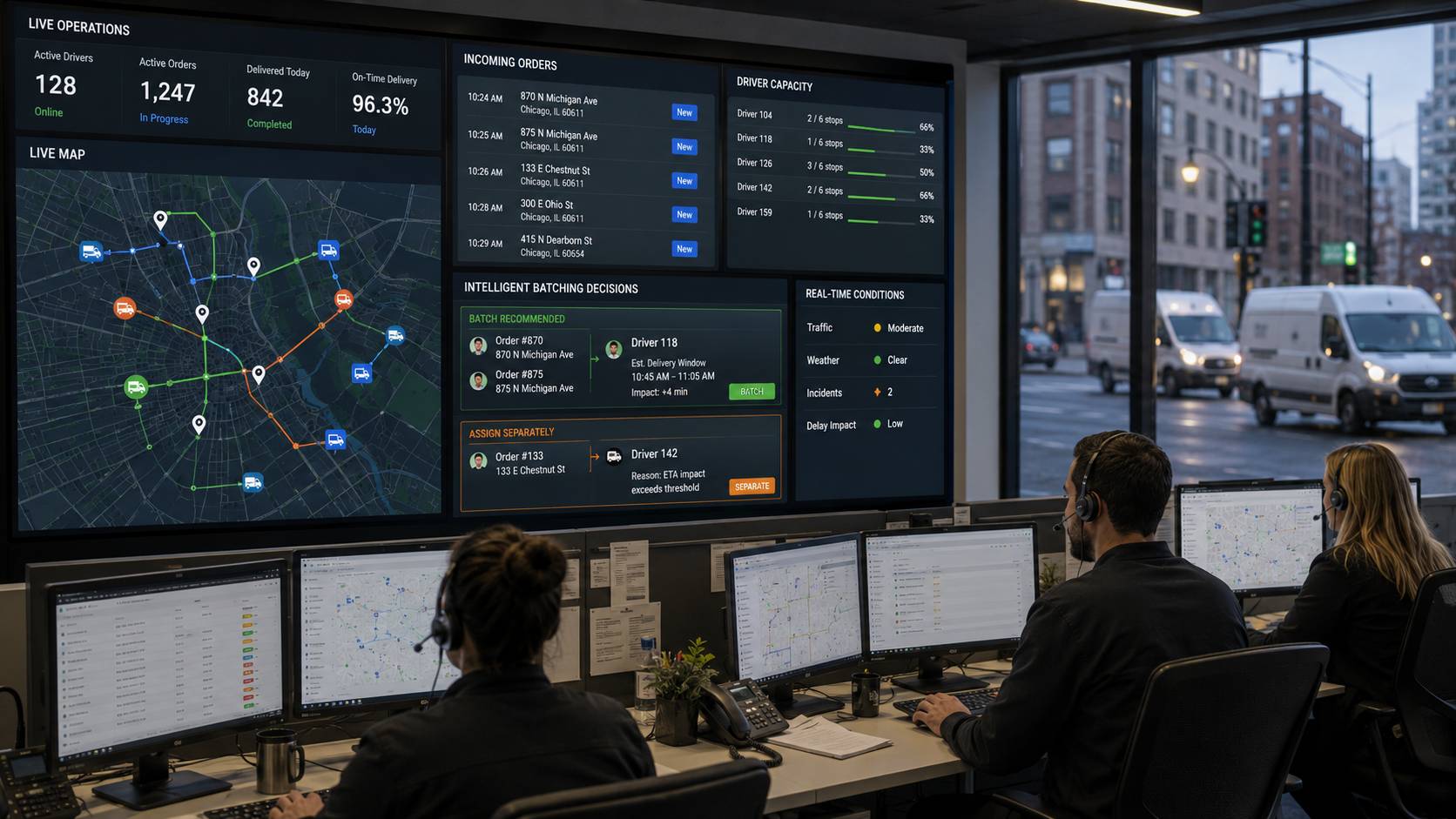
Last mile logistics software brings together the data and decision making required to optimize delivery operations at scale. Depending on the platform, capabilities can include:
- Automated order allocation
- Dynamic route optimization
- Real time dispatch
- Driver and vehicle management
- Live order tracking
- Predictive ETA
- Delivery sequencing
- Capacity and constraint management
- Proof of delivery
- Real time route adjustments
For LogiNext, the important distinction is between planning a route and continuously optimizing a delivery network.
LogiNext’s platform supports route planning, automated allocation, real time tracking, ETA management, and delivery execution. Thereby, giving operations teams the ability to manage changing delivery conditions rather than relying entirely on static plans.
That makes intelligent batching part of a broader last mile delivery optimization strategy rather than an isolated feature.
Frequently Asked Questions
1. How does order batching reduce delivery costs?
Batching compatible orders can reduce duplicate trips, improve driver utilization, and increase the number of deliveries completed within the same available delivery capacity.
2. Is batching always better for last mile delivery?
No. Poorly designed batches can create detours, late deliveries, and frustrated drivers. The objective is to identify compatible orders where consolidation improves efficiency without violating delivery constraints.
3. How does real time optimization improve last mile delivery?
Real time optimization allows delivery systems to respond to new orders, traffic changes, driver availability, and route disruptions instead of relying entirely on a static plan created before deliveries begin.
Conclusion
Last mile delivery optimization isn’t about finding a single perfect route and sticking to it. Delivery networks change too quickly for that approach.
The bigger opportunity is to make better decisions continuously: assigning each order to the right driver, combining compatible deliveries, evaluating detours, and protecting the customer’s promised ETA.
Intelligent order batching is one important piece of that puzzle. When combined with real time dispatch, route optimization, tracking, and predictive ETAs, it can help businesses make better use of existing delivery capacity while keeping customer commitments front and center.
For enterprises looking to move beyond static delivery planning, LogiNext can help turn real time delivery data into smarter allocation and execution decisions.
“” 29
 |  |  |




@LogiNext