



7 Trucking Trends That Will Define the Industry in 2026
The trucking industry is entering a new phase of transformation. Rising customer expectations, increasing operational costs, labor shortages, and evolving regulations are pushing carriers to rethink how they operate. As a result, modern trucking software is becoming a critical investment for fleets looking to improve efficiency, visibility, and profitability.
From AI-powered planning to greater automation in dispatch operations, the technologies shaping transportation today will have an even greater impact in 2026. Companies that embrace the right trucking software solution and digital strategies will be better positioned to compete in an increasingly demanding market.
Key Trucking Trends to Watch in 2026
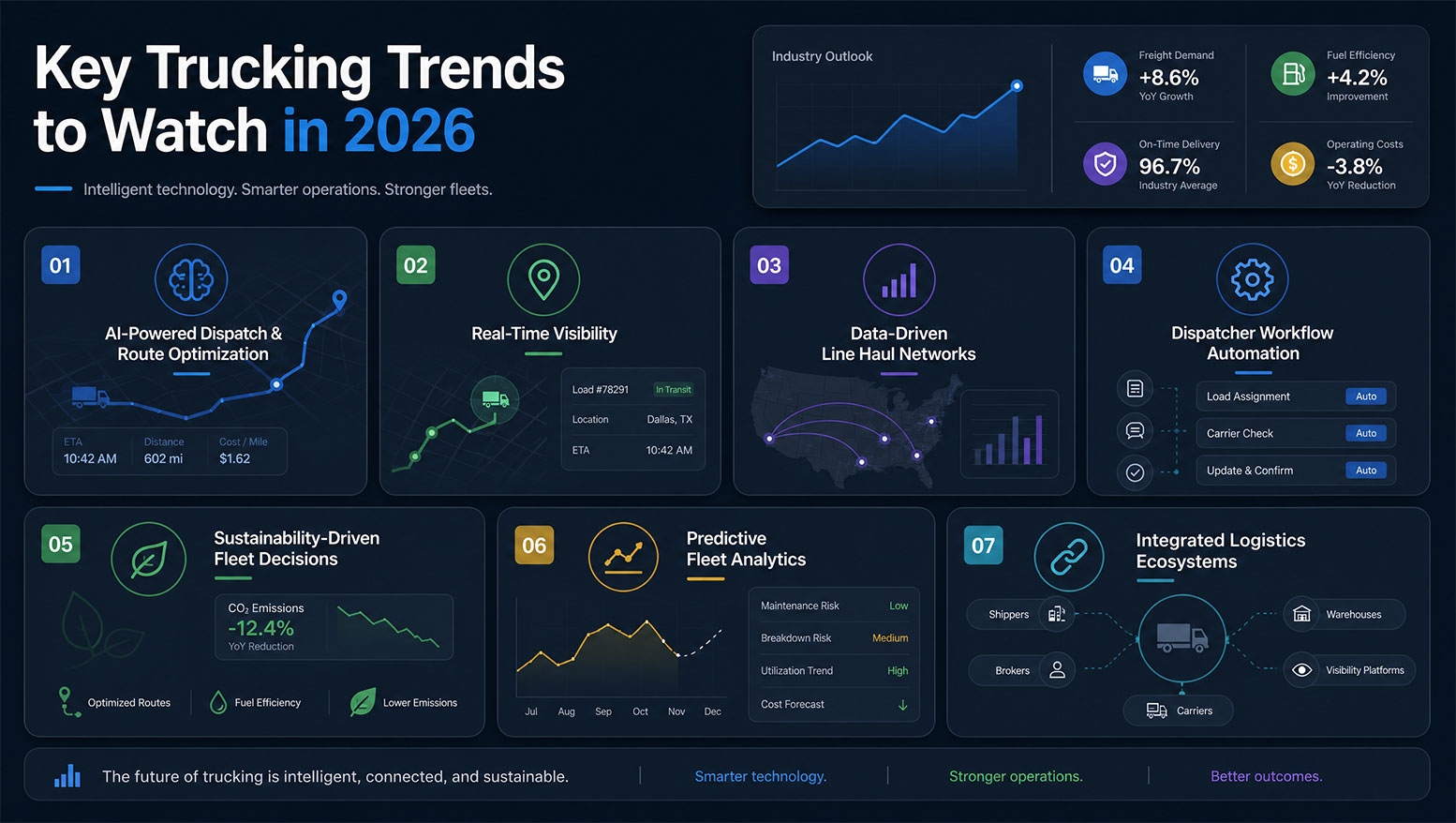
The trucking industry is experiencing rapid digital transformation. Emerging technologies, changing customer expectations, and increasing operational pressures are reshaping how carriers manage fleets and freight movement. The following trends highlight where the industry is headed. And how businesses can use modern trucking software to stay competitive in 2026 and beyond.
1. AI-Powered Dispatch and Route Optimization Will Become Standard:
Artificial intelligence is rapidly changing how fleets plan and execute deliveries. Traditional dispatching methods often rely on manual decision-making, which can lead to inefficiencies, delays, and higher operating costs.
In 2026, more carriers will adopt AI-driven trucking dispatch software. One which is capable of analyzing traffic conditions, delivery windows, vehicle capacity, driver availability, and weather conditions in real time.
Modern dispatch software for trucking can automatically recommend the most efficient routes. Thereby, helping fleets reduce empty miles and improve asset utilization.
Benefits include:
- Lower fuel consumption
- Reduced delivery days
- Improved fleet productivity
- Better customer service levels
As transportation networks become more complex, AI-powered dispatching will become a competitive necessity rather than a luxury.
2. Real-Time Visibility Will Drive Customer Expectations:
Visibility is no longer optional. Shippers and customers increasingly expect real-time updates throughout the transportation journey.
A modern trucking system now serves as the central hub for tracking vehicles, monitoring shipments, and communicating delivery status across stakeholders.
Industry research shows that supply chain visibility remains one of the top priorities for logistics executives worldwide. Companies that cannot provide accurate shipment tracking risk losing customers to more technologically advanced competitors.
In 2026, fleets will continue investing in:
- GPS-based fleet tracking
- Predictive ETAs
- Automated customer notifications
- Exception management alerts
A comprehensive trucking software solution can help carriers deliver the transparency that modern supply chains demand.
3. Line Haul Trucking Networks Will Become More Data-Driven:
The growth of e-commerce and regional distribution centers is increasing demand for efficient line haul trucking operations.
Line haul transportation serves as the backbone of many logistics networks, connecting warehouses, hubs, and fulfillment centers over long distances. However, rising fuel costs and capacity constraints are forcing carriers to optimize every mile.
In 2026, carriers will increasingly use advanced analytics within their trucking software to:
- Improve route planning
- Reduce deadhead miles
- Optimize trailer utilization
- Balance freight capacity across regions
Data-driven decision-making will allow operators to improve margins while maintaining service reliability across complex transportation networks.
4. Automation Will Reduce Dispatcher Workloads:
The trucking industry continues to face labor shortages, and dispatch teams are feeling the pressure.
Many dispatchers spend hours each day managing schedules, assigning loads, updating customers, and resolving exceptions manually. As fleet operations scale, these processes become difficult to manage efficiently.
Modern trucking dispatching software is helping organizations automate repetitive tasks and improve operational efficiency.
Key automation capabilities include:
- Automated load assignments
- Digital driver communication
- Real-time exception alerts
- Smart scheduling recommendations
- Automated documentation workflows
By reducing manual workloads, dispatchers can focus on strategic decision-making rather than routine administrative tasks.
5. Sustainability Initiatives Will Influence Fleet Decisions:
Environmental sustainability is becoming an important factor in transportation planning. Governments, customers, and investors are increasingly encouraging companies to reduce emissions across their supply chains.
In response, fleets are leveraging trucking software solutions to improve fuel efficiency and lower environmental impact.
Key sustainability strategies include:
- Route optimization to reduce fuel consumption
- Idle time reduction
- Vehicle utilization improvements
- Fleet performance monitoring
- Alternative fuel planning
Even small improvements in route efficiency can produce significant cost savings while helping carriers achieve sustainability goals.
As reporting requirements become more stringent, technology will play a larger role in measuring and managing transportation emissions.
6. Predictive Analytics Will Improve Fleet Performance:
Historically, many fleet decisions were made based on past performance reports. Today, predictive analytics is enabling transportation companies to anticipate problems before they occur.
Advanced trucking systems can analyze operational data and identify patterns that may affect service levels, costs, or vehicle performance.
Examples include:
- Predicting vehicle maintenance needs
- Forecasting delivery delays
- Identifying driver performance trends
- Anticipating capacity shortages
Predictive capabilities allow carriers to take proactive action, reducing downtime and improving operational reliability.
In 2026, predictive analytics will become a core feature within leading trucking software platforms.
7. Integrated Logistics Ecosystems Will Replace Siloed Operations:
Many transportation organizations still rely on disconnected systems for dispatching, fleet management, customer communication, and reporting.
These silos create inefficiencies and limit visibility across the transportation lifecycle.
The future of logistics trucking lies in integrated digital ecosystems that connect every operational function through a single platform.
A modern trucking solution can unify:
- Fleet operations
- Dispatch management
- Route planning
- Driver communication
- Shipment tracking
- Analytics and reporting
Integrated platforms enable faster decision-making, better collaboration, and improved customer experiences.
As transportation networks continue to grow in complexity, connected operations will become essential for maintaining competitive advantage.
Conclusion
The future of trucking will be driven by automation, real-time visibility, predictive analytics, and smarter dispatch operations. As fleets face increasing pressure to improve efficiency and service levels, investing in the right trucking software will become essential.
LogiNext helps transportation companies streamline dispatching, optimize routes, improve visibility, and maximize fleet performance through a unified AI-powered platform. Explore how LogiNext can help you build a smarter, more efficient trucking operation for 2026 and beyond. Click on the red button to know more.
28

|

|

|




@LogiNext