





Preorder ETA: The Most Underrated Control Lever in Modern Logistics
In fast-moving supply chains, preorder ETA is often treated as a front-end feature designed. Which is used to improve conversions and reassure customers at checkout. In reality, it is far more powerful and far more dangerous when mismanaged. For logistics and supply chain leaders, preorder ETA is not a cosmetic number on a screen. It is a real-time operational commitment that directly impacts network stability, margins, and customer trust.
When that commitment is disconnected from ground realities, delays compound, costs escalate, and service reliability deteriorates.
What Is Preorder ETA and Why It Matters More Than Ever

A preorder ETA (Estimated Time of Arrival) is the delivery promise shown to a customer before they complete checkout. It answers a simple question: When will I receive this order?. However, behind that seemingly simple answer sits a complex web of operational variables. Which include – fulfillment node capacity, order preparation time, fleet availability, route density, traffic conditions, pickup latency, and SKU complexity.
If these inputs are static, outdated, or incomplete, the estimated time of arrival becomes a theoretical projection rather than a validated commitment.
This matters because customer tolerance for delivery delays is shrinking. According to the National Retail Federation, U.S. retailers handled $743 billion in returns in 2023, representing 14.5% of total retail sales. Delivery failures remain a significant contributor to returns and customer dissatisfaction.
Additionally, a 2023 survey by PwC found that 32% of consumers will stop doing business with a brand they love after just one bad experience. An inaccurate preorder ETA is not simply an operational miss; it is a direct threat to revenue retention.
The Core Problem: Demand Without Capacity Awareness
Traditional ETA engines rely heavily on historical averages, static buffer times, and fixed preparation durations. They assume that today’s throughput mirrors yesterday’s performance and that transit times follow predictable patterns.
In dynamic logistics environments, this assumption breaks quickly. Demand spikes, workforce shortages, SKU-level complexity, and branch-level congestion alter throughput in real time.
When preorder ETA does not incorporate live capacity signals, the system continues accepting orders based on theoretical capability rather than actual operational readiness. Sales channels drive demand aggressively, but the network is left absorbing hidden strain.
Orders begin stacking, preparation times extend, dispatch windows shrink, and overtime costs accumulate. By the time the dashboard reflects stress, delivery promises have already been compromised.
This is not a visibility problem; it is a synchronization problem between commercial intent and operational feasibility.
Why Static Estimated Time of Arrival Models Break Under Pressure
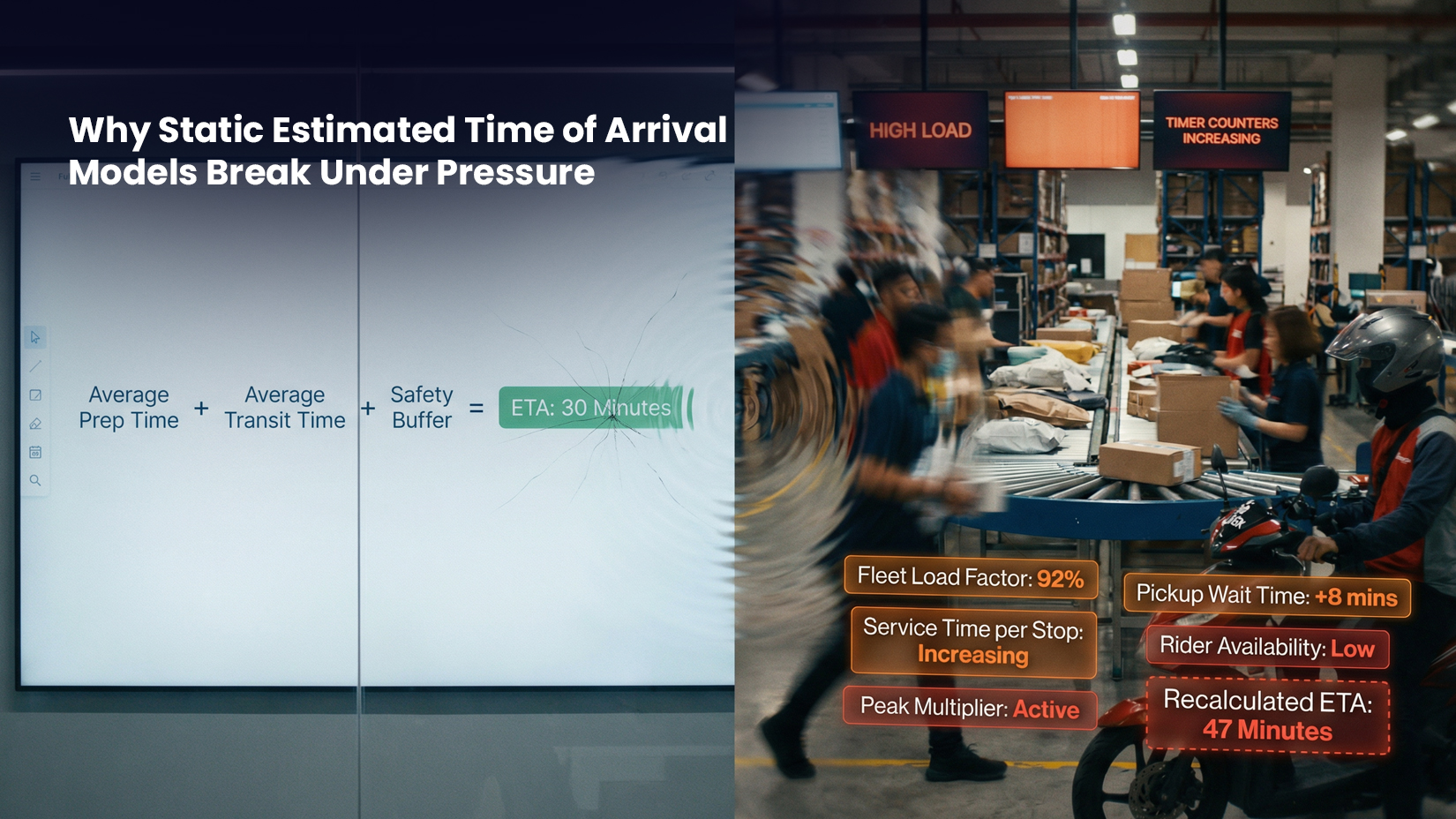
Most static estimated time of arrival calculations follow a predictable formula:
Average prep time plus average transit time plus a safety buffer equals delivery promise.
While this may work during stable periods, it collapses under variability. This is because it ignores critical real-time parameters such as active fleet load factor, pickup wait times, service time per stop, delivery associate availability, and peak-hour multipliers.
For example, a branch that normally processes orders in 12 minutes may experience a 30% throughput decline during peak demand. If the preorder ETA remains unchanged, the system continues promising unrealistic timelines.
Delivery associates rush, branch managers expedite, and margins shrink due to overtime and inefficiencies. What began as a small estimation gap quickly transforms into systemic instability.
The Closest-Node Trap
Another structural weakness in many logistics software systems is proximity bias. Orders are frequently assigned to the nearest fulfillment node under the assumption that shorter distance guarantees faster delivery. In practice, the closest branch may already be operating near capacity while a slightly farther node has available throughput and fleet readiness.
When branch selection logic ignores congestion and capability, it creates uneven utilization across the network. The result is overloaded nodes, underutilized assets elsewhere, higher last-mile cost per drop, and reduced service-level performance.
A truly effective preorder ETA must evaluate node capability in addition to distance. Thereby, ensuring balanced distribution of demand across the network.
Turning Preorder ETA Into a Commitment Engine with LogiNext
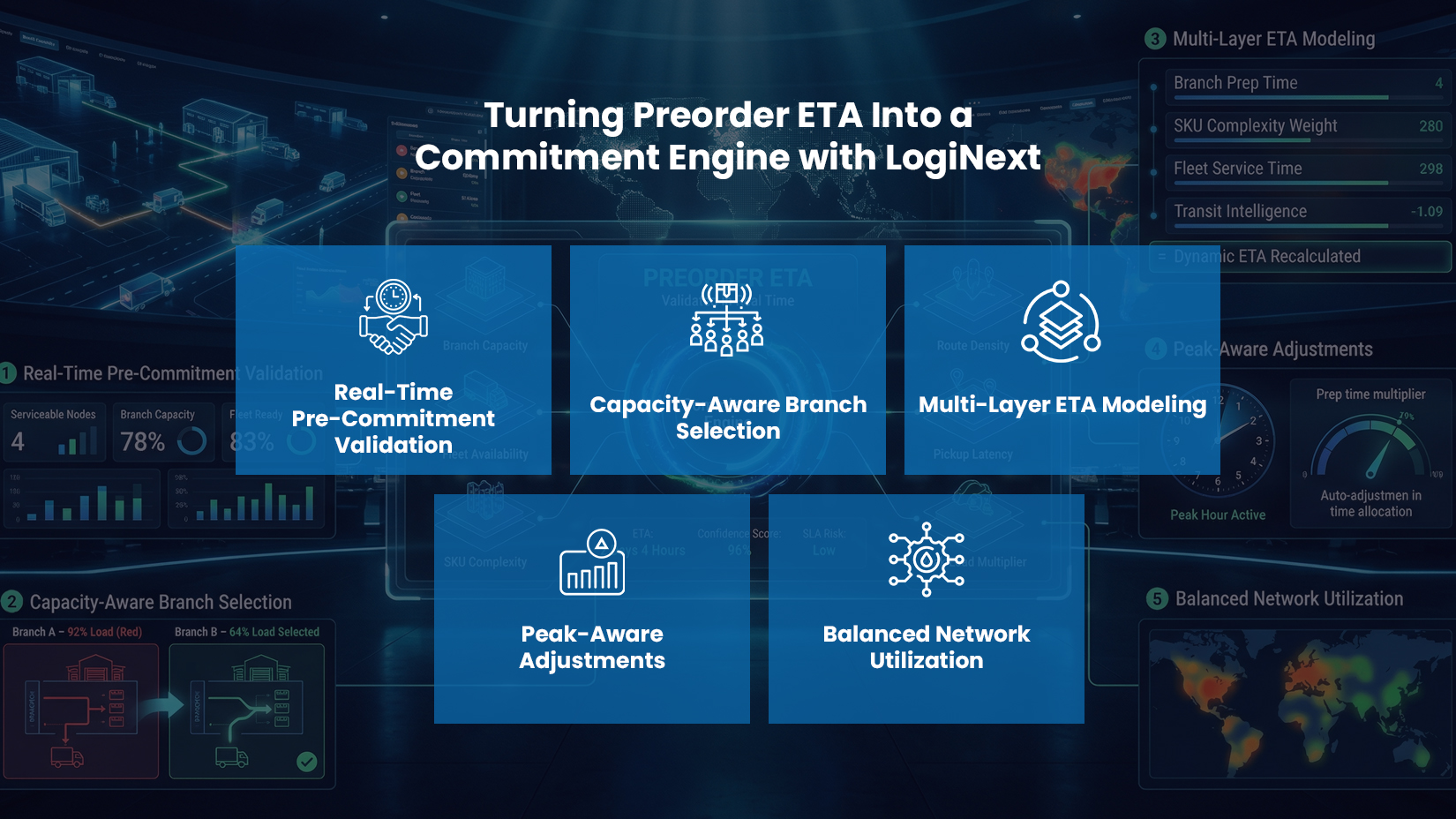
LogiNext transforms preorder ETA from a static estimate into a dynamic, network-aware commitment engine embedded within its logistics management software. Instead of relying on historical averages, every estimated time of arrival is validated against real-time operational conditions before the order is confirmed.
Here is how LogiNext operationalizes preorder ETA:
1. Real-Time Pre-Commitment Validation:
Before checkout, the system evaluates serviceable nodes, live branch capacity, fleet availability, pickup latency, SKU complexity, and time-based load multipliers to generate a realistic preorder ETA.
2. Capacity-Aware Branch Selection:
Orders are allocated based on congestion, throughput, and dispatch readiness, not just proximity, ensuring faster and more reliable delivery.
3. Multi-Layer ETA Modeling:
The platform incorporates:
- Branch-level preparation metrics
- Item-level SKU complexity
- Fleet-level service time, route density and transit inputs
As cart contents change, the estimated time of arrival recalculates dynamically for greater accuracy.
4. Peak-Aware Adjustments:
Load multipliers during high-demand windows adjust prep and dispatch times before the promise is made, protecting SLA performance.
5. Balanced Network Utilization:
Continuous evaluation of node congestion and fleet readiness prevents overload, reduces last-mile costs, and stabilizes delivery operations.
Preorder ETA as a Strategic Control Layer
The future of logistics management software is not centered solely on tracking shipments after dispatch. It focuses on preventing instability before it begins. Preorder ETA sits precisely at that decision point. When powered by real-time intelligence, it becomes a load-balancing mechanism, a demand-shaping tool, and a congestion prevention layer.
LogiNext transforms preorder ETA from a marketing estimate into a strategic supply chain control layer. By aligning commercial demand with operational feasibility before checkout, it ensures that every estimated time of arrival reflects the true state of the network.
Also Read: How LogiNext Ensures Accurate and Fair Driver Payouts at Scale
Final Thought
Preorder ETA is no longer a peripheral feature within logistics software. It is a structural commitment that defines whether the network operates predictably or absorbs hidden strain. Organizations that rely on static averages will continue facing reactive firefighting and margin erosion.
Those that deploy intelligent, capacity-aware logistics management software such as LogiNext position their networks to deliver reliably even under peak demand.
In modern commerce, the promise is part of the supply chain. With a dynamic preorder ETA powered by LogiNext, that promise becomes operationally sustainable. Click on the red button to know more.
1

|

|

|




@LogiNext