




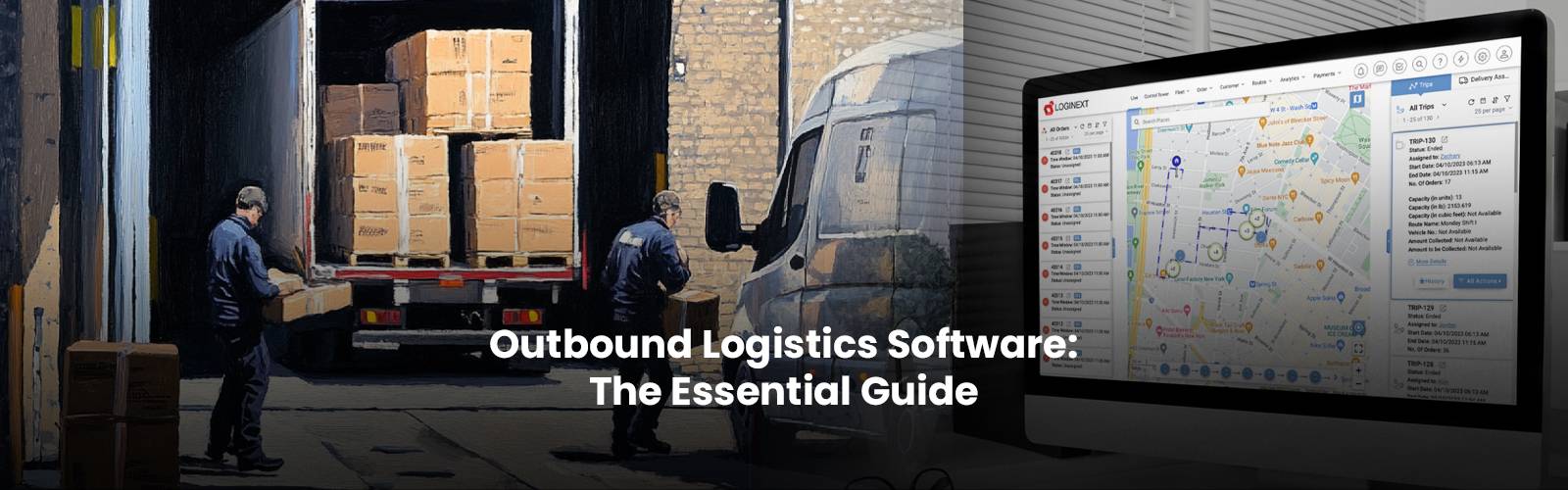
Outbound Logistics Software: The Essential Guide
Outbound logistics has quietly transformed into a decisive competitive edge from a back-office function. Customers today expect fast, accurate and trackable delivery every time time. In this environment, outbound logistics software has now become the backbone of efficient, scalable and profitable delivery operations.
This guide breaks down what outbound logistics involves, why modern operations rely on it. Also, how businesses can use outbound logistics solutions to stay ahead.
What is Outbound Logistics?
Outbound logistics covers everything that goes on after a product is ready to ship. From order processing to packing, dispatching, line-haul, last-mile delivery and even returns.
It is able to directly touch customer experience, fulfillment speed, delivery accuracy and brand reliability. As per a report by McKinsey, over 70% of customer satisfaction in e-commerce depends on delivery experience. That is a huge influence in repeat business.
Traditional processes rely on manual planning, disconnected systems and reactive-decision making. With a rise in delivery expectations and margins getting tighten, these method are no longer capable. This is where automation steps in.
Why Outbound Logistics Software Matters Today

The Operations team is juggling pressure of “faster delivery times, lower costs and zero delivery failures” so far to nearly all manual systems. Today, Modern Outbound Logistics Software will make the process of automating planning, streamlining execution and providing real-time visibility.
Here’s what’s driving rapid adoption:
1. Rising Delivery Expectations:
Customers expect to be able to track their orders in real-time, receive a specific ETA and have their order delivered very quickly. Nearly sixty percent of customers will abandon any brand after two orders become delayed in delivery for any reason. Every quarter, the level of expectation increases, and the level of uncertainty decreases. Fast execution of orders, proactive notifications and seamless communication will help retain customer loyalty.
2. Complex Multi-Node Expectations:
Businesses manage numerous “nodes” throughout their distribution network. For example, a warehouse, dark store, delivery partner and fleet yard/cross-dock that need to be coordinated with each other. Coordinating these nodes manually causes bottlenecks, delays, and visibility issues. This ultimately prevent the warehousing and transportation operations from efficiently operating.
3. Mounting Operational Costs:
Rising operational costs (fuel, labor, storage, and returns), are cutting into margins. According to those reports, companies that are using Digital Routing and Optimization typically save 10-30% on transportation costs based on current trends. Today’s cost control now relies on using Data rather than guesswork.
4. SLA Pressure:
Retailers, Third Party Logistics (3PLs), and Direct-to-Consumer (D2C) Brands are operating under strict Service Level Agreement (SLA). Missing any deadlines results in penalties and attrition. The use of a robust and reliable Outbound Logistics System (OLS) ensures that retailers maintain precision, predictability, and on-time performance.
Key Features of Modern Outbound Logistics Software
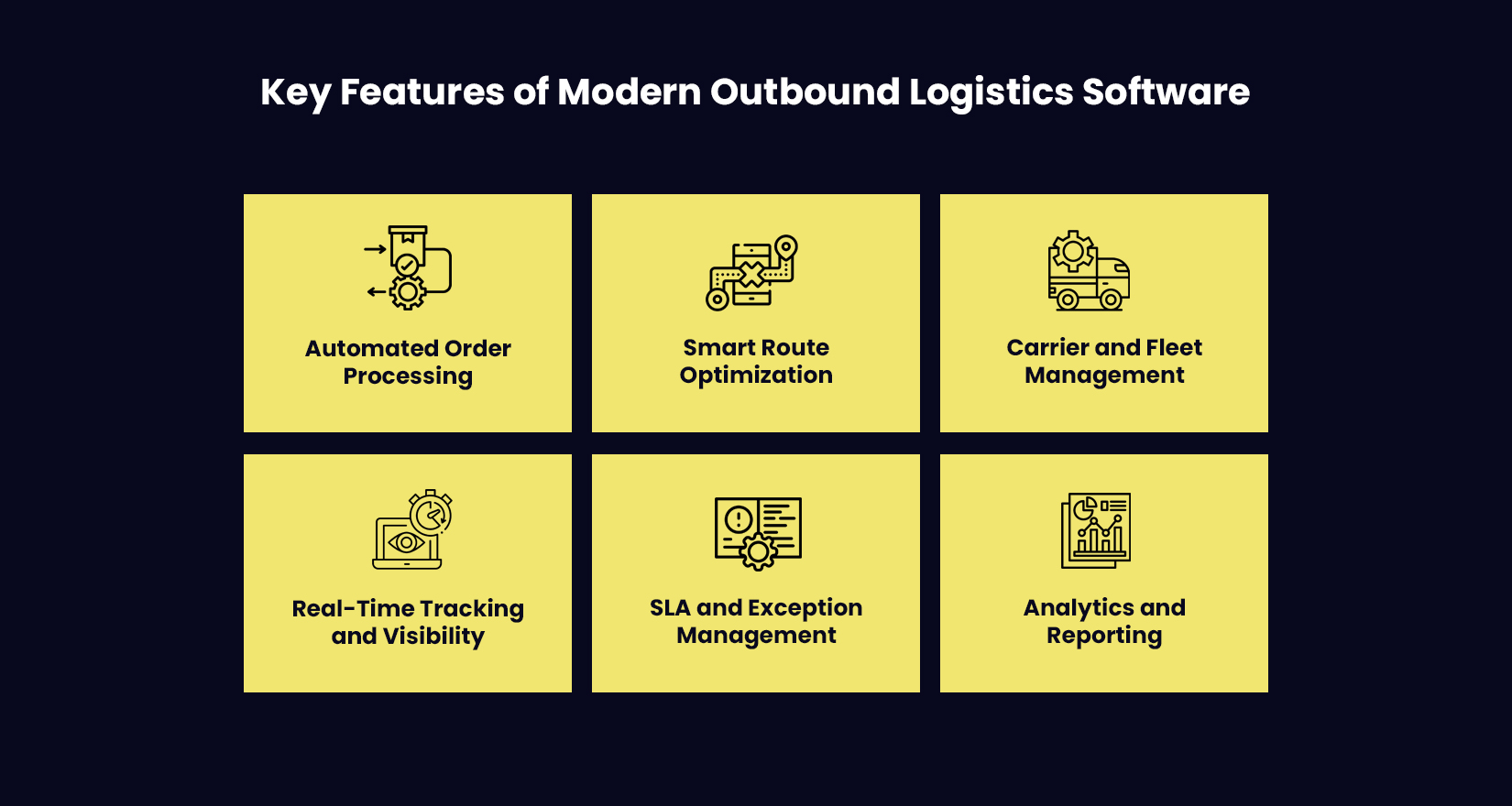
The best modern platforms cover the entire lifecycle, from planning to execution to customer engagement. Here’s what to expect:
1. Automated Order Processing:
With AI-enabled order processing, you never have to worry about human error or inefficient work processes. By using an automated system, you can send orders directly from your ERP/WMS system to your shipping partner with minimal manual effort. Therefore, less time is spent entering duplicate orders, and your dispatch process is greatly accelerated, especially during peak times.
2. Smart Route Optimization:
Using algorithms to calculate which routes will provide the quickest delivery and use the least amount of gasoline. With this your company can save money on both miles driven and fuel and provide improved Estimated Time of Arrival (ETA) accuracy. This also allows for immediate route changes if there is a problem on the road (i.e., construction, etc.). Or changed delivery capacity due to high demand.
3. Carrier and Fleet Management:
With intelligent carrier and fleet assignment capabilities, you can assign your carriers and fleets based on all criteria (cost, capacity, delivery windows, etc.). Therefore maximizing your resources and ensuring the best use of your carrier and fleet each time. This prevents unnecessary wastage and downtime for both parties.
4. Real-Time Tracking and Visibility:
Utilizing real-time GPS tracking, driver status updates, hub updates, and notifications to customers will help you stay informed about your shipments and give you an insight into any disruptions. Visibility also increases customer trust in your service and decreases the number of customer support requests.
5. SLA and Exception Management:
Providing automated alerts or notifications for any delay, diversion, temperature excursion, or compliance violation. This will allow your operations team to take corrective action before it affects the customer.
6. Analytics and Reporting:
Utilization insights such as on-time delivery rate, cost per shipment, route efficiency, vehicles/runs per carrier, and utilization drive smarter decision-making. Therefore, you can reduce waste and maximize profits.
Benefits of Using Outbound Logistics Management Software
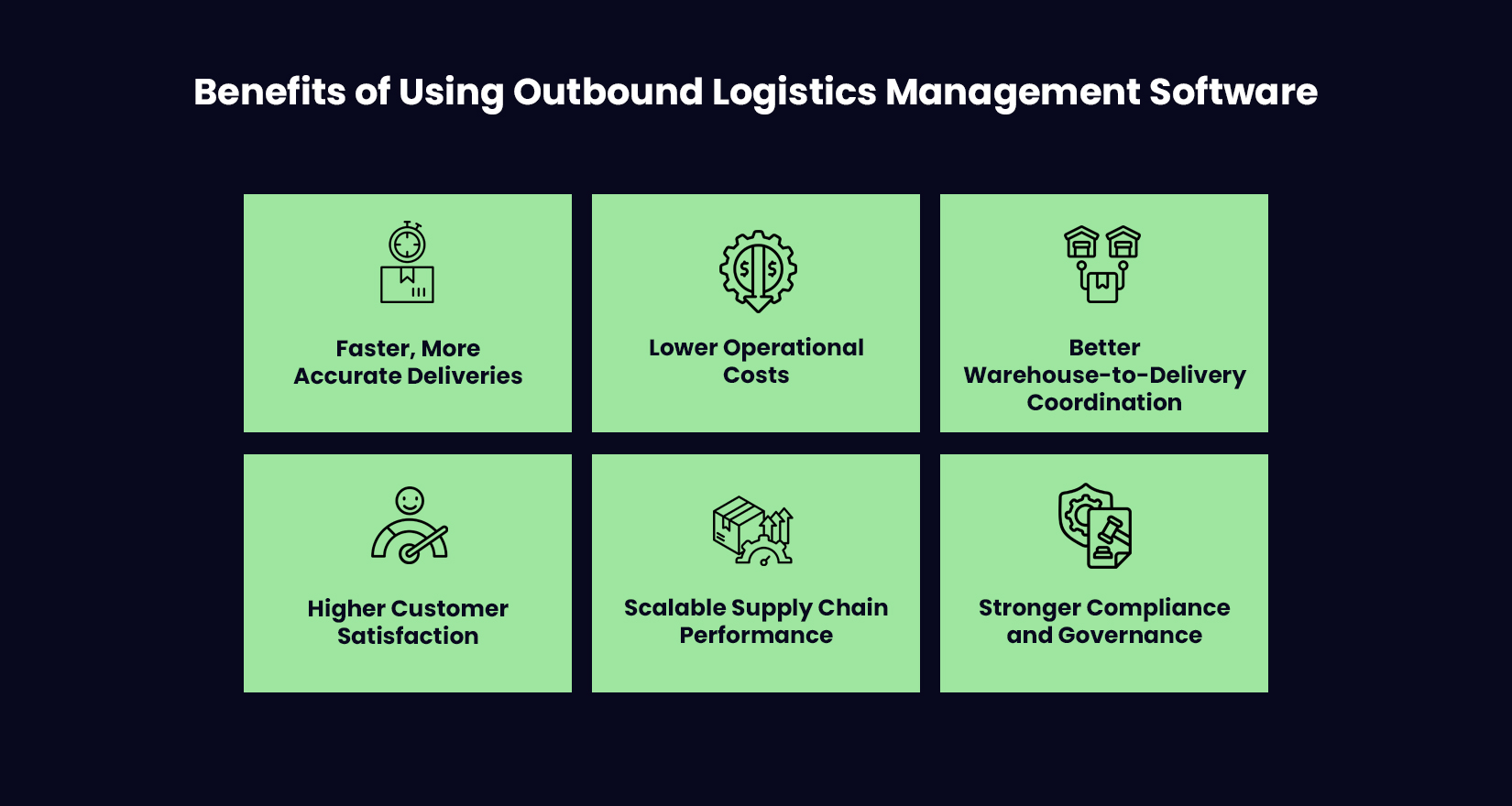
The right digital platform does a lot more than automate tasks. It can sharpen your entire supply chain’s execution muscle.
1. Faster, More Accurate Deliveries:
When creating deliveries, the best digital platforms will use route optimization, automated dispatching and live tracking to maximize the efficiency of all solutions offered by the company. Companies use these advantages to improve OTIF by up to 25%.
2. Lower Operational Costs:
The automated route optimizer, improved load planning and effective fleet management, combined with the resulting savings, will accrue continuously over time for companies that handle large volumes of products on a regular basis.
3. Better Warehouse-to-Delivery Coordination:
With the coordination between WMS + TMS + Carriers + Fleet, as well as minimizing order confusion, businesses will experience a greater level of throughput. Plus will also experience fewer bottlenecks during peak times.
4. Higher Customer Satisfaction:
Due to the ability to provide accurate ETA’s and real-time updates during the delivery process, businesses will be able to build brand loyalty during the delivery process. Thereby creating an environment where customers feel informed and confident. From the moment they place their order until the moment the order is delivered.
5. Scalable Supply Chain Performance:
A digital platform will enable a business to continually improve Supply Chain Performance through the process of Automation as a customer base begins to expand. Automation provides businesses with the ability to scale without having to employ additional staff and will therefore remain efficient and accurate.
6. Stronger Compliance and Governance:
Finally, by utilizing digital logs, proof of delivery and event tracking, a business can demonstrate its Commitment and Accountability. It can do this by providing evidence of Supply Chain Audits and Minimizing Disputes Occurring.
Investing in outbound logistics management software pays off across operations, costs, and customer loyalty.
How an Outbound Logistics System Works
A modern outbound logistics system functions as the central command center for all dispatch and delivery operations. Here’s a simplified journey:
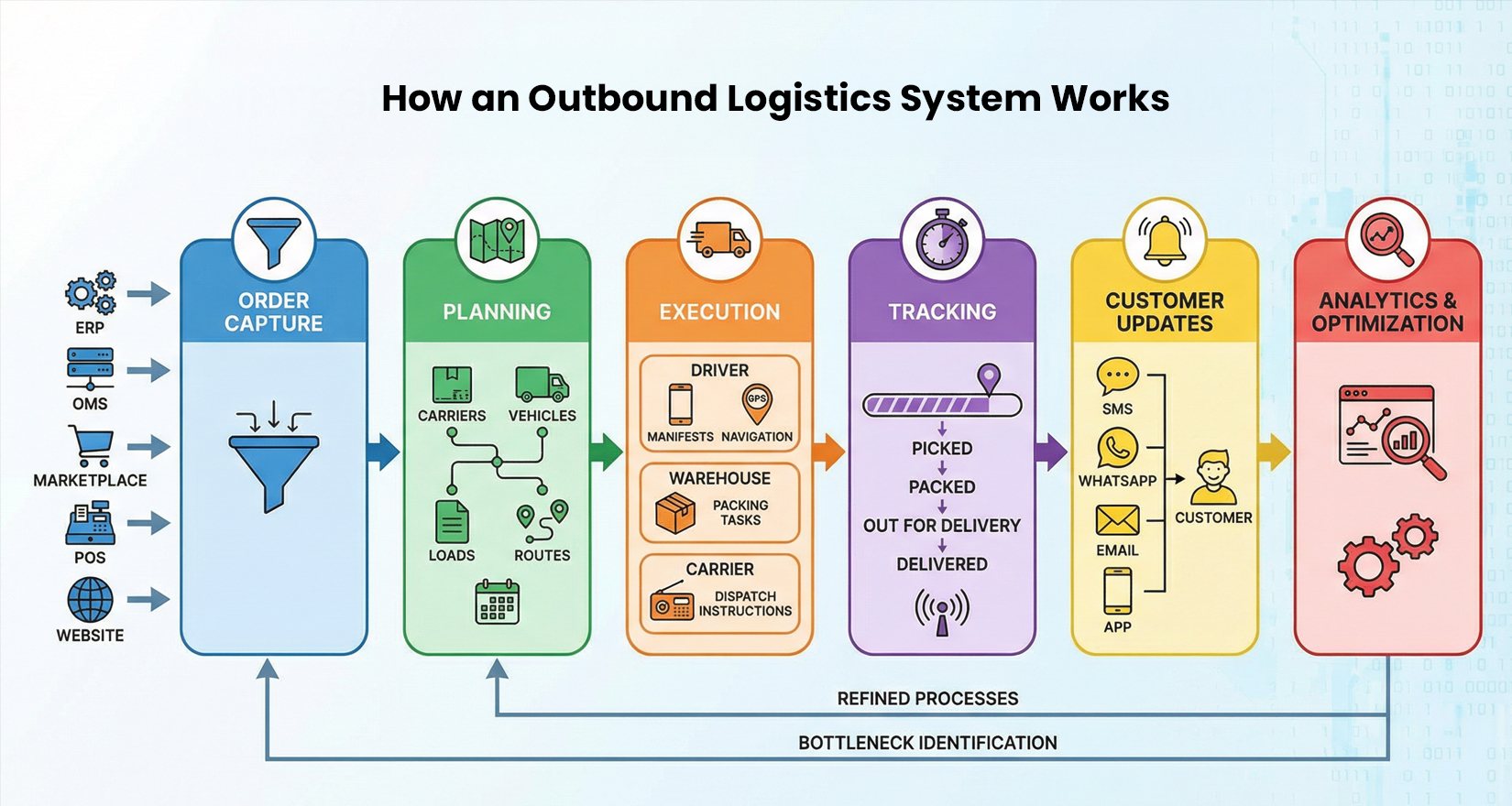
With the right platform, the entire flow is seamless and fully automated.
Industries That Benefit from Outbound Logistics Solutions
There are many industries where outbound operations are common. But because of the complexity of their distribution networks or the high level of delivery requirements, some companies within these industries gain even more benefits by utilizing outbound logistics:
– Retail & E-Commerce: High order volume and tight delivery time frames necessitate intelligent planning.
– FMCG & CPG: Mass distribution networks rely heavily on automated scheduling and load optimization to operate efficiently.
– Pharma & Healthcare: Temperature-controlled and time-dependent deliveries must be closely monitored to ensure compliance.
– Manufacturing: Dispatching from a production facility to multiple distribution points requires a high level of coordination and accuracy.
– 3PL & Logistics Providers: A strong outbound logistics solution is essential for managing multiple clients and SLAs.
Also Read: Inbound Logistics Software: The Essential Guide
Conclusion
Logistics: Today, logistics is a Leading Factor in a Company’s Reputation. Logistics also can be the difference between a company’s ability to operate profitably or painfully. Companies that leverage new technologies outperform those who use manual processes or legacy systems.
Today, a modernized Outbound Logistics Management software solution, should not be seen as optional. Companies that implement and utilize digital logistics effectively will create greater efficiencies, improved speed of service, enhanced customer satisfaction and better overall growth potential.
If you wish to remain successful in a continually increasing delivery expectations era, it is important that you get your Outbound Logistics business functions aligned correctly and have the appropriate software supporting it for optimal results. So, don’t wait up and book a demo with LogiNext Solutions. Click on the red button to know more.
22

|

|

|




@LogiNext