





LogiNext and the Hidden Cost of Invisible Friction in Modern Logistics Software
In today’s complex supply chains, logistics software is expected to do far more than automate tasks. It must actively enable people to work faster, smarter, and with fewer errors. Yet many organizations overlook a costly reality. Even the most advanced systems can slow operations down when everyday workflows are riddled with invisible friction. This friction does not show up as system failures or missed alerts. Instead, it hides inside interfaces, reports, and screens that teams interact with all day, quietly eroding efficiency and accuracy.
Invisible friction is what happens when logistics management software technically works, but operational teams struggle to use it intuitively. As logistics operations scale and involve more stakeholders, these small inefficiencies compound into a serious drag on logistics management performance.
When a High-Performing Logistics Operation Starts to Stall
Consider a large enterprise running high-volume, multi-region logistics operations. The organization has invested heavily in automation, analytics, and reporting. From the outside, the setup looks best-in-class. Yet performance begins to flatten.
The cause is not demand volatility or infrastructure limitations. It is spending unnecessary time navigating systems that were never designed around how different logistics roles actually work. This is a common failure point in traditional logistics management software.
Invisible Friction at the Operational Level

Invisible friction is most damaging at the execution layer, where logistics teams interact with the system constantly. It rarely stems from missing functionality. Rather, it comes from interfaces. The ones that are not aligned with how different roles operate.
Dispatch teams frequently work with overcrowded screens filled with non-essential fields. Execution-critical information competes with secondary data, slowing decisions and increasing error risk. Over time, these small delays accumulate into measurable operational drag.
Customer onboarding teams face friction through generic, overextended data entry workflows. Capturing excessive information creates confusion, weakens data quality, and leads to repeated corrections, turning onboarding into a bottleneck instead of an accelerator.
For finance teams, friction appears as limited visibility. COD reconciliation requires quick access to a small set of financial and delivery details. Generic views bury this data and force teams into manual exports, adding effort and risk.
Together, these issues reveal a core flaw in many logistics software platforms. Treating all users the same introduces operations friction at every step, quietly slowing logistics management performance.
The Core Design Flaw in Traditional Logistics Management Software
Most traditional logistics management software platforms operate on a one-size-fits-all model. The system treats every user the same, regardless of role, with identical forms, list views, and data access.
This lack of role awareness creates persistent operations friction. Dispatchers, finance teams, onboarding specialists, warehouse staff, and managers are forced to adapt their workflows around the system instead of the system adapting to them. Over time, teams rely on workarounds, manual checks, and external tools to compensate.
What suffers is not just speed, but data accuracy, compliance, and team morale. This is not an automation problem, it is a logistics UI/UX problem.
Where Invisible Friction Shows Up Most Clearly
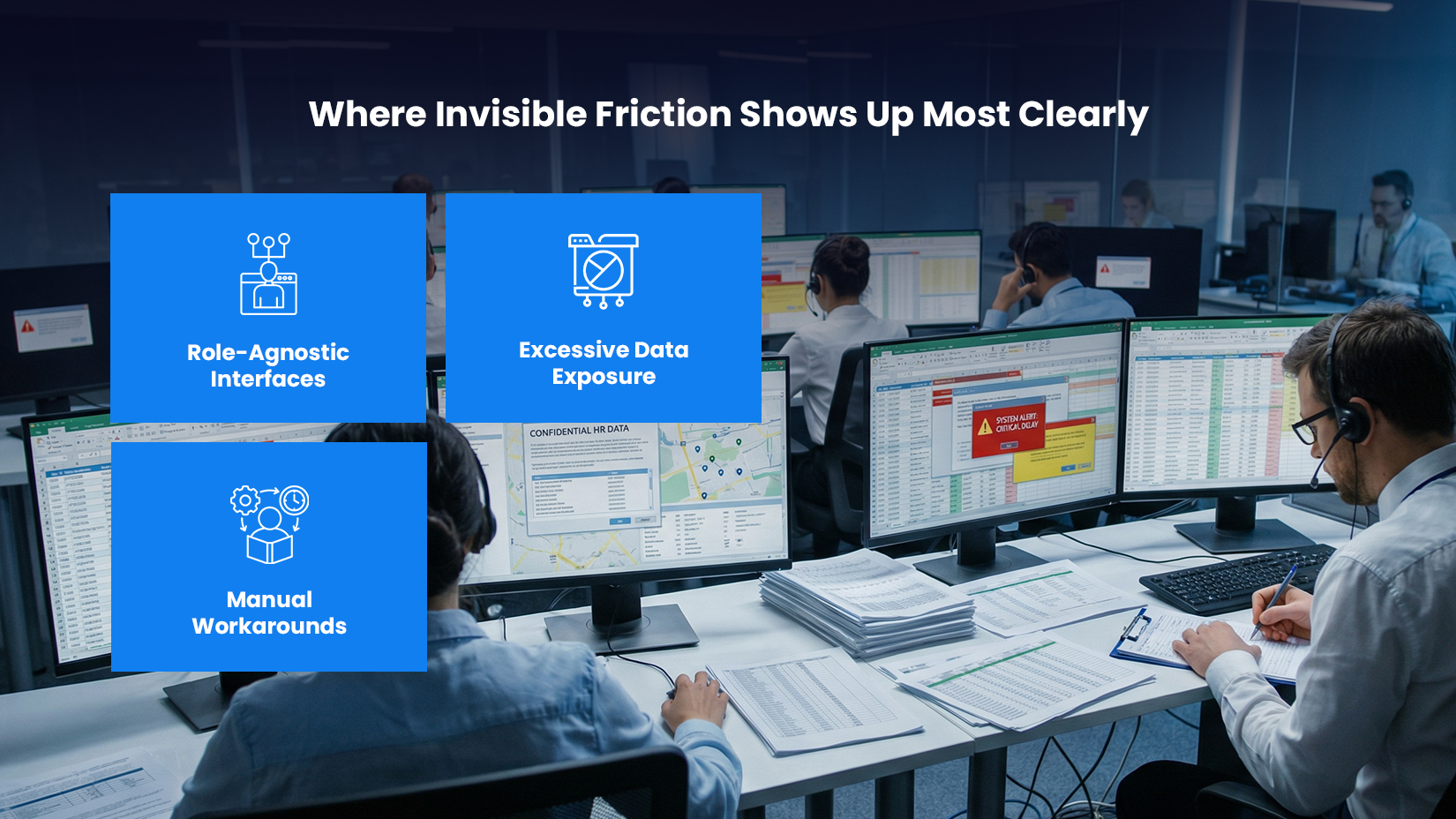
Invisible friction in logistics operations typically concentrates in a few critical areas:
1. Role-Agnostic Interfaces:
When every team sees the same screens, irrelevant data overwhelms users. Critical fields are harder to find, decision-making slows down, and error rates increase.
2. Excessive Data Exposure:
In a multi user logistics system, unrestricted access means sensitive or irrelevant information is visible to users who do not need it. This increases security risks and compliance concerns while adding cognitive load.
3. Manual Workarounds:
Poor logistics UI/UX forces teams to export data, maintain spreadsheets, or rely on offline checks. According to industry estimates, knowledge workers lose 20–30% of their time navigating inefficient systems and workarounds.
These friction points quietly undermine logistics management, even in organizations with otherwise mature technology stacks.
Why Multi-Level Access Is Essential in Modern Logistics Software
As logistics operations become increasingly multi-stakeholder driven, modern logistics software must support structured, role-based experiences. A true multi user logistics system requires multi-level access that aligns data visibility with responsibility.
Dispatch teams should see execution-critical fields first. Finance teams should see payment and settlement data without distraction. Customer onboarding teams should interact only with fields required for accurate setup. Sensitive data should remain inaccessible to unauthorized users.
This approach directly reduces operations friction, improves data quality, and strengthens governance. More importantly, it transforms logistics UI/UX from a passive interface into an active productivity driver.
How LogiNext Removes Invisible Friction from Logistics Operations
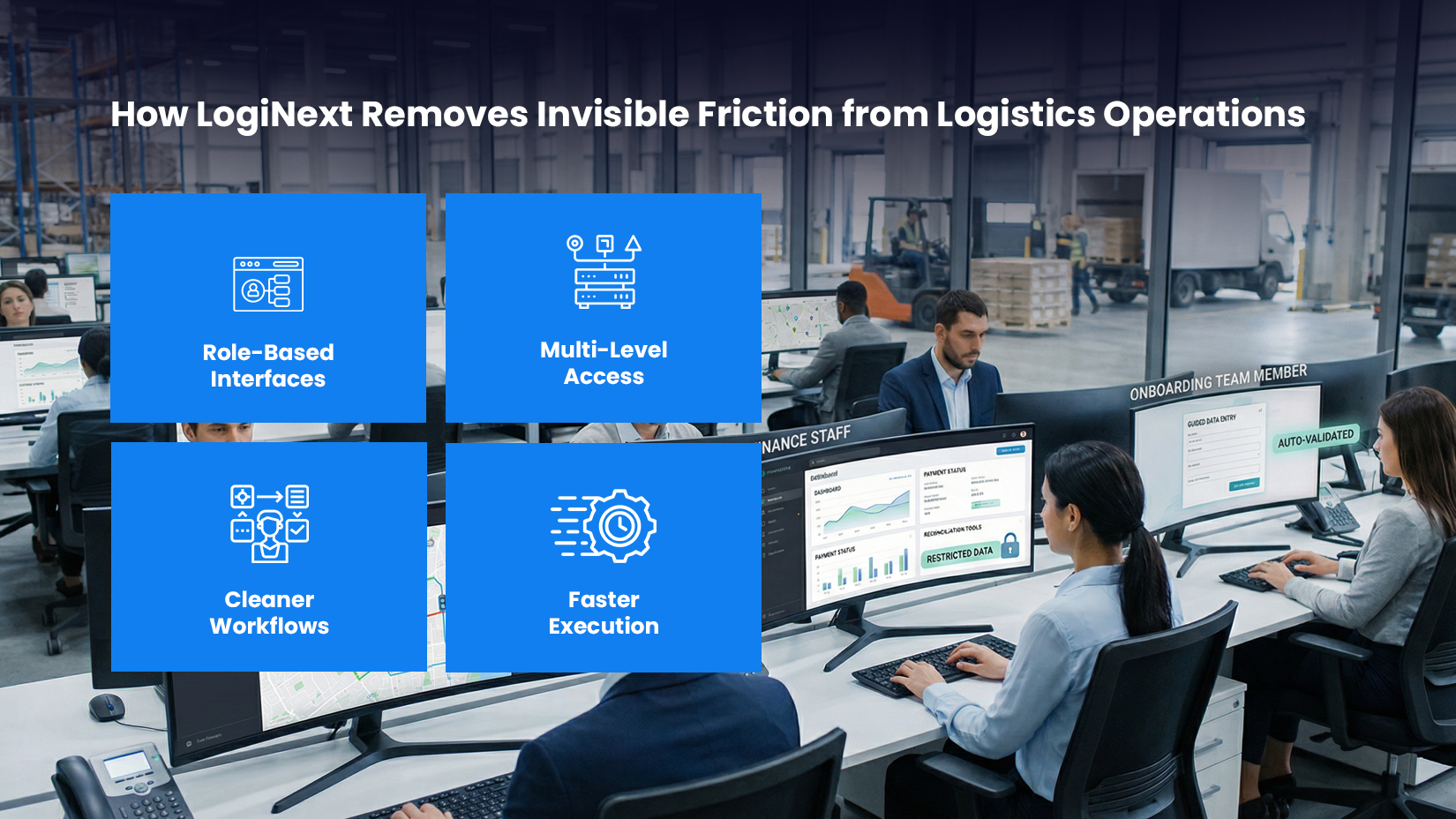
LogiNext reduces operations friction by aligning logistics software with how different teams actually work, rather than forcing uniform experiences across roles.
1. Role-Based Interfaces:
Screens adapt by role. Dispatch teams see execution-critical data, finance teams access payment-focused views, and onboarding teams work with simplified data capture. This reduces cognitive load and speeds decisions.
2. Multi-Level Access:
As a multi user logistics system, LogiNext enables multi-level access so users see only what is relevant to them. Sensitive data stays restricted, improving focus, security, and compliance.
3. Cleaner Workflows:
Unnecessary fields are removed and role-specific validations are applied. Errors drop, rework declines, and data quality improves at the source.
4. Faster Execution:
Simpler interfaces shorten dispatch cycles, accelerate onboarding, and enable quicker reconciliation, without adding complexity.
Together, these capabilities make LogiNext a role-aware logistics management software platform built to eliminate invisible friction at scale.
The Measurable Impact of Reducing Operations Friction
Organizations that remove invisible friction through LogiNext’s logistics management software typically see measurable improvements within weeks:
- 35% faster order creation
- More than 50% reduction in operational errors
- 2x faster customer onboarding
- Same-day COD reconcilliation
- Increased shipper sign-ups
- Higher operations team satisfaction
These outcomes are not driven by new assets or complex algorithms. They result from making everyday workflows simpler and more intuitive.
Also Read: Milo: The AI Chatbot Transforming the Logistics Experience – One Smart Answer at a Time
Conclusion
The logistics industry is racing toward AI-driven optimization and automation. Yet one of the most powerful performance levers remains overlooked, the user experience of the logistics software itself.
Invisible friction silently undermines logistics management by slowing execution, increasing errors, and exhausting teams. By addressing operations friction through role-aware design, multi-level access, and thoughtful logistics UI/UX, LogiNext delivers a multi user logistics system built for how logistics actually works.
In an industry where margins are tight and execution speed defines competitiveness, removing invisible friction is not a cosmetic improvement. It is a strategic advantage, hidden in plain sight. See how LogiNext’s role-aware, multi-user logistics platform turns everyday execution into a competitive advantage. Click on the red button to know more.
1

|

|

|




@LogiNext