




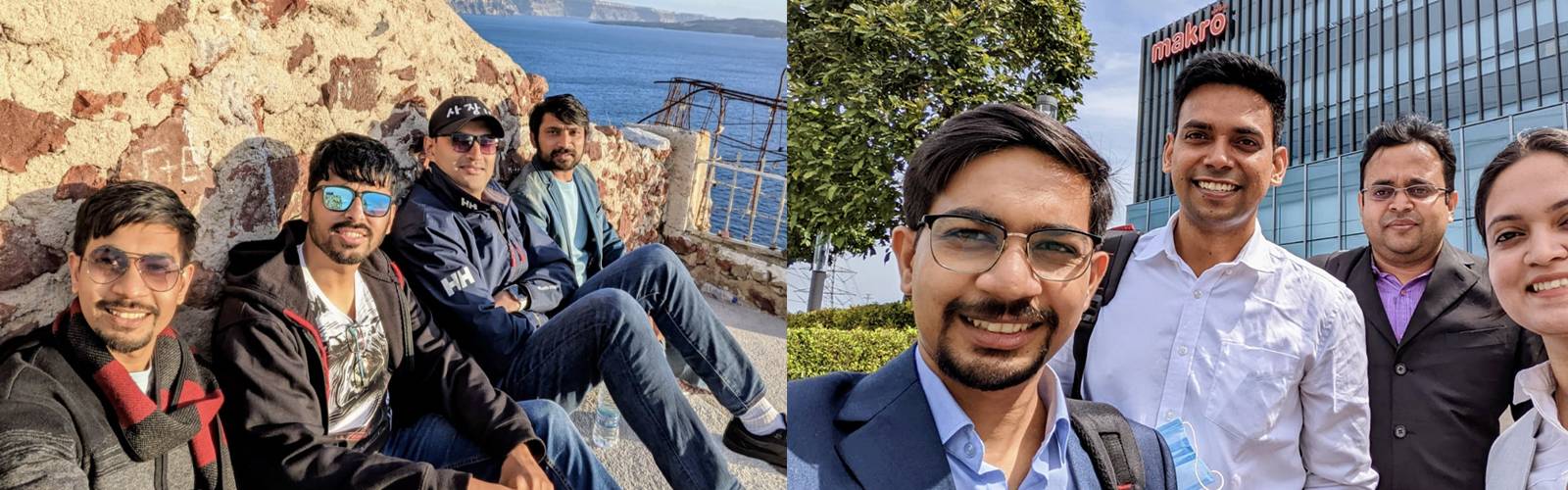
Meet Mr. Versatile of LogiNext, Kanishk Jain
This quote came into mainstream in the 1950s from American Football and nothing describes Kanishk Jain better. Growing up in the capital on India, Kanishk epitomizes the spirit of young India with global aspirations. An engineer from IIT Roorkee, Kanishk took on the startup world head on straight away as he joined LogiNext and started his career in the exciting world of Enterprise SaaS.
Closing in on six years with LogiNext, Kanishk has donned several hats and has earned the moniker of ‘problem solver’ in the team. Here, we speak to Kanishk to learn about his journey and share it with you.
LN: How has your journey at LogiNext evolved over the years, both professionally and personally?
KJ: When I joined LogiNext on campus as an Operations Analyst, I had little to no idea where I would be in the next five or ten years. Even in my wildest guesses, I wouldn’t have thought I’d be a product manager. Mostly because I didn’t even know such a title existed at the time!
My journey has been a complete evolution, driven by my personal belief that “change is the only constant”. And it can be for better or worse. Because of this, I’ve always kept an open mind, constantly evaluating what I am doing now and what else I can do.
Professionally, I have always viewed myself as a problem solver, and over time, I’ve stopped thinking in terms of titles. This perspective gives me the freedom to operate on a problem holistically rather than just a subsection of it. Ensuring I truly understand the core issues with conceptual clarity before building a solution.
LN: Over the years, how has your role, designation, and scope of responsibilities evolved through your journey at LogiNext?
KJ: It’s been an incredibly rewarding progression. I joined LogiNext in mid 2016 as an Operations Analyst working with our own fleet. Where I managed driver allocation, city P&Ls, and expense disbursements while making day-to-day operations more efficient.
Later that year, when we moved to an enterprise-only model, I started helping the sales team close enterprise deals and manage key accounts. By mid-2017, I officially transitioned into a Pre-Sales and Solutions role. There, I architected enterprise solutions and helped secure major clients while expanding our geography across LATAM, EMEA, and the US.
This experience, combined with my fascination for how we were solving logistics challenges holistically, led me to Product Management. From Jan 2021 to Dec 2024, I progressed from PM to Senior PM, taking ownership of larger roadmap items and graduating from isolated features.
As of Jan 2025, I stepped into the role of AVP of Product Excellence, where my responsibilities now include defining and maintaining quality gates for the product team. And also aligning our product goals with the organization’s overarching vision.
LN: You’ve worn multiple hats across operations, pre-sales, and products. How have these diverse experiences shaped the way you approach problem-solving today?
KJ: Each role I’ve stepped into has given me a rare, multi-view perspective on how enterprise software actually creates and retains value.
From Operations: Spending time on the ground and making deliveries with drivers helped me address their concerns, alongside those of our clients. It taught me what each user genuinely needs—which isn’t just “software,” but a tangible solution to their day-to-day challenges.
From Pre-Sales & Account Management: This phase gave me clarity on what goes into software buying decisions. The regional nuances of different markets, and what it truly takes to win over an enterprise client’s C-suite.
From Product: Piggybacking on my previous experiences, I learned to translate operational, commercial, legal, and security challenges into a scalable technical vision. I learned what goes into building a strong foundation to solve a problem the right way.
This holistic view ensures I don’t build features in a vacuum. It helps me recognize my inherent product biases and validate my approach through actual customer feedback and data rather than assumptions. In logistics, assumptions are a sweet pill we simply shouldn’t swallow.
LN: What are some of the most exciting product, customer, or business challenges you are focused on solving today?
KJ: Right now, I am focused more than ever on serving the right information to the user at the exact right time. Thereby, reducing operational friction as much as possible. In our ecosystem, a client’s main role is to keep things moving on the ground, not to spend all their time behind a screen. I firmly believe AI has enabled us to deeply deliver on that premise.
We recently launched “Milo,” a helpful AI assistant accessible across all of our client personas. On LogiNext Mile—Dispatcher, Driver, and Shipper—providing contextual help exactly as they need it.
We are now going further to help our users extract digestible insights from the massive amounts of data they generate every single day. I want to push this theme further to give users their time back. Allowing them to focus on solving core challenges rather than struggling to find information.
LN: Looking back, what has been one of your proudest milestones or defining moments at LogiNext so far?
KJ: While it’s tough to pick just one after nearly a decade, a milestone close to my heart is closing Coca-Cola as our first enterprise customer back in 2016, just two months into my shift to enterprise SaaS. That relationship is still active and solid today. It strengthened our belief in the foundation we built a decade ago and serves as a testament that we continue to evolve in the right direction.
Additionally, being part of the team that laid the groundwork for the Carrier Integration Marketplace has been incredibly rewarding. Making our platform deeply connected to the broader logistics ecosystem and helping companies manage their end-to-end operations under one system is truly satisfying.
LN: What continues to motivate and drive you after all these years at LogiNext?
KJ: It really comes down to enjoying what you do. What drives me is taking a broad vision, trying to make it a reality, and seeing it seamlessly complement an entire global logistics ecosystem.
Every time we release a feature that solves a massive operational bottleneck, I get that “aha” moment. Striving for that sense of satisfaction in my work keeps me going every single day. Furthermore, the immense support and trust from Dhruvil, Naveen, and the entire team over the years has been a massive motivator.
LN: How do you see logistics automation and product innovation evolving over the next few years?
Logistics is one of the core and fastest-evolving industries globally. The evolution we’ve already seen—from next-day route planning to 10-minute hyperlocal deliveries—wouldn’t have been possible without the massive underlying efficiency gains these systems provide at scale.
Looking ahead, I see innovation moving beyond just spatial and location optimization. We are entering an era driven deeply by context-aware agents. The future lies in predictive workflows, where AI doesn’t just look at system constraints but can adapt and navigate on the fly with new information
Outside of LogiNext, I look up to Elon Musk. Professionally, he is a visionary at identifying and solving large scale problem in the most innovative ways.
LN: What advice would you give to aspiring product managers and young professionals looking to build long-term careers in SaaS?
KJ: Over-communicate: For a PM, there is no point in building a feature that doesn’t solve a problem. It is your responsibility to ensure all stakeholders—developers, designers, and management—understand the underlying objective so they can build accordingly. No feature works in isolation. It is part of a product ecosystem, part of a larger organizational tech stack, and must revolve around the user’s actual day-to-day life.
Trust the process and use data: Maintain detailed documentation and clearly state your problem statements. Always be on the lookout for the customer’s voice—features requested, support tickets raised, and feedback given. Combine this with product data like user interactions and pain points to prioritize your decision-making.
Acknowledge your biases: You will always have a bias toward a specific feature or a problem. To build something truly valuable, you must proactively spend time with customers and validate your approach against hard data to keep those biases in check.
Stay tuned to read more stories about those taking LogiNext to the next level.
196

|

|

|




@LogiNext