



See the Risk. Act Faster. Build a More Resilient Supply Chain.
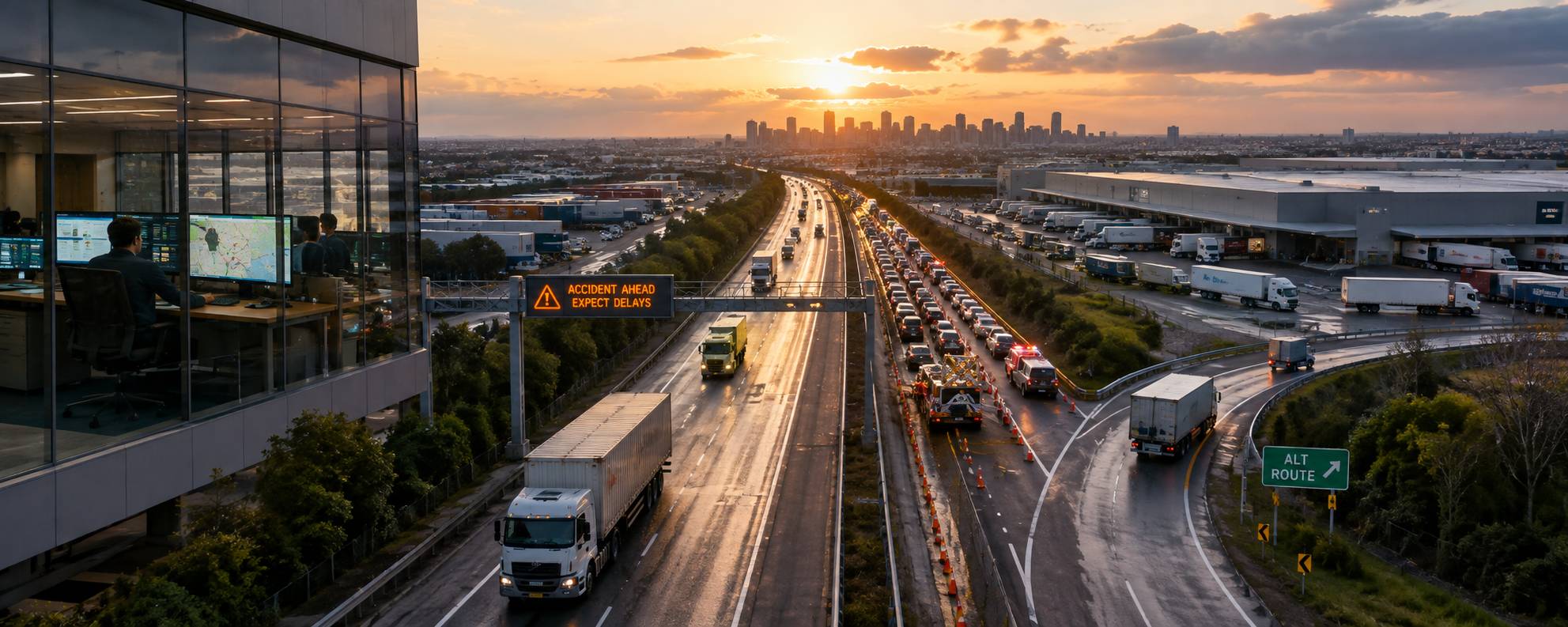
Supply chain resilience is the ability to anticipate disruptions, adapt operations, and recover without letting one problem snowball into several. Easier said than done when a traffic incident delays one vehicle, that delay affects a delivery window, the next route loses capacity, and suddenly a transportation issue becomes a customer-service issue.
The risk is hardly theoretical. McKinsey’s 2024 Global Supply Chain Leader Survey found that nine in ten supply chain leaders encountered supply chain challenges in 2024.
The answer is not simply to carry more inventory or build bigger buffers. Businesses need to know what is happening across their logistics network. Understand what could happen next, and have enough time to respond. That makes real-time supply chain visibility a foundation for resilience. While software turns that visibility into something teams can actually act on.
Key Takeaways
- Supply chain resilience is the ability to anticipate, withstand, adapt to, and recover from disruptions.
- Transportation is a major source of uncertainty because traffic, weather, infrastructure, and operating conditions can change rapidly.
- Supply chain visibility software provides a real-time view of shipments, fleets, routes, and exceptions.
- Predictive ETAs and analytics help identify potential problems before they become service failures.
- Transportation intelligence adds external context that helps teams understand why delivery conditions are changing.
- Resilience improves when visibility is connected directly to actions such as rerouting, reallocation, and exception management.
- The ultimate goal is to reduce the gap between detecting a disruption and responding to it.
What Is Supply Chain Resilience?
Supply chain resilience is the ability to anticipate, withstand, adapt to, and recover from disruptions while continuing to meet critical operational and customer requirements.
A resilient supply chain should help teams answer four questions quickly:
- What is happening right now?
- What could happen next?
- What will be affected?
- What action should we take?
That last question is where many supply chains struggle.
McKinsey found that 60% of surveyed companies had comprehensive visibility of their tier-one suppliers in 2024, but visibility into deeper tiers remained a challenge. More concerning, once a disruption occurs, companies take an average of two weeks to plan and execute a response.
Two weeks is a long time when transportation conditions can change by the hour.
Why Does Transportation Visibility Matter for Supply Chain Resilience?
Transportation is where supply chain plans meet real-world conditions.
A shipment can leave a warehouse exactly as planned and still arrive late. This might be because of congestion, road closures, extreme weather, vehicle issues, border delays, or unexpected changes in demand. If teams only discover the problem after the delivery is already late, their options are limited.
Transportation visibility gives businesses an earlier view of these changes so they can understand the potential impact and respond before a disruption spreads.
The World Bank’s Logistics Performance Index found that an average of 44 days can elapse between a container entering the export country’s port and leaving the destination port. That represents about 60% of the total time involved in international trade. The World Bank also identified ports, airports, and multimodal facilities as major sources of delay.
That puts the value of visibility into perspective. A supply chain cannot be resilient if its decision-makers are consistently finding out about problems after they have already happened.
How Does Supply Chain Visibility Software Strengthen Resilience?
Supply chain visibility software strengthens resilience by connecting operational data with real-time monitoring, predictive intelligence, exception management, and actions that help logistics teams respond to disruptions.
But visibility is not one feature. It is a chain of capabilities that takes a business from simply seeing a disruption to actually responding to it.
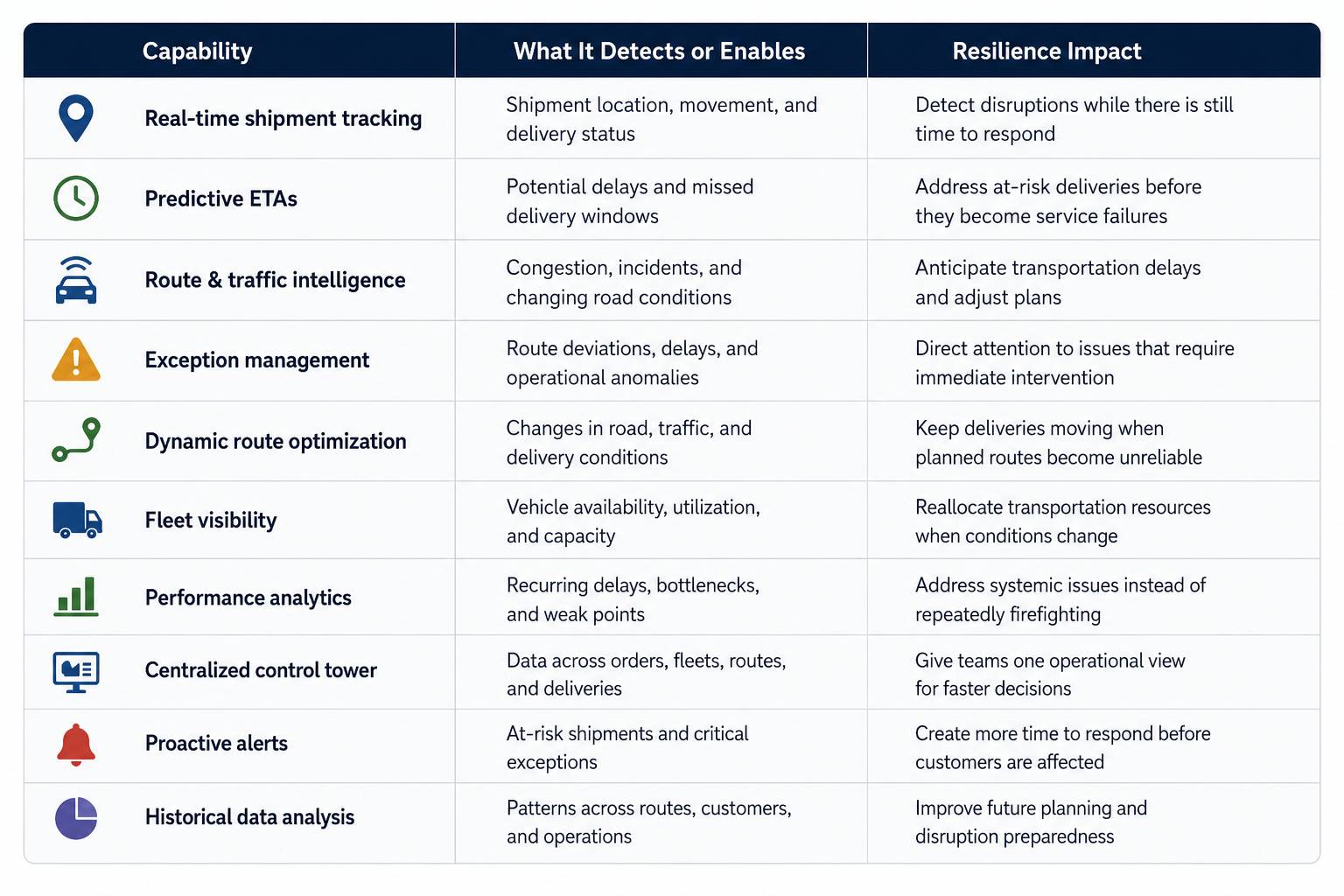
The distinction matters. A tracking system can tell you that a truck is late. A resilient logistics operation needs to know why it is late, which deliveries are at risk, what alternatives exist, and what action should happen next.
McKinsey’s research found that 67% of surveyed companies had implemented digital dashboards for end-to-end supply chain visibility. Those companies were twice as likely to avoid supply chain problems caused by disruptions compared with others.
So the objective is not another dashboard for someone to stare at. It is a connected operational layer that helps teams move from visibility to intervention.
How Do Predictive Analytics and Transportation Intelligence Improve Resilience?
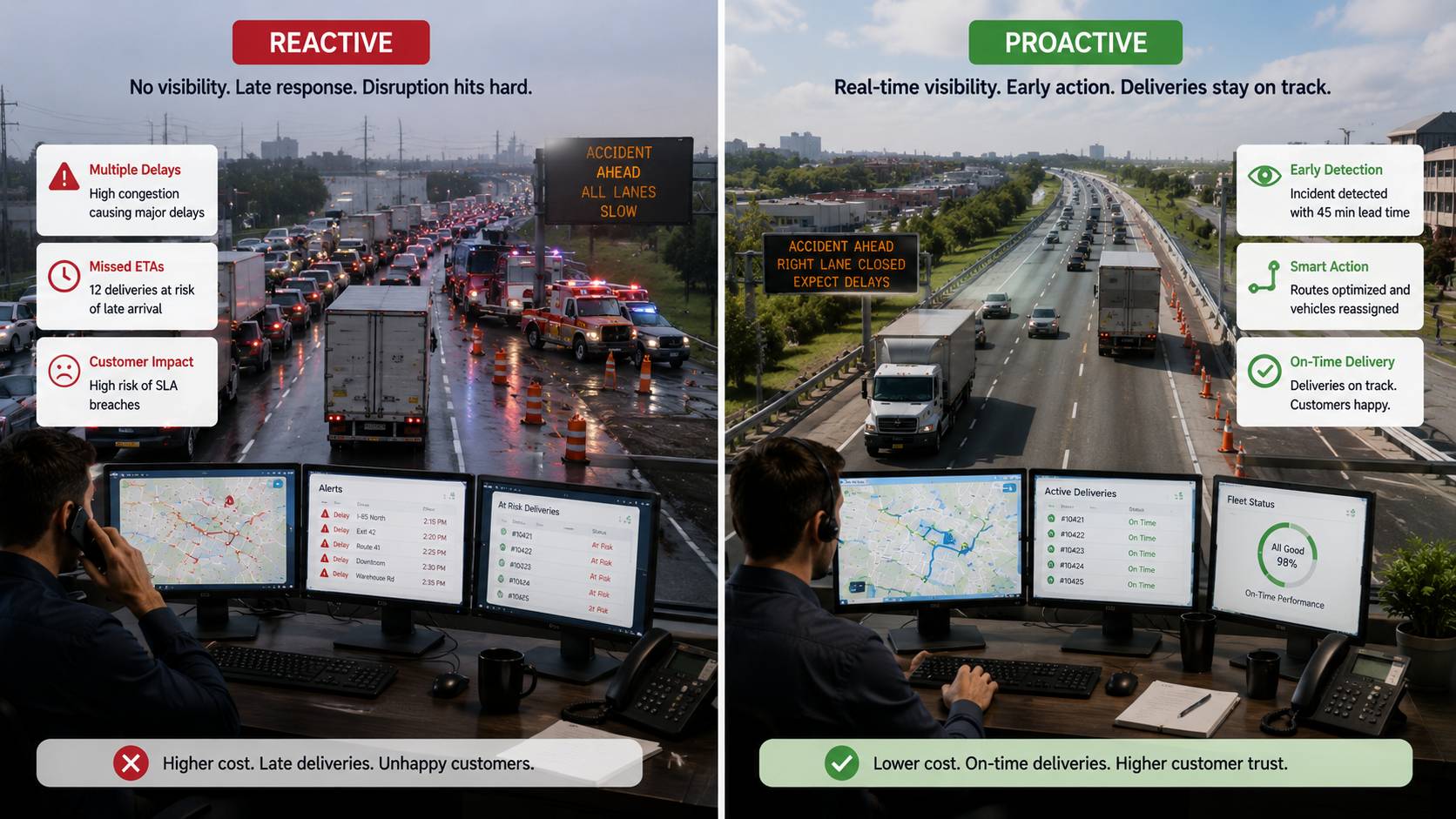
Real-time visibility tells teams what is happening. Predictive analytics and transportation intelligence help them understand what is likely to happen next.
That distinction is increasingly important.
Transportation intelligence can combine operational information with external factors such as traffic, road conditions, incidents, and other transportation signals. Predictive analytics can then help identify which shipments or routes are likely to be affected.
For example, imagine 500 deliveries are moving across a city when a major traffic incident affects a key corridor.
A reactive operation waits for drivers to start running late. A more resilient operation can:
- Detect the disruption.
- Identify affected routes and deliveries.
- Predict which ETAs are likely to change.
- Prioritize high-risk orders.
- Reroute or reallocate available resources.
- Monitor the results in real time.
That is the practical difference between knowing there is a problem and having enough intelligence to manage it.
It also explains why predictive analytics in the supply chain is becoming increasingly important. The value is not in predicting the future perfectly. It is in giving teams more time and better information to influence the outcome.
What Are the Key Steps to Build a More Resilient Supply Chain?
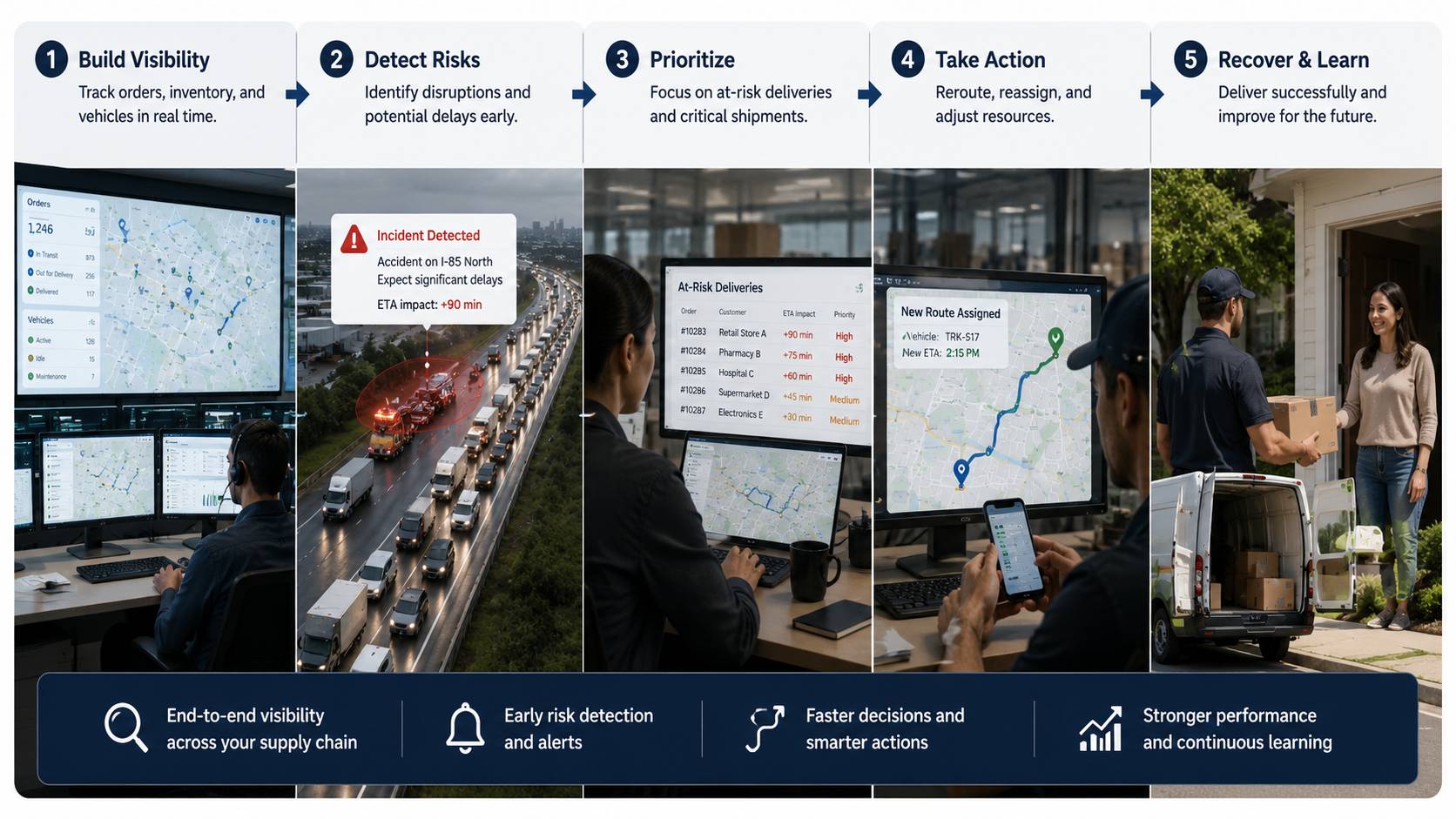
Technology helps, but resilience does not come from software alone. Businesses also need processes that turn visibility into action.
1. Build A Single Operational View:
Connect order, shipment, fleet, route, and delivery data so teams are not working from disconnected systems.
2. Detect Risks Early:
Connect order, shipment, fleet, route, and delivery data so teams are not working from disconnected systems.
3. Prioritize the Disruptions That Matter:
Not every delay requires the same response. Focus on issues that could affect critical orders, customers, SLAs, or downstream operations.
4. Connect Insight to Action:
Use predictive ETAs, route optimization, intelligent allocation, and automated alerts to respond before disruptions cascade.
5. Learn From Every Disruption:
Use historical analytics to identify recurring bottlenecks and improve future planning rather than repeatedly solving the same problem.
The World Bank’s research reinforces the value of this digital shift. Its 2023 LPI found that end-to-end supply chain digitalization can shorten port delays by up to 70% in emerging economies compared with developed economies.
The lesson is simple: resilience is not about collecting more data. It is about making data useful before, during, and after a disruption.
How Does LogiNext Help Build Supply Chain Resilience?
LogiNext connects visibility, prediction, optimization, and execution to help enterprises manage complex logistics operations from a centralized platform.
Its supply chain visibility software provides real-time tracking, predictive ETAs, end-to-end order visibility, analytics, proactive alerts, and exception management.
That means logistics teams can monitor shipments and vehicles, identify potential disruptions, understand their impact, and take action without jumping between disconnected systems.
LogiNext also connects visibility with execution through capabilities such as route optimization, fleet management, dispatch automation, and real-time operational monitoring.
And that connection is important.
Visibility without action is just information. Resilience comes from turning that information into a decision.
Frequently Asked Questions
1. What is supply chain resilience?
Supply chain resilience is the ability to anticipate, withstand, adapt to, and recover from disruptions while maintaining critical operations and customer commitments.
2. How does supply chain visibility improve resilience?
It provides real-time information about shipments, vehicles, routes, and exceptions. Thereby, allowing businesses to detect risks earlier and respond before disruptions escalate.
3. What is supply chain visibility software?
Supply chain visibility software provides centralized insight into logistics activity. Depending on the platform, it can include real-time tracking, predictive ETAs, analytics, alerts, route optimization, and exception management.
4. Can software eliminate supply chain disruptions?
No. Disruptions cannot be eliminated entirely. Software helps businesses detect risks earlier, understand their impact, respond faster, and recover more effectively.
Conclusion
Supply chain resilience is not about eliminating every disruption. It is about seeing risks sooner, responding faster, and minimizing their impact. Real-time visibility, predictive analytics, and intelligent transportation tools give logistics teams the information they need to make those decisions.
With LogiNext, enterprises can connect real-time visibility, predictive ETAs, route optimization, fleet management, and exception management on a single platform. Request a demo and see how LogiNext can help build a more resilient logistics operation.
“” 28
 |  |  |




@LogiNext