




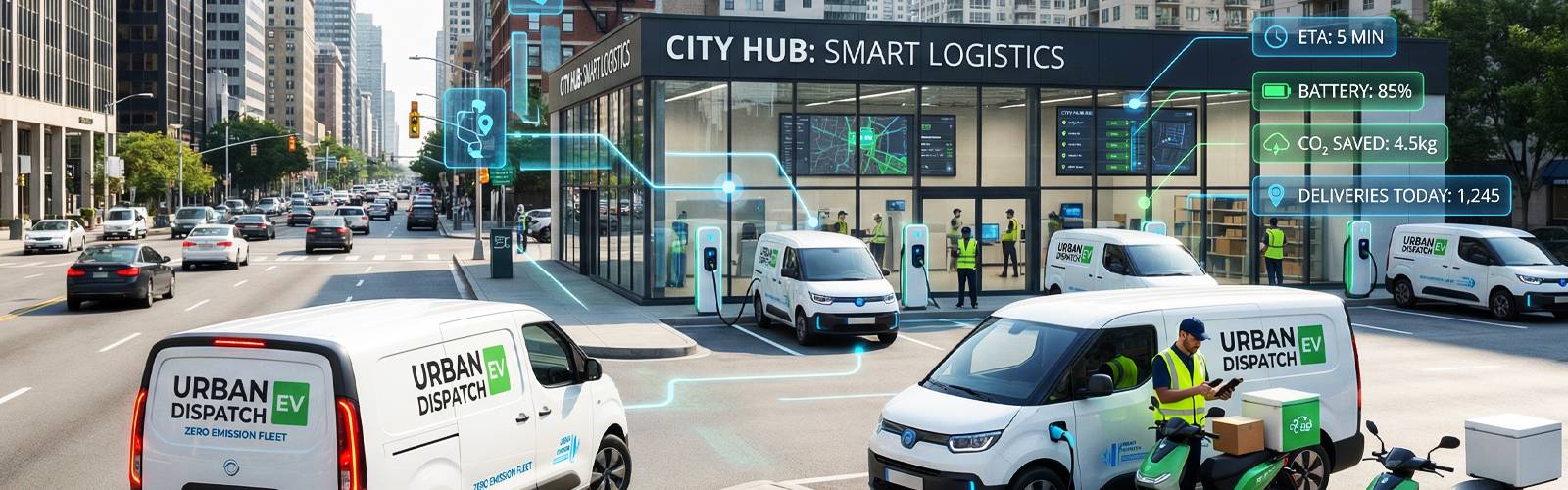
From Pilots to Scale: How EVs Are Redefining Last Mile Logistics
Electric Vehicles (EVs) are no longer the cool new experiment parked in a company’s sustainability report. They’ve moved from small pilots to large-scale deployments, reshaping last mile logistics with speed, efficiency, and data-driven precision. As retail, e-commerce, and hyperlocal delivery surge, businesses are realizing that the old diesel-driven model can’t keep up with today’s demand for faster, cleaner, and more predictable fulfillment.
EVs are stepping in as the game-changers. And the shift is not subtle, it’s transformative.
Why the Last Mile Needed a Reset
The last leg of delivery has always been the most expensive. Nearly 53% of total logistics costs occur in the last mile. Add rising fuel prices, stricter emission norms, shrinking delivery windows, and congestion in urban areas, and the pressure becomes intense.
Businesses relying on traditional fleets are facing challenges that can’t be solved with incremental tweaks. That is where EVs enter, not as a sustainability checkbox, but as a strategic advantage for last mile logistics, last mile management, and operational profitability.
EV Adoption Is Accelerating Not Crawling
The global electric delivery vehicle market is projected to grow at over 14% CAGR till 2030. India alone is expected to deploy over 4-5 million EVs in logistics and mobility by 2030.
Why the sudden spike?
– Battery prices have dropped 89% in the last decade.
– Governments are rolling out incentives for EV fleets.
– Charging infrastructure is expanding at record speed.
– Urban delivery density makes EVs significantly cheaper per km.
This perfect storm is pushing companies to scale EV operations beyond initial pilots and limited trials.
Total Cost of Ownership: The Real Breakthrough
In logistics, emotions don’t win. Numbers do.
A well-run EV fleet can reduce operating expenses by 30–40% compared to ICE vehicles. Energy costs are predictable, maintenance is minimal, and downtime drops sharply because EVs have fewer moving parts.
For enterprises running high-volume deliveries, this shift is massive. The economics alone justify scaling EVs across last mile delivery, city logistics, and hyperlocal runs.
EVs + Digital Intelligence = The New Backbone of Last Mile Logistics
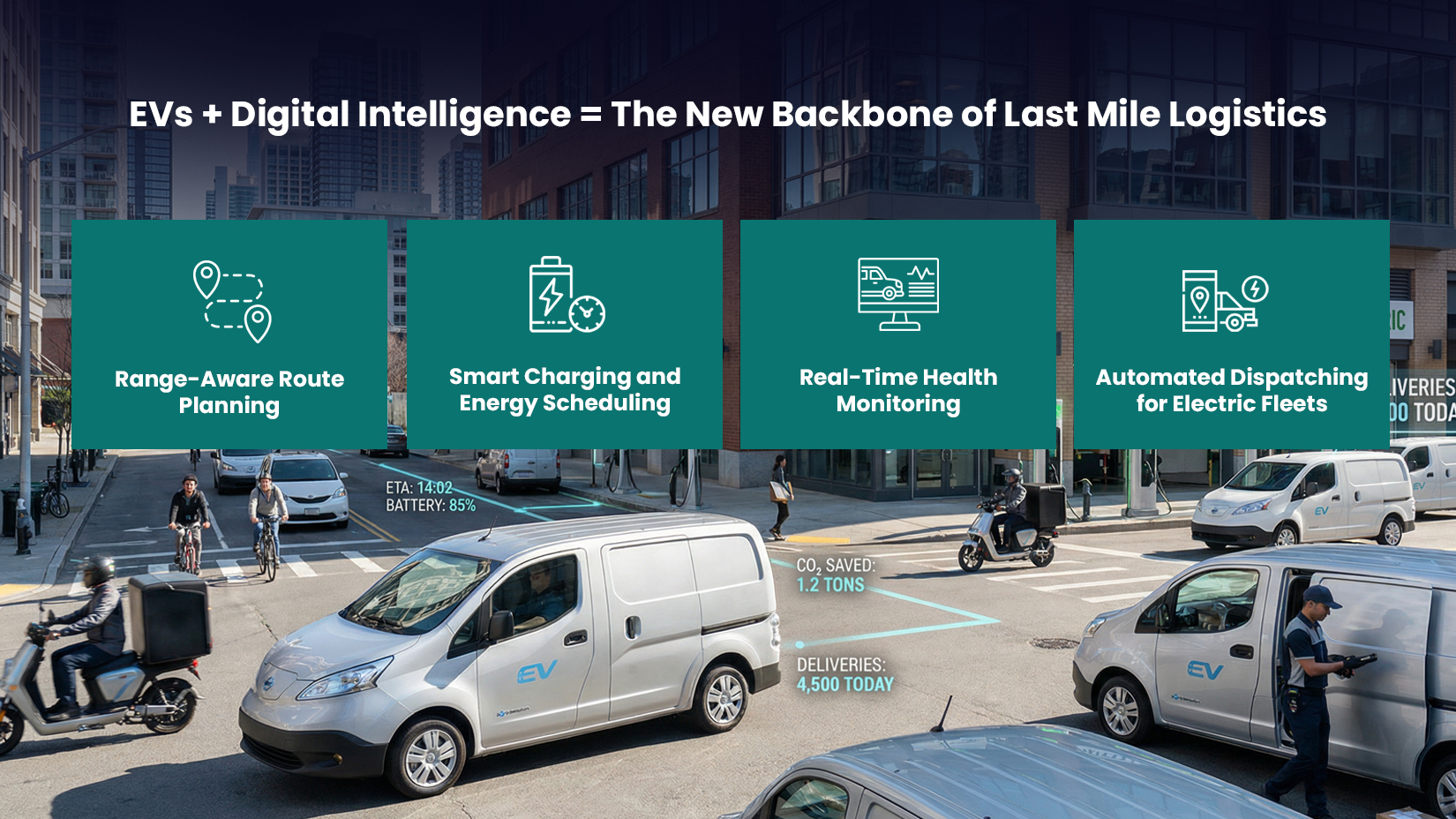
Deploying electric fleets is only half the story. Scaling them requires smart routing, real-time visibility, and fleet-wide optimization. That’s where digital platforms come in, especially last mile logistics software and last mile delivery software.
1. Range-Aware Route Planning:
EV route optimization needs more than distance calculations. It must consider battery levels, payload weight, terrain, and charging availability. Modern last mile logistics software automatically assigns EVs to routes where they perform best.
2. Smart Charging and Energy Scheduling:
Idle-time charging, automated charging cycles, and charge-station mapping help minimize downtime. For high-density delivery zones, businesses are seeing 15–20% higher utilization of EVs compared to ICE vehicles.
3. Real-Time Health Monitoring:
EVs generate more actionable telematics data than traditional vehicles. Insights include:
– Battery degradation
– Power efficiency
– Regenerative braking metrics
– Predictive maintenance alerts
This data strengthens last mile management and reduces unexpected failures.
4. Automated Dispatching for Electric Fleets:
Dispatch systems can prioritize EVs for short-haul routes, high-density clusters, or sustainability-focused orders. Businesses using advanced last mile delivery software report:
– 12–15% surge in successful first-attempt deliveries
– 25% lower cost per order
– 20–30% reduction in carbon emissions
Scalability Challenges Are Real But Solvable
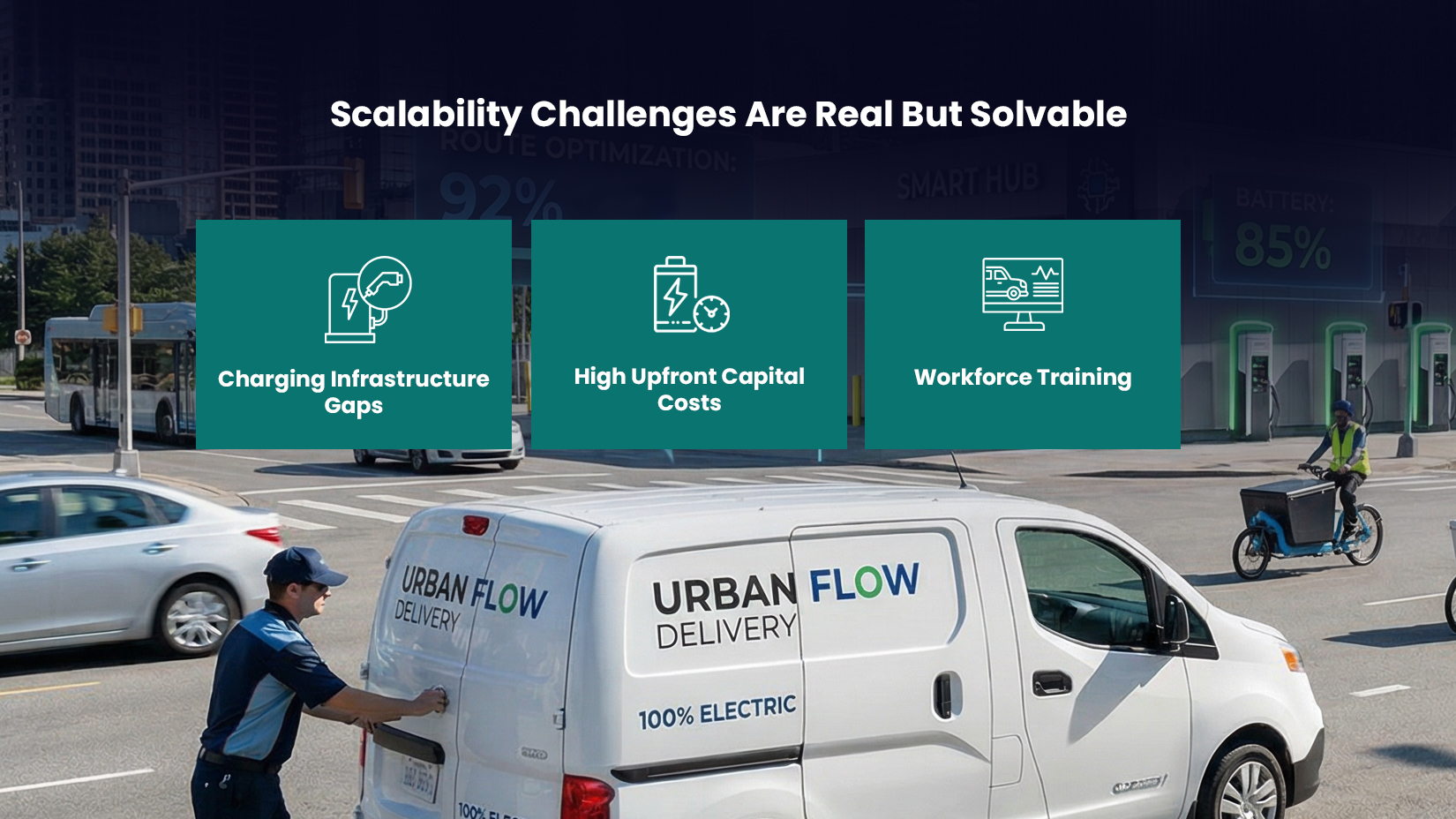
Scaling EVs across cities isn’t a plug-and-play task. Companies face hurdles, such as:
1. Charging Infrastructure Gaps:
Not every zone has reliable fast-charging support. Smart route planning and micro-hubs are helping fill this gap.
2. High Upfront Capital Costs:
EVs cost more initially, but leasing and battery-as-a-service models are making adoption easier.
3. Workforce Training:
Drivers and operations teams need training on smart charging, battery management, and EV-friendly routing.
Digital last mile logistics software solves many of these gaps with scenario planning, simulation, and automated decision-making.
Case Study Snapshot: EVs Delivering Real-World Impact
A leading Indian e-commerce marketplace deployed over 10,000 EVs across metro cities. Results after 12 months:
– 35% reduction in last mile delivery cost.
– 28% improvement in delivery density.
– 40% drop in CO₂ emissions.
– 19% faster deliveries in high-traffic zones.
The scale-up didn’t just cut carbon, it strengthened competitive advantage in a market with zero delivery tolerance.
Future Outlook: The EV-First Last Mile Era
Electric fleets will soon dominate urban logistics. Three major trends will accelerate the shift:
1. Micro-Fulfilment + EV Synergy: Short distances + dense order volumes = EV sweet spot.
2. AI-Driven Fleet Orchestration: Predictive algorithms will manage charging, routing, vehicle allocation, and battery health automatically.
3. EV-Exclusive Delivery Fleets: Major retailers and QSR chains are already piloting EV-only fleets for urban delivery.
As these trends mature, EVs will become the default choice for last mile logistics, supported by smart last mile management and intelligent last mile delivery software.
Conclusion: The EV Scale-Up Isn’t a Trend, It’s a Turning Point
EVs are shifting from pilot programs to enterprise-wide deployment. The combination of lower operating expenses, cleaner mobility, and AI-powered orchestration is redefining last mile logistics from the ground up.
Forward-looking companies are already integrating EVs with modern last mile logistics software, ensuring data-driven routing, smarter energy use, and reliable deliveries at scale.
The message is clear: the future of last mile delivery is electric, intelligent, and unstoppable. So, to be part of the future you need to be part of the revolution. For that the first step is to get the best last mile delivery platform by LogiNext. Click on the red button to know more.
“”
 |  |  |




@LogiNext