





AI in Logistics: What Worked in 2025 & What Will Scale in 2026
The logistics industry is in the midst of a transformation. In 2025, companies moved rapidly from experimentation toward measurable results in AI in logistics. While hype still surrounds some applications, real wins are showing up across transportation management, warehouse automation, predictive analytics, and customer experience tools. This blog will break down what actually worked in 2025 and, importantly, what will scale in 2026, backed by data and real industry trends.
The Real Gains of 2025: Practical Wins in AI-Driven Logistics
In 2025, the logistics landscape saw tangible benefits from AI powered logistics. Firms that deployed mature AI solutions, especially where data quality and integration were strong, captured measurable improvements across core KPIs.
1. Operational Efficiency and Cost Reduction:
One of the most consistent themes in 2025 was efficiency. AI-driven tracking, route optimization, and predictive planning helped cut costs and streamline workflows:
– Those who were early users reported that AI could help freight and logistics grow and expand operationally.
– Case studies have shown that when utilizing AI capabilities to optimize routes, shipping costs can be reduced as much as 15% in some cases according to Gitnux.
– AI-driven predictive forecasting has allowed companies to more accurately forecast demand and increase their inventory.
AI in the freight and logistics industry did not occur by chance. These gains are primarily realized through the integration of AI-enabled logistics software within everyday operational systems
2. AI-Powered Automation in Warehouse:
Warehouse floors became another real success story. Robotics and automation backed by AI intelligence delivered consistent results:
– With the growth of smart robotics, Companies can automate their warehouse operations using robotics and intelligent software as AI Data. Resulting in increased efficiency of more than 60% across many sites, with some achieving reductions in errors approaching 99%.
– Many Companies have now deployed either autonomous mobile robots to do the tedious work while leaving human workers to perform higher value tasks.
– The use of AI in warehouse management has also improved the control over how warehouses allocate their space and resources.
3. Documentation and Customs Automation:
One underestimated win in 2025 was AI’s role in paperwork and compliance:
– With AI, top tier Logistic Providers have now been able to automate as much as 90% of their Documentation Process. With using AI to enhance performance and decrease error rates, thus improving the speed of clearance at Customs.
– By facilitating the Automatic Classification of Goods and performing Real-time Compliance Checks, AI has enabled shipping at borders to be more efficient.
This has opened the door to companies around the world to grow their businesses by relying on AI-driven logistics solution. To automate many previously manual portions of their Supply Chain processes.
What Didn’t Work (Yet) And Why That Matters
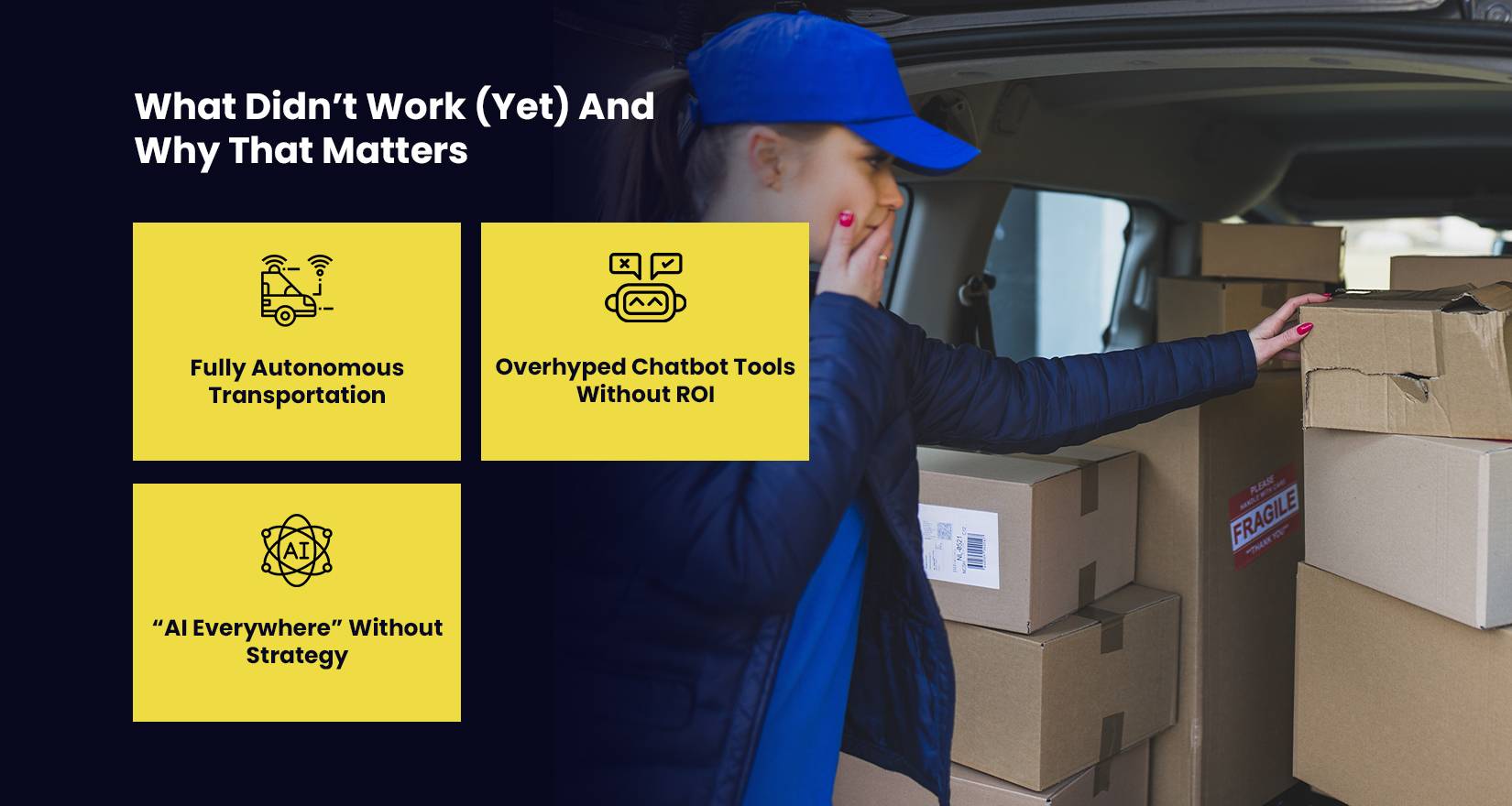
Not everything in 2025 lived up to the hype. Some AI pilots struggled to deliver real value:
1. Fully Autonomous Transportation:
Autonomous vehicles and drones had a very high profile but did not provide a large amount of operational volume in 2025. Thus remaining mostly at the pilot level (due to regulations, safety concerns, or limited operational domains).
2. Overhyped Chatbot Tools Without ROI:
While there is promise in providing customers with around-the-clock access to customer service via generic chatbots. Most organizations found that rather than reducing their overall workload, they caused human operators to remain involved to prevent incorrect information from being shared with customers.
3. “AI Everywhere” Without Strategy:
Organizations have introduced AI tools into their operations without any defined strategic plans to utilize them. They often created more clutter in their dashboards than they added to strategies to help grow their businesses.
Looking Ahead: What Will Scale in 2026
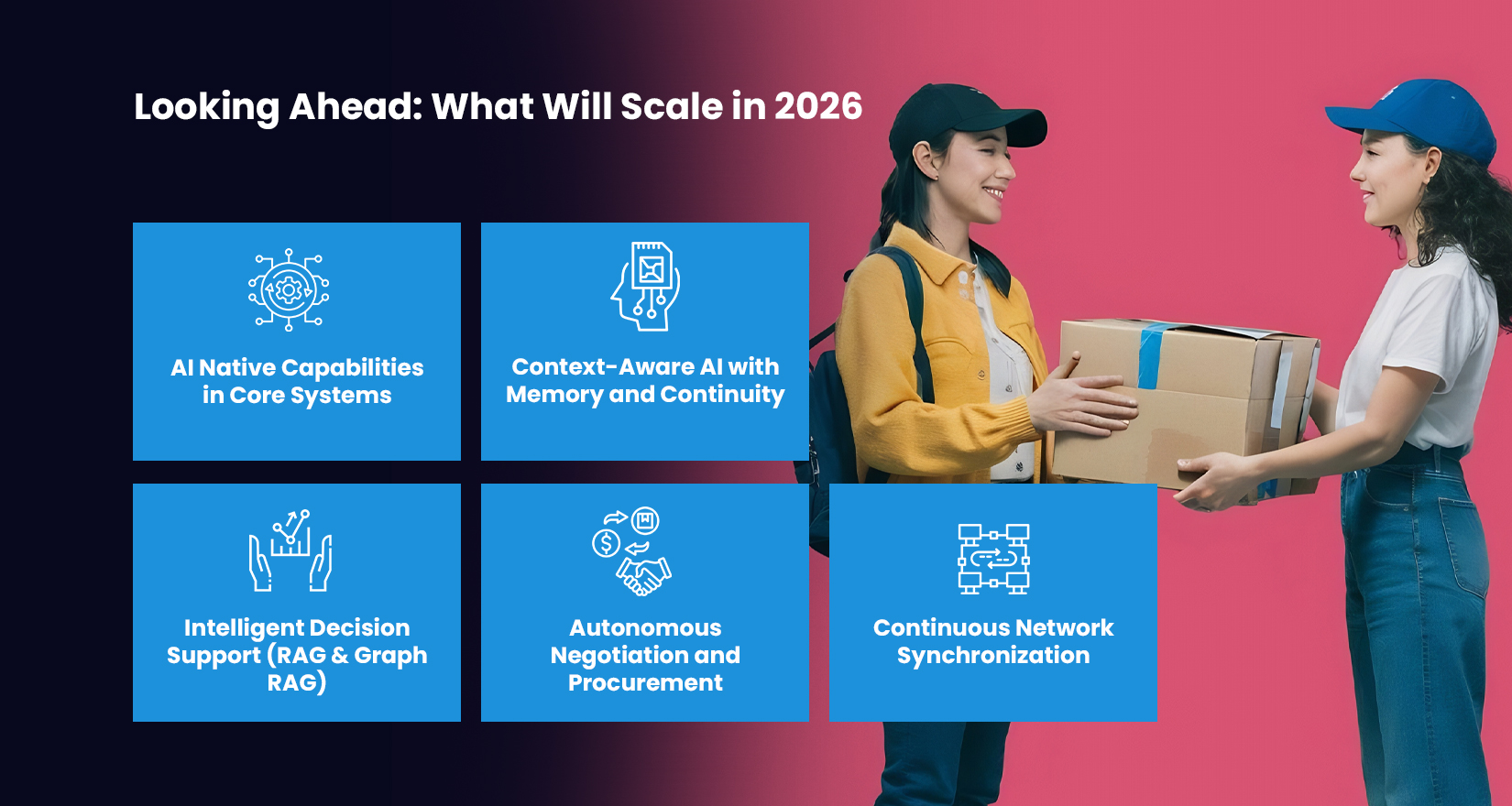
Winners of 2026 are going to be those organizations that take AI beyond the use cases of point tools, and integrate it deeply and holistically within their workflows. Trends that will be preparing to achieve significant scaling in 2023, based on industry analyst predictions include:
1. AI Native Capabilities in Core Systems:
Vendors are now developing their existing TMS and WMS platforms to be AI NATIVE by embedding the AI directly, rather than just adding an AI tool on top. Examples of this development include:
– Real Time Routing Decisions Based upon Cost Service Levels and Emissions.
– Task Prioritisation based upon Congestion and Labour Availability.
– Integrated Replenishment Planning with real time adjustments.
This trend will reduce resistance to adoption and deepen the impact of AI logistics software.
2. Context-Aware AI with Memory and Continuity:
In 2025, most of the AI systems were stateless, meaning that the AI system could not take into consideration prior interactions. That’s changing in 2026 with context retention protocols:
– The AI Assistants will be able to remember shipment histories.
– They will learn patterns of performance from Suppliers.
– They will keep track of user’s preferences and overall.
This elevates AI powered logistics from reactive tools to proactive partners in planning and execution.
3. Intelligent Decision Support (RAG & Graph RAG):
Through RAG and Graph RAG, intelligent AI will enable us to determine complex relationships in logistics through analysis of supply chain (multi-tier supplier networks) and logistics (multi-modal transport lanes) data.
So rather than simply having the answer to a query, planners will also receive actionable insights generating from an established set of reasoning methodologies.
4. Autonomous Negotiation and Procurement:
AI will allow for proxy procurement and negotiations by companies beginning in the procurement and negotiation stages. Such as:
– Issuance of Automated RFQs.
– Historical performance of rates..
– Identification and scoring of carriers based on cost and service.
Human control remains essential, but AI shaving hours off administrative tasks will be a major productivity boost.
5. Continuous Network Synchronization:
In 2026, companies will move from their currently existing, static plans to event-aware continuous planning loops that provide for:
– The daily rebalancing of transport capacities.
– Continual adjustments to safety stock throughout the network.
– Increased frequency of scenario simulations.
This transforms reactionary logistics into anticipatory operations, a big leap forward for AI in logistics and transportation.
Final Thoughts: The Road Ahead
The year 2025 marked the transition from AI in logistics being an expected benefit to providing an actual return on investment for companies. Those companies that capitalized on the most advanced, proven uses of AI, such as warehouse automation, predictive routing, and intelligent document processing, have a competitive edge over others.
In 2026, the focus has shifted from “Does AI Work?” to “How do we Scale AI?”. Embedding AI deep into core logistics platforms, enabling context-aware reasoning, and automating key decisions will differentiate leaders from laggards.
In short, AI isn’t the future of logistics, t’s already the present. But the next wave of AI logistics software innovations will determine which companies win in efficiency, customer experience, and supply chain resilience as we move deeper into the decade. So, to not miss out the next wave, book the demo your company needs with LogiNext. Click on the red button to know more.
99

|

|

|




@LogiNext