




What to Expect in 2026 – 5 Trends That Will Shape E-Commerce Logistics
E-commerce logistics is developing rapidly due to the growth of digital shopping. Logistics has changed to be a part of the e-commerce experience with the growth of online sales. While also allowing for businesses to operate at a lower cost, while increasing efficiency and resiliency.
The demand for faster shipping options increase through e-commerce sites. With this so does the need for a more environmentally conscious approach. Additionally, as logistics operations have become increasingly complex due to the proliferation of delivery services, the logistics model must change to reflect these changes in demand.
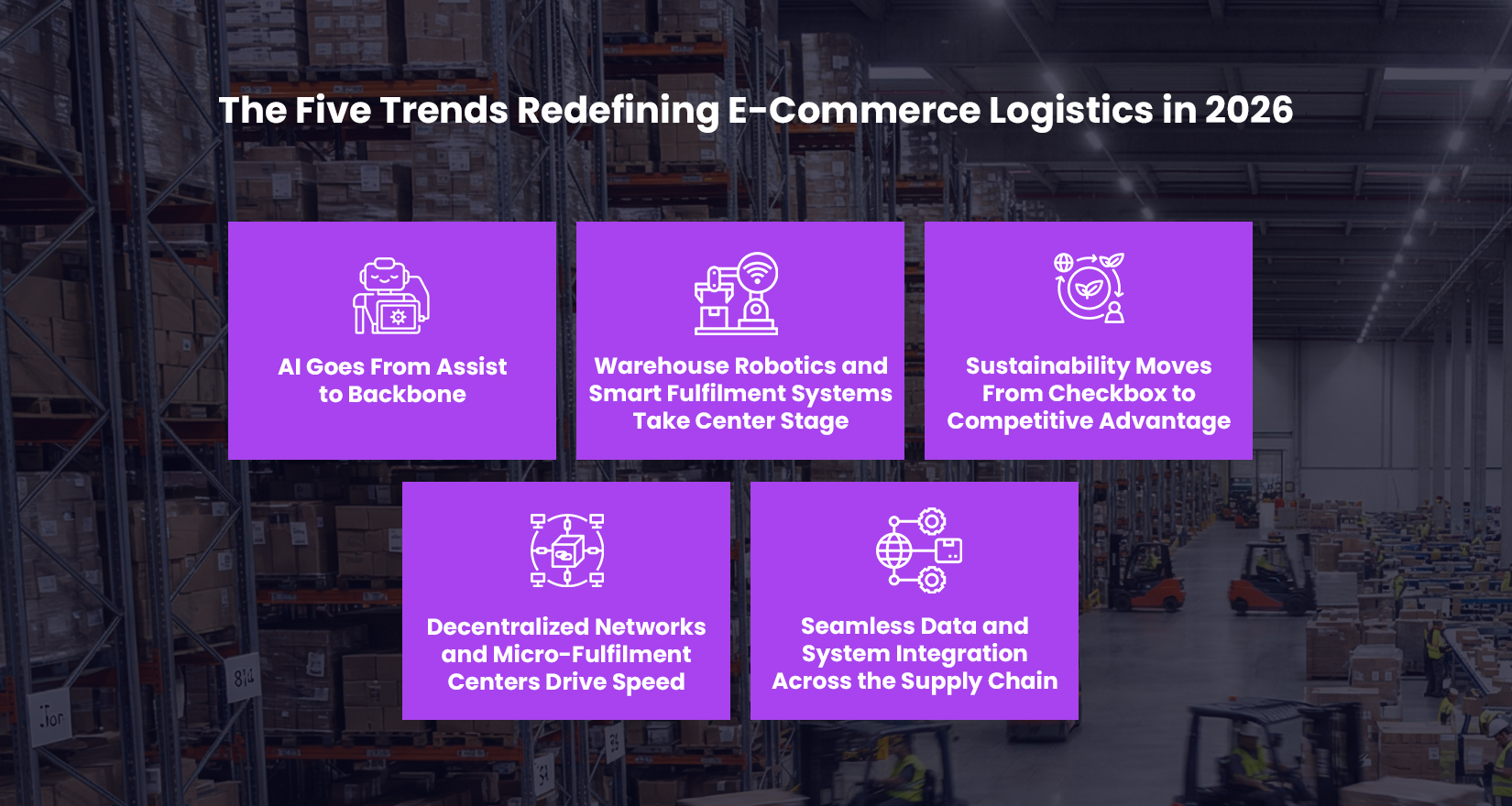
The Five Trends Redefining E-Commerce Logistics in 2026
In 2026, logistics performance will influence an organization’s brand. The organization that implements an effective logistics model to meet new marketplace demands will have an advantage in the areas of speed, scalability, and customer satisfaction. The delay in implementing a logistics model will hamper the advantage, especially as competition continues to grow.
1. 1. AI Goes From Assist to Backbone (AI Powered E-Commerce Logistics):
In 2026, artificial intelligence will not be just a buzz word but the engine driving the logistics industry, albeit in a practical way with proven success and impact.
Analysts at Maersk believe we have yet to see the complete transition to Artificial Intelligence. However, 2026 may be viewed as the beginning of AI enablement, allowing businesses to determine if AI fits within their Supply Chain. Businesses must first tackle data quality, system integration and real-time visibility in order to maximize the potential for AI within Logistics
AI-enabled eCommerce Logistics are expected to provide logistics teams with the following:
– Delivery windows that are predicted, thus offering more certainty to customers.
– Automated exception handling, whereby the system identifies issues and resolves them prior to the human examining them.
– Accurate demand forecasts based upon real time input. Thereby, elevating the level of preparation for warehouses to stage inventory where it is needed most.
As per the industry, AI is enhancing workflow processes for logistics. Also enabling Logistics teams to make proactive decisions prior to issues occurring. This represents a significant advancement from Legacy Reactive Systems used by Logistics.
For Logistics Executives assessing eCommerce Logistics Solutions, AI capability will be a unique advantage (as opposed to merely being a luxury).
2. Warehouse Robotics and Smart Fulfilment Systems Take Center Stage:
Robots were cool before. In 2026, they’ll be essential.
Automation in warehouses — from autonomous mobile robots (AMRs) to robotic picking arms — is no longer experimental. It’s delivering measurable gains: faster throughput, fewer errors, and lower cost per order. Industry reports show that robotics can reduce fulfilment costs by up to 25% or more while supporting massive order spikes.
Key developments in this space include:
– The use of “smart” slotting technology. It has enabled businesses to use AI models to automatically determine where to place products on shelves based on order patterns.
– Collaborative work methods have improved the safety of human-robot interactions, and have reduced repetitive motion injuries from lifting boxes.
– Automated packaging and labelling systems, trimming cycle times.
All of these technologies have been combined into eCommerce logistics software solutions. Providing businesses with a cost-effective way to implement warehouse automation without having to invest in developing their own custom systems.
3. Sustainability Moves From Checkbox to Competitive Advantage:
Consumers demand more than rapid shipping timeframes, they want their orders delivered in an environmentally-responsible manner.
Sustainability is not merely a buzzword on your website. Rather, it is incorporated into each phase of your logistic operation from packaging to shipping method. By 2026:
– Eco-friendly packaging will be mainstream, with recyclable and compostable materials standard.
– Green fleets — especially EVs and electric bikes for last-mile — will significantly cut carbon footprints.
– Carbon-tracking dashboards will give brands and customers transparent emissions data.
As a result of this trend, forward-thinking logistics departments will take sustainability into account when choosing e-commerce logistics solutions. Solutions that report and optimize carbon emissions will rise to the top of e-commerce shipping companies’ preference lists. Not only because of their ethics but also because of future regulatory requirements and buyer expectations.
4. Decentralized Networks and Micro-Fulfilment Centers Drive Speed:
Large warehouses will continue to exist but will be molded in different ways.
Micro Fulfilment Centers (MFCs), are smaller fulfilment centers located close to urban areas that contain larger volumes of consumer population. They are being utilized to achieve a two-fold objective of getting products to consumers as quickly and efficiently as possible.
Combined with real-time inventory integration, this trend means:
– Faster delivery windows without massive cost increases.
– Better local inventory matching, reducing stockouts and returns.
– Smarter routing decisions, where orders are fulfilled in real time from the optimal node.
For e-commerce logistics providers by the year 2026 and beyond, decentralising is not just about speed. It is about flexibility and resilience. If an active node goes offline due to bad weather, labor shortages, or scheduled maintenance, then customers will always find another node to meet their delivery commitments.
A best-in-class e-commerce logistics software stack will centralize the overall inventory visibility for all nodes. Plus allow fulfilment operations to be seamless regardless of where the inventory is stored.
5. Seamless Data and System Integration Across the Supply Chain:
Disconnected systems are the enemy of efficiency.
E-commerce logistics are becoming more complicated. Leading many retailers and third-party companies to invest in an all-in-one platform that merges the various functions of:
– Retail market places.
– Warehouse management systems.
– Carrier networks.
– Order management systems.
– Customer communication systems.
This model of using an entire ecosystem for logistics makes logistics a growth engine rather than a cost center.
Today’s advanced platforms utilize everything from application program interfaces (APIs) to real time data to instantly connect with a partner’s systems. The results are:
– Accurate tracking updates shared across all stakeholders.
– AI systems trained on high-quality, end-to-end data.
– Proactive responses to delays, not reactive scrambling.
In 2026, if you do not have a fully integrated logistics system you will not survive. The most effective logistics systems will allow data to flow seamlessly. Thus, allowing logistics professionals to focus on strategy and not fixing the holes in the system.
Why These Trends Matter for Business
Delivering products is not simply what e-commerce logistics does. It is also delivering a service. It provides customers with their onsite experience, as well as meting customer expectation every time. The forecasted growth of the e-commerce market is predicted to remain strong through 2030. Therefore, the importance of employing smart logistics will provide a competitive advantage.
The stark reality is that if your e-commerce logistics solution does not have integrated artificial intelligence (AI), real-time data, automation, and sustainability goals. Then you are not preparing yourself for the future; you will be considered a legacy organization.
Using modern e-commerce logistics software is not a temporary solution. Rather, it is the requisite for successful, flexible, fast, and profitable deliveries as part of the overall e-commerce experience for your customers.
How LogiNext Enables the Next Era of E-Commerce Logistics
LogiNext offers a scalable, rapid and efficient solution for delivering eCommerce packages. It creates a single digital platform to help manage complex, high-volume logistics operations in all areas of an enterprise’s distribution operations. While enabling flexibility and coordination across geographical locations and fulfilment models.
With an extensive set of features such as advanced route planning capabilities, real-time tracking of shipment status, and automated handling of exceptions, LogiNext gives logistics teams the ability to have complete control over their last-mile activities by providing insights to ensure that bottlenecks are resolved before they affect delivery fulfilment times.
In addition, LogiNext delivers an eCommerce logistics solution powered AI that enables quicker decision-making processes and reduced delivery costs. Thereby enhancing your customers’ experience and improving overall efficiencies, while not increasing your operational costs.
Also Read: 5 Best Logistics Management Software for E-Commerce
Conclusion: Preparing for the Future of E-Commerce Logistics
The evolution of e-commerce logistics in 2026 will not be defined by isolated technologies, but by how intelligently they are integrated into daily operations. AI, automation, sustainability, decentralized fulfillment, and seamless data integration will collectively redefine how goods move at scale.
Organizations that invest early in modern e-commerce logistics software and flexible e-commerce logistics solutions will be better equipped to handle volatility, meet rising customer expectations, and grow profitably. Those that delay risk falling behind in a market where delivery performance is inseparable from brand value.
The future of e-commerce logistics belongs to businesses that treat logistics as a strategic growth engine, powered by data, driven by intelligence, and executed with precision. So, take the leap and book a demo with LogiNext. Click on the red button to know more.
“”
 |  |  |




@LogiNext