




Trucking in 2026: What Fleet Leaders Should Expect Next
The trucking industry sits at an inflection point. As we steer into 2026, fleet leaders must balance operational realities with a rapidly evolving tech landscape. Productive strategy now hinges on maximizing trucking software, especially advance like trucking dispatch software, trucking dispatcher software. Digital tools are no longer optional, they’re mission-critical for survival and growth.
This isn’t hype, it’s transformation backed by data, trends, and shifting industry economics. Buckle up: here’s what 2026 has in store for trucking and how leaders should prepare.
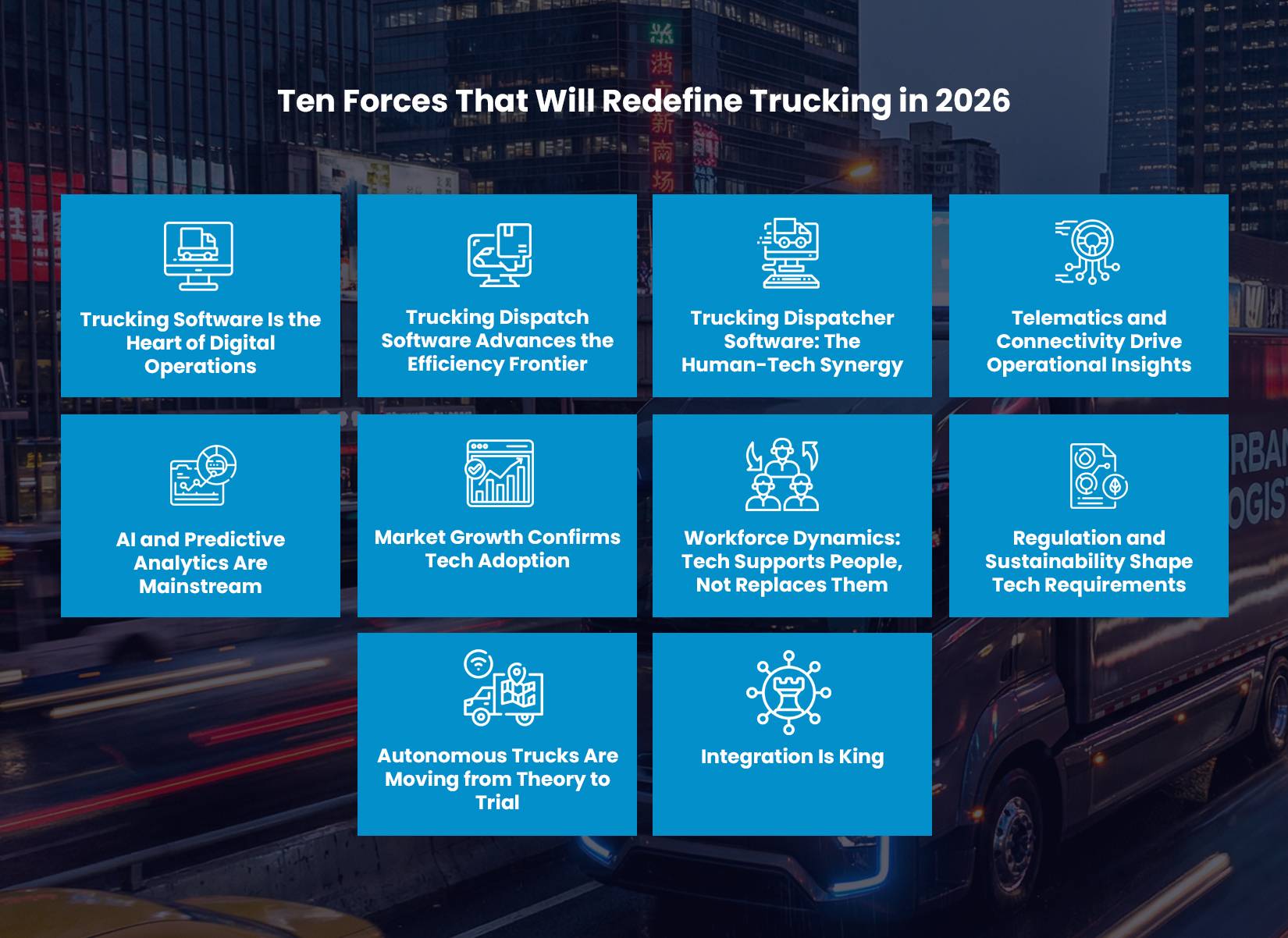
Ten Forces That Will Redefine Trucking in 2026
1. Trucking Software Is the Heart of Digital Operations:
Fleets of all sizes are embracing software to streamline workflows that were once paper-heavy and chaotic. Modern trucking software goes far beyond basic tracking or electronic logs, it integrates real-time telematics, predictive analytics, route optimization, compliance, and customer visibility into a cohesive platform.
Key takeaway: Logistics tech is now the operating system of a truck fleet, touching everything from safety to customer satisfaction.
Why It Matters
– Fleets leveraging advanced dispatch systems improve turnaround times and utilization.
– Software reduces idle time, cuts down manual processes, and brings clarity to complex route decisions.
2. Trucking Dispatch Software Advances the Efficiency Frontier:
One subset of trucking dispatch software, is driving tangible performance improvements in 2026.
Dispatch tools now fuse AI, live telematics, weather data, and traffic insights to optimize routes dynamically. This isn’t simple “optimization”, it’s real-time decision automation that reshuffles assignments on the fly to minimize delays and cut costs.
Hard Numbers You Should Know
– AI-driven dispatching can boost on-time delivery rates by 10–15 percentage points over traditional methods.
– Automated dispatch systems reduce planning time from hours to minutes.
These aren’t incremental gains, they compound into meaningful operational advantages.
3. Trucking Dispatcher Software: The Human-Tech Synergy:
Trucking dispatcher software empowers dispatch teams to make faster, more informed choices. Rather than replacing dispatchers, it augments their capacity. Think of it as a cognitive turbocharger:
– It analyzes load boards, driver hours, shipment urgency, and vehicle status.
– It cross-references this with live data to recommend the best possible decisions.
– Frees dispatchers from mundane tasks so they can focus on exceptions and strategy.
By elevating human judgment with data, trucking dispatcher software reduces errors, cuts cycle times, and increases revenue opportunities.
4. Telematics and Connectivity Drive Operational Insights:
Connected trucks aren’t futuristic, they’re the baseline expectation in 2026. Fleets are installing advanced sensors that feed real-time engine, driver behaviour, and environmental data back into trucking software platforms.
What This Enables
– Near-real-time fuel consumption and waste alerts.
– Predictive maintenance before costly failures.
– Safety coaching based on actual behavior patterns.
Smart telematics give fleets actionable insights rather than just historical dashboards.
5. AI and Predictive Analytics Are Mainstream:
AI adoption in trucking isn’t a gimmick, it’s measurable value creation:
– About 65% of trucking companies now use some form of AI to optimize operations.
– Predictive maintenance can decrease downtime by up to 30%.
– AI improves ETA accuracy and reduces planning cycles dramatically.
This means fleets that lean into AI see concrete improvements, shorter delivery windows, fewer unplanned breakdowns, and cost savings that show up on the bottom line.
6. Market Growth Confirms Tech Adoption:
Statistics tell a compelling story about investment direction:
– The global truck dispatch software market is projected to grow at a 9.35% CAGR from 2026 to 2032.
– Cloud-based solutions dominate nearly half of the market, showing a clear preference for scalable, SaaS-style deployments.
These figures confirm that software adoption isn’t a fad, it’s market consensus.
7. Workforce Dynamics: Tech Supports People, Not Replaces Them:
Driver shortages and turnover continue to challenge fleets. Even in 2026, drivers remain essential. What’s changing is how drivers and dispatchers work with technology:
– Software reduces tedium and lets personnel focus on strategic tasks.
– AI doesn’t replace drivers; it helps dispatchers and planners make better decisions faster.
In fact, industry insights suggest that jobs tied to human interaction, strategic planning, relationship management, and customer service, will remain resilient.
8. Regulation and Sustainability Shape Tech Requirements:
Compliance isn’t optional, it’s baked into software platforms.
From electronic logging to emissions reporting, trucking software for logistics now includes workflows that ensure regulatory adherence. This protects fleets from fines and operational headaches.
At the same time, pressure for sustainability driven by emission standards and customer expectations, means dispatch tools and telematics must support energy-efficient routing and reporting.
9. Autonomous Trucks Are Moving from Theory to Trial:
Completely driverless rigs aren’t mainstream yet, but development is accelerating. Partnerships between hardware innovators and software platforms are making autonomous operations schedulable and manageable within existing systems.
This means that in 2026, fleet leaders should view autonomy as a phased integration — not an overnight switch.
10. Integration Is King:
Silos are out, integration is in. Fleets want:
– TMS that speaks to telematics.
– Dispatch modules that connect to maintenance and compliance tools.
– APIs that let best-of-breed systems share data effortlessly.
The result? A unified trucking software for logistics ecosystem that drives efficiency and reduces friction.
Conclusion
Trucking in 2026 will favor fleets that operate with intelligence, not just scale. As complexity rises, the role of advanced trucking software, trucking dispatch software, trucking dispatcher software, and integrated trucking software for logistics will be central to controlling costs, improving delivery performance, and maintaining reliability.
LogiNext equips fleet leaders for this next phase of trucking. With AI-driven dispatching, real-time visibility, and scalable logistics intelligence, LogiNext helps fleets stay agile, compliant, and future-ready, today and beyond. So, click on the red button bellow and book a demo with LogiNext.
21

|

|

|




@LogiNext