




Highway Blockades: How Smart Dispatch Software Helps Fleets Survive Protest Disruptions
Highway protests have become a defining feature of modern social movements. From climate activism on California freeways to trucker demonstrations across the Midwest, blockades have turned major U.S. road networks into slow-moving parking lots. To logistics teams, this isn’t just an inconvenience. It is a direct hit at service levels, fuel budgets, delivery timelines, and customer trust. Thereby signaling a need for dispatch software.
Road transport has always been vulnerable to public unrest. But the frequency, scale, and unpredictability of such events have risen sharply in recent years. According to the U.S. Department of Transportation, unplanned road disruptions-including protests-jumped 22% between 2022 and 2024. For fleets already stretched thin by labor shortages and congestion, blockades add another layer of chaos.
This is where new generation of intelligent steps in. Modern-day dispatch software, especially AI-driven dispatch software, changes the way how fleet handle sudden disruptions. The right platform turns uncertainty into controlled action. Making sure the wheels keep turning even when the highway doesn’t.
When Highways Turn Into Flashpoints

Highway protests seem to happen at the worst time. Morning peak hours. Holiday shipping windows. Big retail events. In 2023, Los Angeles saw repeated climate protests blocking I-110 and I-5, two critical for freight moving from the port inland. Some of these disruptions stretched well beyond an hour, stranding trucks and creating secondary congestion. This forced dispatchers to improvise under pressure.
Fleets typically face three major challenges during these events:
1. Zero Visibility Into the Situation:
Most highway protests strike without warning. Dispatchers have to interpret incomplete information coming in from drivers, news alerts, and traffic dashboards. This slows decision-making during the minutes that matter most.
2. Route Diversions That Increase Costs:
Rerouting around city-center blockades adds 20-45 minutes per trip. Multiply that by 300 daily deliveries, and the financial impact becomes impossible to ignore. U.S. fleets currently lose $74.5 billion each year because of traffic congestion. Protests only push that number higher.
3. Customer Commitments Go Out the Window:
When trucks are sitting still, promised delivery windows stretch thin. Missed ETAs trigger refunds and failed SLAs, plus all the long-term consequences of negative customer experiences.
It’s simply not possible for traditional manual planning to keep pace with the pace or volatility of real-world disruptions. This is why fleets are shifting aggressively toward efficient dispatch software that adapts in real time.
The Rise of Smart Dispatching in a Disrupted World
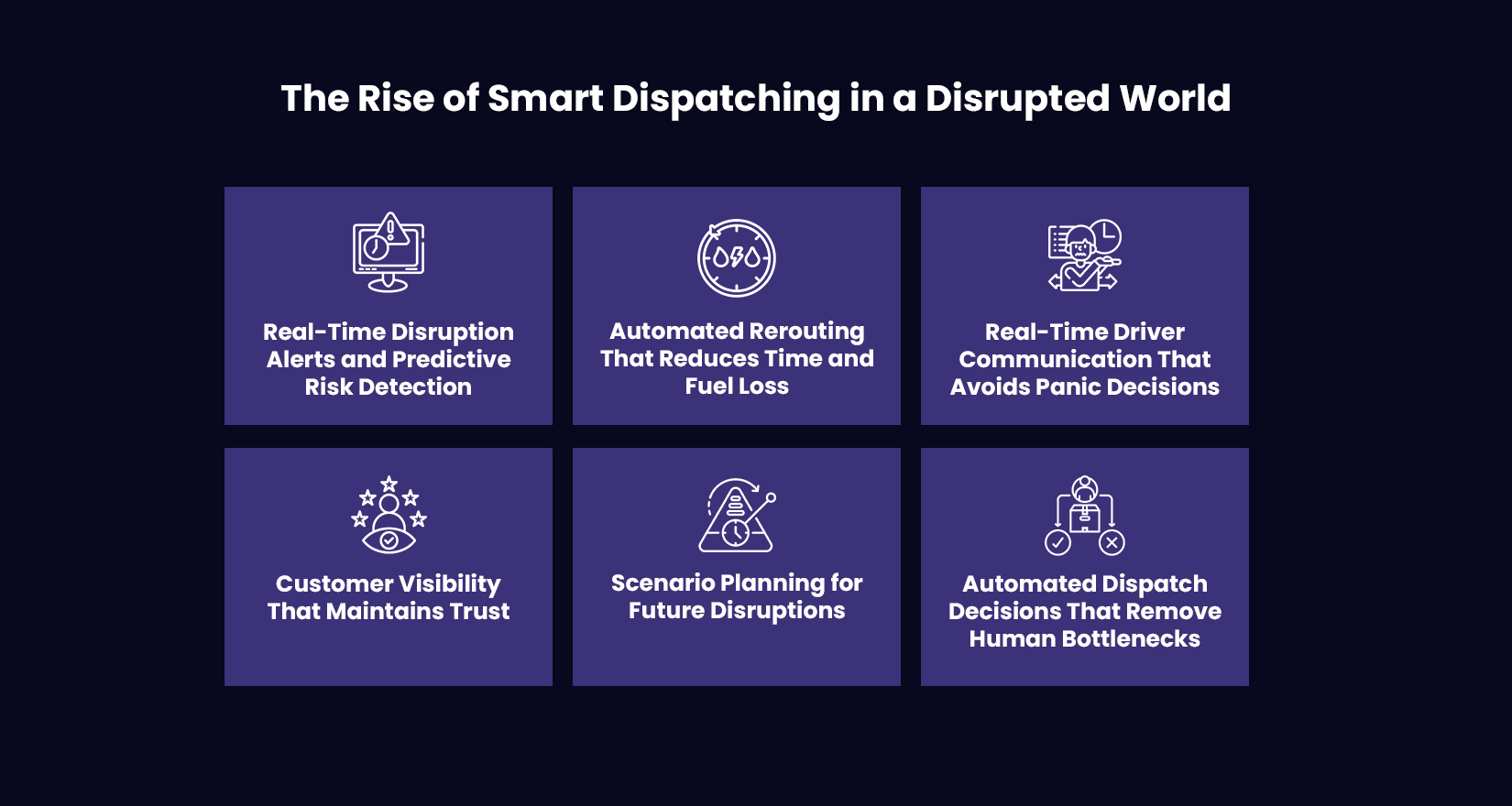
Ten years ago, dispatch systems were basically just glorified spreadsheets. But today, they are predictive, automated and adaptive. Perhaps the biggest leap comes with the integration of AI and Machine Learning. This lets the software analyze patterns, recommend rerouting and minimize disruptions during protests and other planned events.
Here’s how modern dispatch software powered by AI gives fleet an upper hand when highways shut down.
1. Real-Time Disruption Alerts and Predictive Risk Detection:
AI models consume vast streams of data-traffic sensors, social platforms, local news, GPS pings-and identify unusual congestion spikes associated with protests. And dispatchers receive early-warning alerts before drivers have even hit the bottleneck.
Even a 10-15-minute detection window gives the fleets an opportunity to reroute proactively instead of reactively.
Smart systems can also predict where similar disruptions might emerge. For example, if they protest chatter trends around New York’s FDR Drive, the software flags potential hotspots and suggests alternate planning for the next shift.
2. Automated Rerouting That Reduces Time and Fuel Loss:
During a blockade, every second counts. AI-based route engines simulate hundreds of alternatives simultaneously. The software evaluates:
– Distance.
– Congestion levels.
– Fuel impact.
– Road restrictions.
– Driver duty hours.
In a matter of seconds, it produces an optimized alternative that limits disruption throughout the network.
Fleets that have made the switch to AI-driven dispatch software report an average 18% reduction in disruption-related delays and as much as 12% lower fuel consumption. Those savings add up quickly when 50+ trucks hit a protest wall.
3. Real-Time Driver Communication That Avoids Panic Decisions:
In customary operations, drivers facing a blockade usually make decisions on their own: U-turns, hazardous shortcuts, unapproved detours. This creates safety issues and inconsistent performance.
Modern platforms now allow instant, step-by-step navigation updates to drivers via their mobile apps. Dispatchers remain fully in control. Drivers remain calm, informed, and guided.
4. Customer Visibility That Maintains Trust:
Transparency is expected by customers today, even when the world outside isn’t predictable. The right efficient dispatch software auto-adjusts ETAs and updates customers through:
– SMS.
– Email.
– Live trackers.
– Customer portals.
A Midwest logistics survey during the 2024 Chicago protest blockades reported that companies with dynamic ETA recalibration received 32% fewer customer support calls.
Being transparent about delays, and with real-time data backing up that transparency, keeps customer satisfaction from taking a hit.
5. Scenario Planning for Future Disruptions:
Highway protests aren’t going anywhere. AI systems learn from every event. Platforms can simulate:
– Port shutdowns.
– Fuel shortages.
– Climate rallies.
– Labor strikes.
– Political demonstrations.
In each simulation, the dispatch managers learn how many routes are in jeopardy, where capacity needs to shift, and how fast the network can recover. This forecasting capability turns crisis response into strategic preparation.
6. Automated Dispatch Decisions That Remove Human Bottlenecks:
Manual decisions slow down teams when chaos hits. AI removes friction by:
– Assigning the best driver for diverted routes.
– Automatic load rebalancing.
– Adjusting delivery priorities
– Optimizing fleet capacity.
This level of automation makes AI-powered dispatch software the most valuable tool in a dispatcher’s arsenal. The system acts in seconds-far faster than humans trying to triage the crisis through calls and spreadsheets.
Why Fleets Can’t Afford to Ignore Smart Dispatch Tools
Fleets have traditionally underestimated how quickly small disruptions compound into operational losses. Consider this:
– A 30-minute protest delay for 50 trucks equals 25 hours of lost fleet time.
– Fuel burn increases on detours by 8–15%.
– Missed customer ETAs can reduce repeat business by up to 20%.
Multiply this across a month of recurring protests, and the financial impact becomes staggering.
That’s why U.S. fleets, but especially those operating in major metro corridors, are adopting powerful dispatch solutions at record speed. Smart tools turn unpredictable street-level disruptions into manageable, data-driven decisions.
Final Thoughts: Protests May Be Unpredictable, but Your Fleet Doesn’t Have to Be
Highway protests will continue to erupt driven by social, environmental, and political movements. While logistics leaders can’t control these events, they can control how fleets respond to them.
Dispatch software is no longer a “nice-to-have tech upgrade.” It’s a critical shield against operational chaos. With AI-powered dispatch software, real-time rerouting, predictive alerts, better communication, and automated decisions, the fleets can keep service levels intact, even when the highway becomes a battleground.
In a world where disruption is the new normal, resilience belongs to those that plan smarter, respond faster, and operate with intelligence, not guesswork. If you’re ready to turn uncertainty into an advantage, book a demo with LogiNext and see how real control feels.
51

|

|

|




@LogiNext