





Geocoding Intelligence That Reduces Exceptions Before They Happen
In modern logistics management, most leaders focus on routing optimization, fleet visibility, and driver productivity. Yet delivery exceptions continue to rise. According to industry reports, failed first-attempt deliveries can cost businesses 10–15% more per order, while address-related errors contribute to nearly 30% of last-mile exceptions in urban markets.
The issue is not always routing efficiency. It addresses reliability. An optimized route built on unreliable location data will still fail. The missing layer in many operations is intelligent geocoding and more importantly, visibility into geocoding confidence. This is where structured geocoding intelligence within logistics management software changes the equation.
The Hidden Risk in Traditional Geocoding
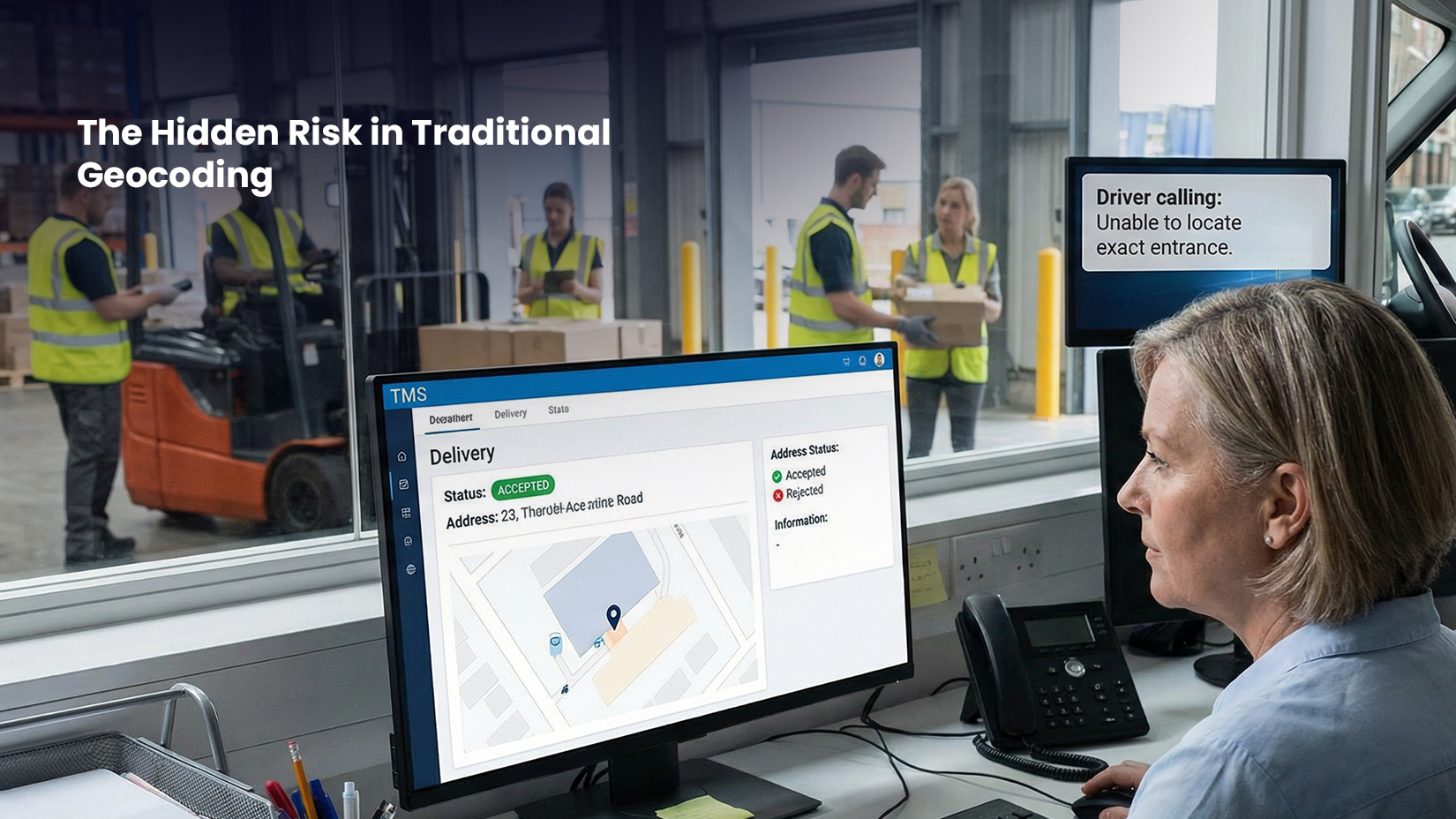
In most systems, addresses are treated in binary terms:
- Accepted
- Rejected
There is no operational nuance.
An address that is slightly ambiguous is treated the same as one that is perfectly accurate. It gets routed. It gets dispatched. And the issue only surfaces when the driver is already on the road.
This reactive approach creates predictable problems:
- Mid-route calls to dispatch
- Delayed deliveries
- Increased fuel consumption
- Customer dissasatisfaction
- Lower driver productivity
A 2023 supply chain benchmark study found that companies with poor address validation processes experience up to 18% higher operational costs in last-mile delivery.
The root cause is simple: geocoded data is invisible and ungoverned. True logistics management requires more than mapping. It requires knowing which addresses can be trusted.
The Four Geocoding Status Indicators
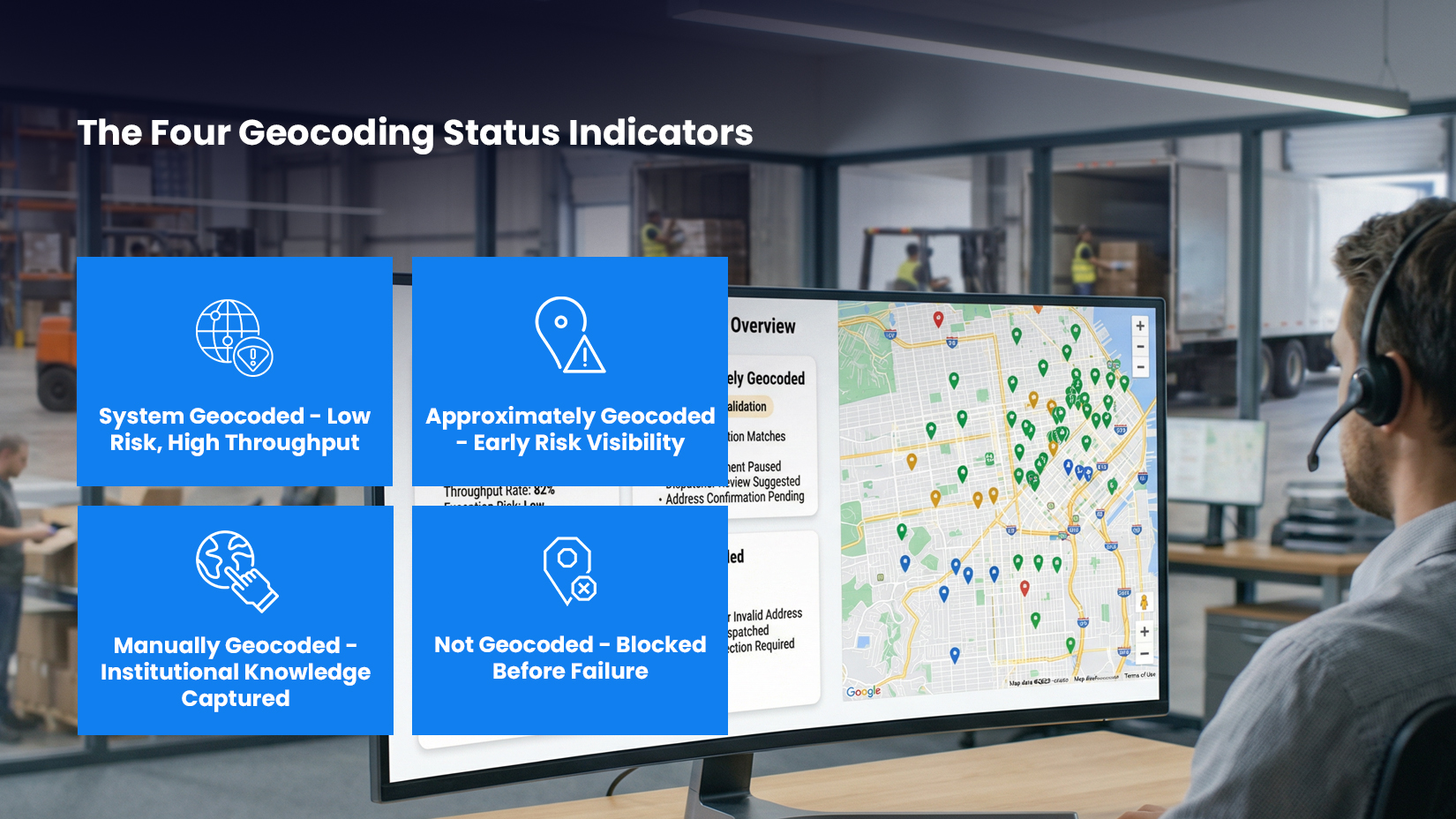
Modern delivery management platforms categorize addresses into four operational statuses. Each status reflects a different level of confidence and required intervention.
1. System Geocoded – Low Risk, High Throughput
These addresses match exact coordinates and require no review.
Characteristics:
- Auto-assigned
- Included in trip planning by default
- No manual intervention required
Operational Impact:
- Minimal dispatcher involvement
- No driver clarification calls
- High delivery predictibility
For enterprises handling thousands of daily orders, even a 5% increase in high-confidence geocoded addresses can significantly reduce exception rates. System geocoded addresses enable scale without adding operational overhead.
2. Approximately Geocoded – Early Risk Visibility
In this category, the system identifies multiple possible matches. Instead of silently accepting ambiguity, the platform flags it.
Intelligent delivery management workflows may:
- Trigger automated address confirmation messages
- Allow dispatcher review before routing
- Pause auto-assignment until validated
This early intervention model prevents mid-route surprises.
Research shows that resolving delivery issues before dispatch can reduce exception handling costs by up to 40%. When ambiguity is surfaced during planning, corrective action is simple. When discovered on the road, it is expensive.
Approximately geocoded addresses introduce structured risk management into logistics management.
3. Manually Geocoded – Institutional Knowledge Captured
Certain delivery locations are inherently complex:
- Industrial parks
- Special Economic Zones (SEZs)
- Large industrial clusters
- Warehouse compunds with multiple entrances
In traditional systems, drivers resolve these manually every time. Knowledge stays in people’s heads.
Advanced logistics management software captures these adjustments permanently. When a driver refines a pin or confirms coordinates, the system stores it as manually geocoded. Future orders reuse the verified data.
Operational impact:
- No repeated confusion
- Reduced delivery dependency
- Network-wide learning
Over time, manually geocoded entries improve the overall geocoding accuracy rate. This creates cumulative operational intelligence.
In large delivery networks, even a 1% monthly improvement in address precision can significantly lower long-term exception rates.
4. Not Geocoded – Blocked Before Failure
Some addresses are incomplete, poorly formatted, or pulled from legacy systems. Instead of allowing them into routing, intelligent systems block them.
They cannot be auto-assigned. They cannot be dispatched. This proactive constraint prevents guaranteed delivery failures.
In reactive models, such addresses only surface after dispatch. In predictive logistics management, they are resolved in planning. Blocking flawed data may seem restrictive. In reality, it protects operational reliability.
Why Geocoding Intelligence Matters in Logistics Management
Modern logistics management is no longer about moving goods. It is about controlling variability.
Address accuracy directly influences:
- Route optimization effectiveness
- Driver productivity
- Customer satisfaction scores
- Cost per delivery
- On-time performance
If 20% of addresses require clarification, route efficiency drops regardless of algorithm sophistication.
This is why advanced geocoding within logistics management software is becoming essential. Geocoding is not a map feature. It is a risk management layer.
Closing the Loop: Continuous Data Improvement
The true power of intelligent geocoding lies in feedback.
Every delivery generates location intelligence. Modern delivery management systems close the loop by:
- Capturing driver-confirmed coordinates
- Allowing dispatcher corrections
- Enabling customer validation via automated communication
- Updating future orders automatically
Each successful delivery refines future planning. Over time, address quality improves month over month- without additional operational cost. This feedback-driven model transforms static geocoded data into a dynamic operational asset.
From Technical Process to Governance Control
In many organizations, geocoding is treated as an IT configuration step. It sits in the background.
However, in advanced logistics management environments, geocoding becomes governed.
Leaders gain visibility into:
- Percentage of system geocoded orders
- Rate of approximately geocoded addresses
- Frequency of manual corrections
- Volume of blocked addresses
These metrics offer a direct leading indicator of delivery exception risk. Instead of waiting for KPI failures, operations teams can monitor geocoding health as a predictive signal. This governance approach aligns address reliability with strategic delivery management goals.
The Business Impact
Organizations that integrate structured geocoding intelligence into logistics management software typically experience:
- Reduced first-attempt failure rates
- Fewer dispatcher interventions
- Lower customer complaint volumes
- Improved route adherence
- Increased driver efficiency
According to last-mile optimization studies, reducing address-related uncertainty can improve on-time performance by 8-12%.
More importantly, improvements compound. As more addresses become reliably geocoded, the network stabilizes. Predictability increases. Scalability becomes achievable without proportional cost increases.
Also Read: LogiNext and the Hidden Cost of Invisible Friction in Modern Logistics Software
Conclusion
Delivery exceptions rarely start on the road; they originate in planning, often at the address level. Effective logistics management goes beyond route optimization and demands confidence in foundational data. Without reliable geocoding, even the best delivery management strategy remains vulnerable to preventable disruptions.
Structured geocoded status indicators bring predictive control to operations, ensuring clarity before dispatch. As networks scale, trusted address intelligence becomes mission-critical. Discover how LogiNext strengthens your logistics management with smarter geocoding built for precision and scale. Click on the red button to know more.
In an industry where margins are tight and execution speed defines competitiveness, removing invisible friction is not a cosmetic improvement. It is a strategic advantage, hidden in plain sight. See how LogiNext’s role-aware, multi-user logistics platform turns everyday execution into a competitive advantage. Click on the red button to know more.
19

|

|

|




@LogiNext