





Choosing Logistics Management Software: From Needs to the Right Fit
Buying logistics management software can feel like shopping for a Swiss Army knife. The feature list keeps growing, every vendor promises smarter operations, and suddenly everyone wants AI.
But there is a problem: technology cannot fix a problem you have not clearly defined.
Before evaluating platforms, logistics leaders need to understand where their operation is struggling, which decisions need improvement, what constraints the technology must handle, and how success will be measured. This matters even more as logistics technology becomes more sophisticated. Gartner reports that 94% of supply chain logistics leaders either already have a transportation management system or plan to deploy one within the next one to two years.
So, before asking “Which platform should we buy?”. Ask a better question: “What exactly do we need the technology to solve?”
Key Takeaways
- Define the logistics problem before selecting technology.
- Convert business problems into specific, measurable technology requirements.
- Evaluate AI based on the decisions it improves, not the label attached to it.
- Look for technology that connects planning, execution, visibility and action.
- Test platforms against real operational scenarios, not just demonstrations.
- Measure success through business outcomes rather than implementation alone.
What Problem Are You Actually Trying to Solve?
The first mistake is surprisingly easy to make: choosing a technology category before defining the operational problem.
A company might say it needs route optimization. But is the real problem excessive mileage, poor vehicle utilization, missed delivery windows, or planners spending hours manually building routes?
Those are different problems.
The same applies to visibility. A dashboard is not the objective. The objective might be identifying delayed deliveries early enough to intervene, predicting SLA risks, or giving customer service teams reliable answers.
A useful starting framework is:
Operational problem → Required decision → Business outcome → Technology capability
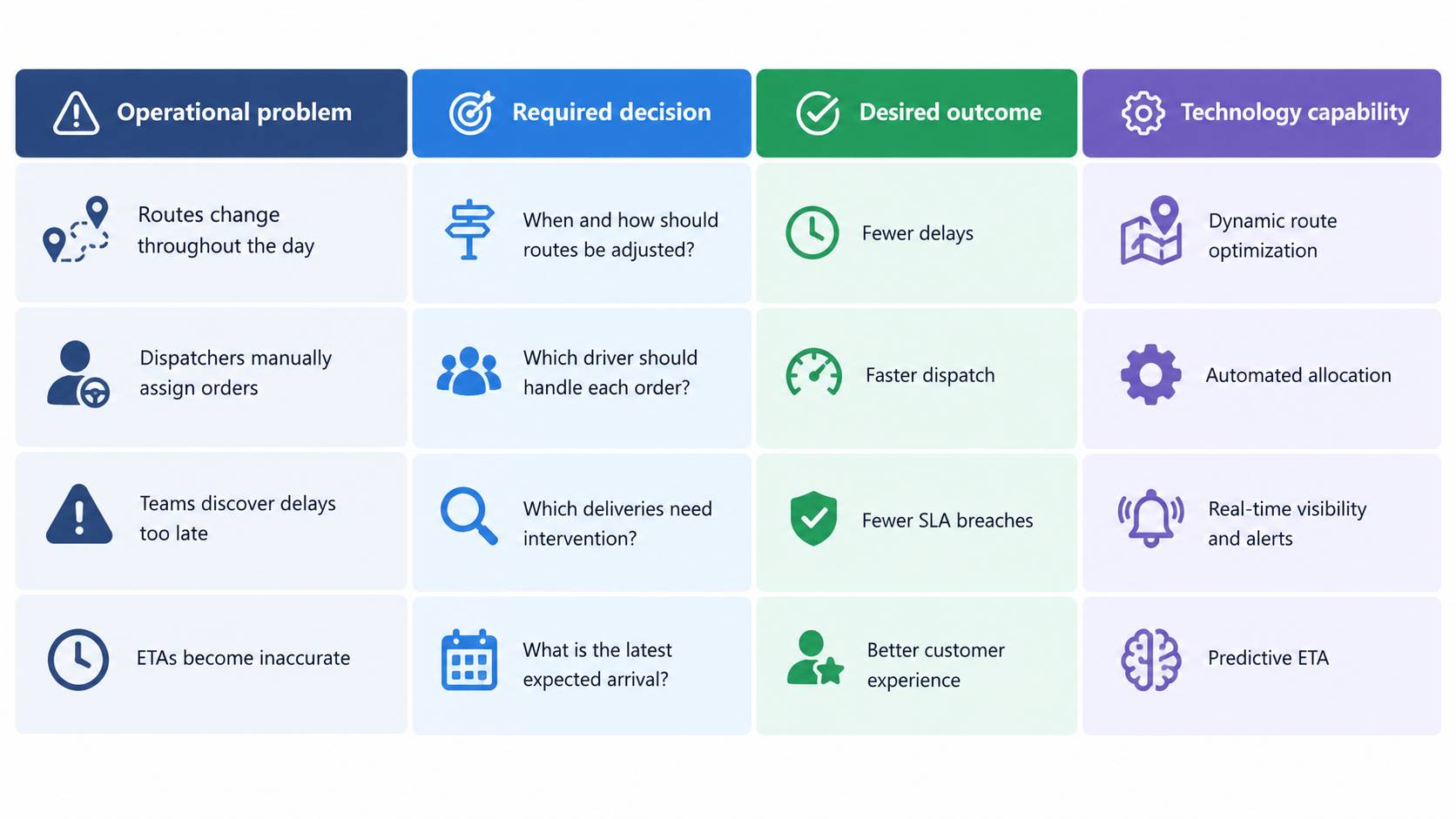
This prevents the classic mistake of buying a feature because it sounds impressive rather than because the operation actually needs it.
What Should Your Logistics Management Software Actually Be Able to Do?
Once the problem is clear, translate it into requirements that technology can actually satisfy. Avoid requirements such as:
- “We need AI”
- “We need real-time tracking”
- “We need automation
They sound good, but they are incomplete. Instead, define what the technology must do. For example:
Weak: We need AI-powered routing.
Better: The system should continuously optimize routes using delivery windows, vehicle capacity, driver constraints, traffic and changing operational conditions.
Weak: We need real-time visibility.
Better: Operations teams should be able to identify at-risk deliveries and take corrective action before an SLA is missed.
This distinction is becoming increasingly important. Gartner identifies decision intelligence as a major supply chain technology trend. Because it combines decision modeling, AI and analytics to support or automate decisions tied to business outcomes.
In other words, the interesting question is no longer simply “Does the software use AI?”. It is “What decisions does the AI improve?”
What Should Logistics Management Software Actually Do?
Once requirements are defined, technology evaluation becomes much easier. Modern logistics software should connect the decisions that happen across planning and execution rather than solve each one in isolation.
1. Plan Around Real-World Constraints:
Routes and schedules should account for factors such as delivery windows, vehicle capacity, driver availability, service areas and operational rules.
2. Automate Repetitive Decisions:
If planners repeatedly allocate orders, build routes or react to the same exceptions manually, those workflows are candidates for automation.
3. Stay Connected to Live Operations:
A plan created at 8 a.m. can become irrelevant by 10 a.m. Traffic, cancellations, failed attempts and new orders can change the situation. Technology should respond to those changes rather than simply report them.
4. Turn Visibility to Action:
Seeing a vehicle on a map is useful. Knowing that its current route creates an SLA risk, understanding why, and being able to intervene is much more valuable.
5. Measure the Outcome:
The platform should ultimately help answer questions around on-time performance, utilization, delivery costs, exceptions, productivity and customer experience. This is where LogiNext fits naturally into the conversation.
Its AI-native logistics platform brings planning, route optimization, dispatch, live tracking, exception handling and execution together across first, middle and last mile operations.
How Do You Know if a Logistics Platform Is Right for You?

Two logistics platforms can both claim to offer route optimization. That does not mean they solve the same problem equally well.
The better evaluation question is: Can this capability work within our actual operating environment?
Consider five areas:
- Constraints: Can the system account for the rules that govern your operation?
- Data: Can it work with the systems and data you already have?
- Scale: Can it handle your order volume, geography and operational complexity?
- Adaptability: Can it respond when conditions change?
- Outcomes: Can you measure whether the investment improved performance?
This matters because logistics technology is becoming increasingly sophisticated. McKinsey’s 2026 State of Digital Logistics Survey found that nearly 90% of shippers have adopted at least one transportation AI use case, while about 88% say their transportation AI and digital use cases have met or exceeded expectations.
The market is moving beyond experimentation. That makes choosing the right use cases more important, not less.
How Should You Measure the Success of Logistics Technology?

Before sitting through another 60-slide product demo, create a simple requirements scorecard.
Step 1: Define the Operational Problem
What is currently costing time, money, capacity or customer trust?
Step 2: Identify the Decision Behind It
Which decision is currently manual, delayed, inconsistent or reactive?
Step 3: Define the Required Capability
What must technology do to improve that decision?
Step 4: Set Measurable Outcomes
Choose KPIs before implementation. These could include:
- On-time delivery
- Route efficieny
- Vehicle utilization
- Dispatcher productivity
- SLA compliance
- Cost per delivery
- Exception resolution time
Step 5: Test the Technology Against Reality
Don’t just ask for a product walkthrough. Give vendors real operational scenarios.
- What happens when 200 orders arrive late?
- What happens when a driver becomes unavailable?
- If traffic disrupts an active route?
- What happens when a delivery is at risk of breaching its SLA?
The answers will tell you considerably more than a feature checklist ever will.
Frequently Asked Questions
1. What is logistics management software?
Logistics management software helps businesses plan, execute, monitor and optimize logistics operations. Depending on the platform, it can include route optimization, scheduling, dispatch, fleet tracking, delivery visibility, exception management and analytics.
2. What should I consider before buying logistics management software?
Start with your operational problems, required decisions, business constraints, integration requirements and measurable outcomes. Then evaluate whether a platform can address those requirements at your operational scale.
3. How do I measure the success of logistics software?
Define KPIs before implementation. Common measures include on-time delivery, vehicle utilization, route efficiency, dispatcher productivity, SLA compliance, operating costs and exception resolution time.
4. What makes LogiNext different?
LogiNext combines AI-native orchestration with planning, routing, dispatch, real-time visibility and execution capabilities. Its platform is designed to help enterprises coordinate complex first, middle and last mile logistics operations at scale.
Conclusion
The best logistics technology purchase is not necessarily the platform with the longest feature list. It is the one that solves the problems that matter most to your operation.
Define the problem. Identify the decision that needs to improve. Translate it into a measurable requirement. Then evaluate whether the technology can deliver the outcome at your actual scale and under your actual constraints.
That approach also changes how you think about AI. Instead of asking whether a platform has AI, ask where AI can make your logistics operation faster, smarter and more responsive.
LogiNext takes that approach further with an AI-native orchestration platform that connects planning, optimization, dispatch, visibility and execution across complex logistics networks. If you’re defining your requirements for a new logistics management software platform, explore how LogiNext can help turn those requirements into measurable operational outcomes.
 |  |  |




@LogiNext