




Why On-Demand Delivery Still Takes Two Days When the Product Is Just Two Miles Away
You order a phone charger at 9 a.m. The checkout page tells you it will arrive in two days. Out of curiosity, you check the retailer’s app and discover the exact product is available at a store less than two miles from your home. If on-demand delivery has become the standard for modern commerce, why are customers still waiting days for products that are practically around the corner?
The answer has very little to do with distance. It has everything to do with how on demand delivery works behind the scenes. Every order triggers dozens of operational decisions before a package even leaves the shelf. Businesses that make those decisions intelligently can deliver faster without increasing costs. Those that don’t often struggle to meet customer expectations despite having inventory close by.
The Product Isn’t Far Away. The Decision-Making Is.
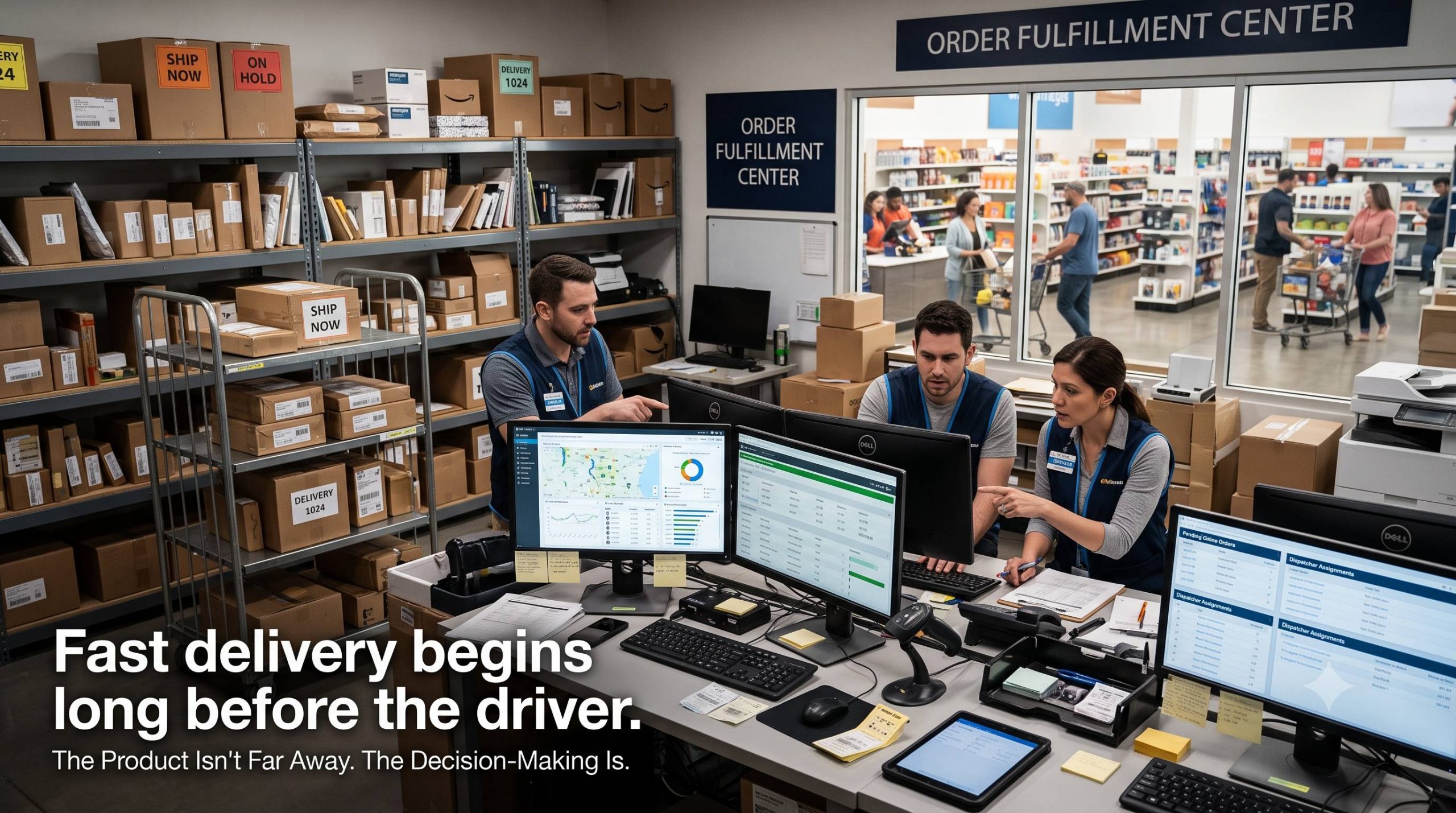
Customers often assume delivery starts when a driver picks up a package. In reality, delivery starts the moment an order is placed.
The system must answer a series of questions in seconds:
- Which store or warehouse should fulfill the order?
- Is the inventory actually available?
- Should the order be shipped individually or batched with others?
- Which driver has the right capacity?
- Can another fulfillment location complete the order more efficiently?
- Will fulfilling this order affect future demand in that location?
This is how on-demand delivery works in practice. The driver is only one part of the equation. The bigger challenge is making the right operational decisions before dispatch.
A poor decision at this stage can add hours or even days to delivery timelines, regardless of how close the inventory is.
Why the Nearest Store Isn’t Always the Fastest Option
Imagine a customer ordering a pair of running shoes from a nearby retail outlet. The store is only two miles away, but several factors could prevent it from fulfilling the order:
- The inventory shown online hasn’t been updated.
- The last pair has already been reserved for another customer.
- Store associates are busy serving walk-in shoppers.
- The location isn’t configured to process online orders efficiently.
- Another fulfillment center can bundle multiple nearby deliveries, reducing costs.
Suddenly, the “closest” store is no longer the smartest choice.
This is one of the biggest misconceptions about same day on-demand delivery. Physical proximity alone does not guarantee speed. Businesses must balance inventory availability, labor capacity, transportation costs, and customer commitments before assigning an order.
Understanding how on demand delivery works means recognizing that the fastest-looking option is not always the most efficient one.
Every Delivery Begins With Hundreds of Micro-Decisions
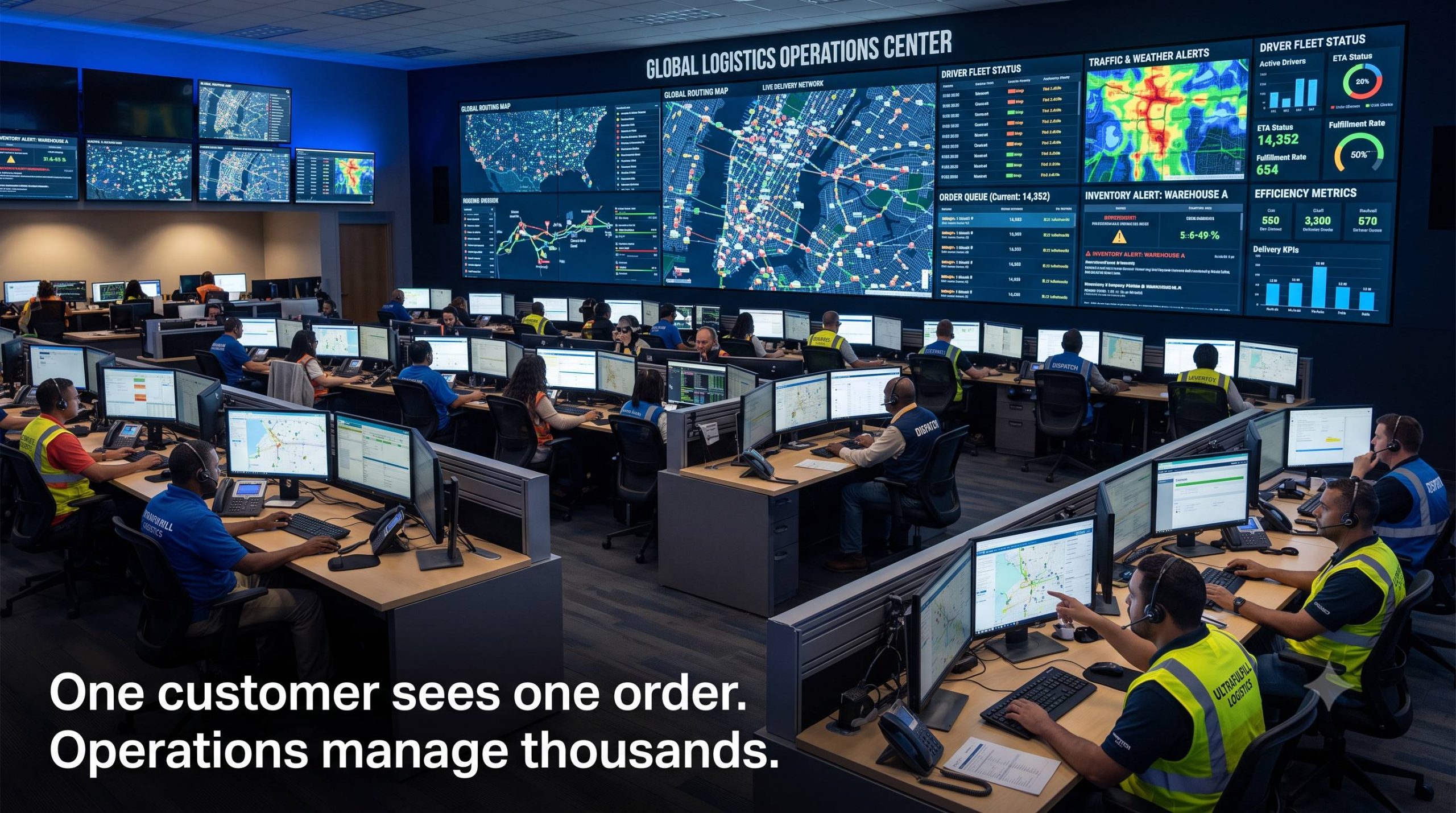
Customers see one package. Operations teams see thousands of moving parts.
Every hour, retailers process hundreds or even thousands of orders, each competing for inventory, vehicles, drivers, and delivery windows.
Now imagine a typical afternoon.
A customer orders groceries for immediate delivery. Another orders electronics with next-day shipping. A pharmacy receives an urgent prescription request. A restaurant experiences a sudden spike in dinner orders.
Treating every order as equally urgent creates congestion rather than efficiency. This is where intelligent order allocation becomes critical.
Instead of assigning orders based only on distance, businesses evaluate multiple variables simultaneously:
- Driver availability
- Vehicle capacity
- Delivery commitments
- Traffic conditions
- Inventory levels
- Predicted future demands
- Existing delivery routes
The goal isn’t simply to deliver one package faster. The goal is to optimize the entire delivery network.
This is why leading organizations invest in on demand delivery software capable of making thousands of allocation decisions in real time. Manual dispatch simply cannot keep pace with today’s order volumes.
Speed Without Intelligence Becomes Expensive
Many businesses assume the solution to faster deliveries is simple: hire more drivers. Unfortunately, that often creates new problems.
More drivers can increase idle time during slower periods. More vehicles can increase operating costs. And more delivery routes can reduce overall efficiency if orders are poorly distributed.
According to Capgemini, the last mile can account for more than 50% of total shipping costs, making it the most expensive part of the fulfillment journey. Improving speed without improving decision-making can quickly erode profit margins.
Instead of asking, “Who is closest?”
Leading organizations ask:
- Which fulfillment point minimizes total network cost?
- Which delivery route serves multiple customers efficiently?
- Which assignment protects service levels for future orders?
- Which decision keeps the network balanced over the next several hours?
These are fundamentally different questions.
This is why real-time delivery optimization has become essential for businesses managing high delivery volumes. Every decision influences the next one, creating either a smoother operation or a growing backlog.
AI Is Changing How On-Demand Delivery Works
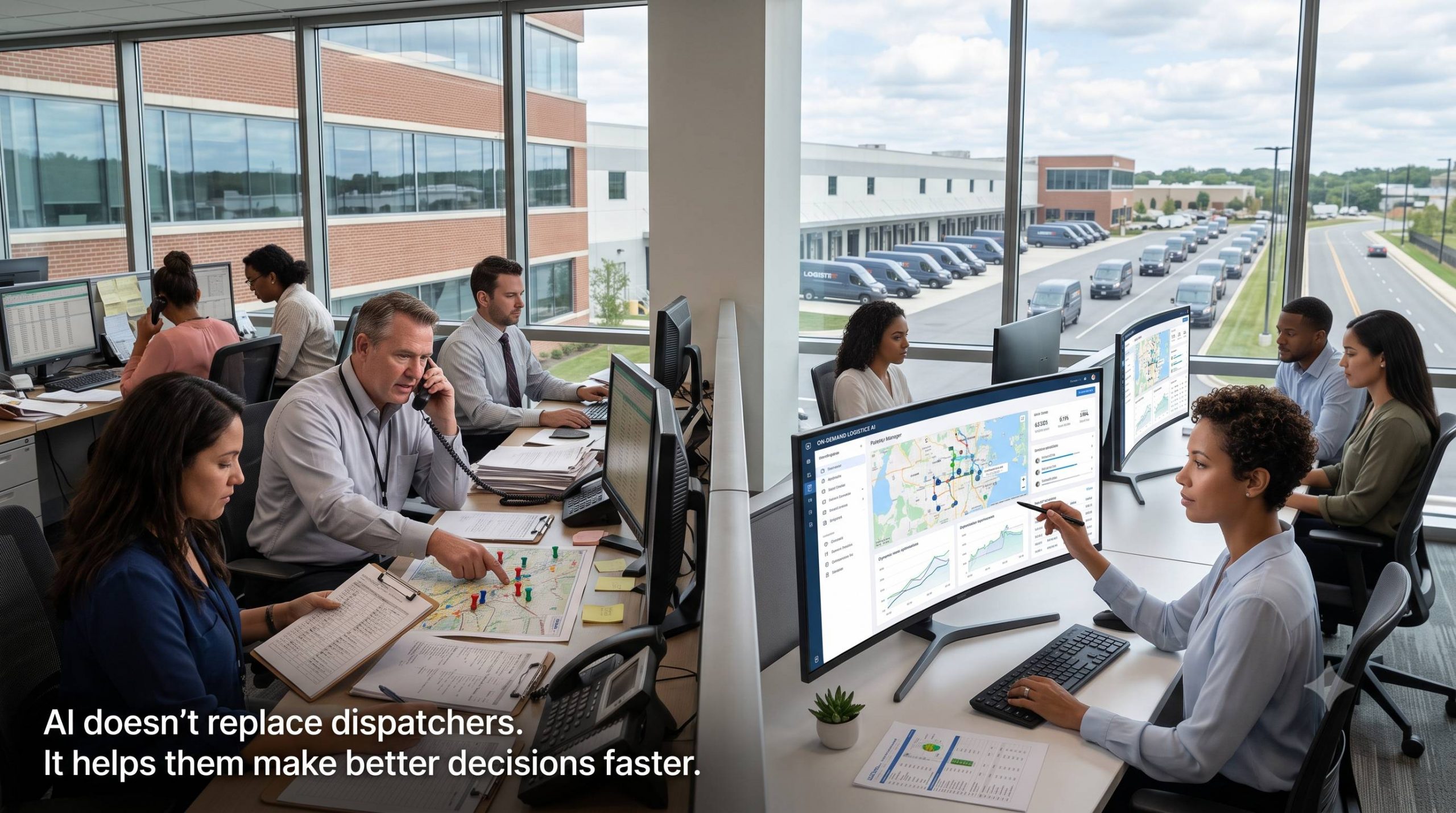
Modern logistics networks are too dynamic for static rules.
Traffic changes every minute. Drivers complete deliveries ahead of schedule. Inventory updates continuously. New customer orders arrive every few seconds. Static planning cannot keep up.
This is where AI-powered on demand delivery creates a measurable advantage.
Instead of relying on predefined rules, AI continuously analyzes live operational data to recommend better decisions.
It can:
- Allocate orders dynamically.
- Predict delivery delays before they occur.
- Recommend the most efficient fulfillment location.
- Balance driver workloads.
- Continuously improve ETAs.
- Adjust routes as conditions change.
McKinsey has highlighted that AI-driven logistics can significantly improve operational efficiency by enabling smarter planning, better asset utilization, and faster decision-making across supply chains.
The result isn’t simply faster deliveries. It is a delivery network that adapts in real time.
This is why businesses investing in AI-powered on demand delivery are increasingly outperforming competitors that rely on manual dispatch or fixed routing logic.
Building an On-Demand Delivery Network That Keeps Its Promise
Customer expectations have changed.
People no longer compare your delivery experience with your direct competitors. They compare it with the fastest experience they’ve ever had.
That means businesses must think beyond drivers and delivery vehicles.
Reliable same day on demand delivery depends on synchronized inventory, intelligent fulfillment, automated dispatch, accurate ETAs, and continuous optimization working together.
Businesses also need scalable on demand delivery software that can orchestrate every stage of the journey, from order placement to doorstep delivery.
The companies winning today are not necessarily the ones with the largest fleets or the most warehouses. They are the ones making better decisions, faster.
Conclusion
The next time a customer wonders why a product sitting two miles away still takes two days to arrive, the answer probably isn’t distance.
It’s orchestration.
Fast delivery is no longer defined by how close inventory is to the customer. It’s defined by how intelligently businesses allocate orders, manage inventory, dispatch drivers, and respond to changing conditions in real time.
That’s exactly where LogiNext makes the difference. With AI-powered orchestration, intelligent order allocation, and real-time delivery optimization, LogiNext helps enterprises transform fragmented delivery operations into agile, high-performing networks that consistently meet customer expectations.
15

|

|

|




@LogiNext