




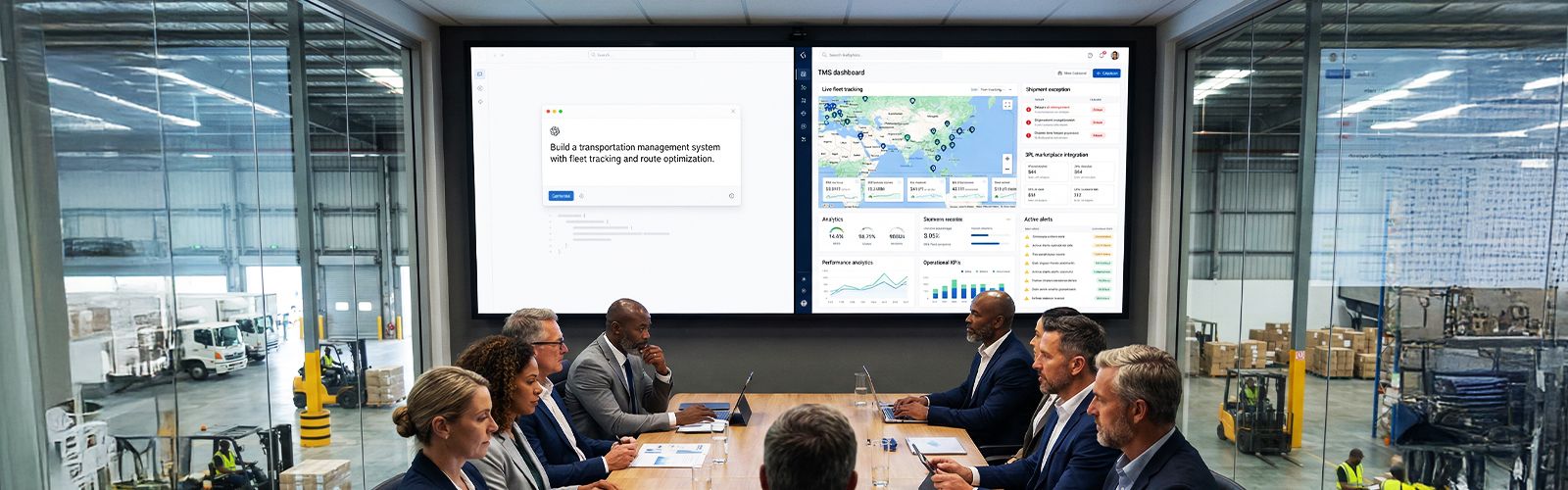
Should You Really Vibe Code Your Transportation Management System?
“Vibe coding” is having a moment. Thanks to generative AI, developers—and increasingly, business teams, can now build software by describing what they want in plain language. No heavy specs. No months of development. Just prompts, iterations, and speed. As this approach gains traction, logistics leaders are beginning to ask whether a Transportation Management System (TMS) can also be built this way.
So the question naturally pops up in logistics boardrooms and tech teams alike: should you really vibe code a TMS? You can, but whether you should is where things get interesting. To answer that, we need to look at the scale, complexity, and expectations placed on a modern system in real-world logistics operations.
First, What Does a Transportation Management System Really Handle?
A Transportation Management System is not a lightweight workflow tool. It sits at the core of transportation management, orchestrating:
- Route planning and optimization
- Carrier selection and freight rating
- Load consolidation
- Dispatch and execution
- Real-time tracking and visibility
- Compliance and documentation
- Freight audit and payment
- Analytics, reporting, and cost control
According to Gartner, transportation costs account for 50–60% of total logistics spend in many enterprises. That alone explains why transportation management software is mission-critical, not experimental.
A modern transportation management solution must handle thousands of shipments, integrate with ERPs, WMS, telematics, and customer systems, and operate with near-zero tolerance for failure.
That’s the baseline. Now let’s talk about vibe coding.
What “Vibe Coding” Actually Means in Practice
Vibe coding typically refers to using AI tools to generate application logic, workflows, or even full products using natural language prompts instead of traditional development cycles.
In theory, you could prompt an AI to:
- “Build a TMS dashboard”
- “Create a shipment allocation engine”
- “Optimize routes using real-time traffic”
And the AI would comply fast.
This approach is already being used for internal tools, MVPs, and proofs of concept. The appeal is obvious:
- Faster time to build
- Lower upfront engineering effort
- Rapid extermination
But transportation management is not a sandbox problem. It’s a production-grade, high-stakes environment.
Where Vibe Coding Works for a TMS
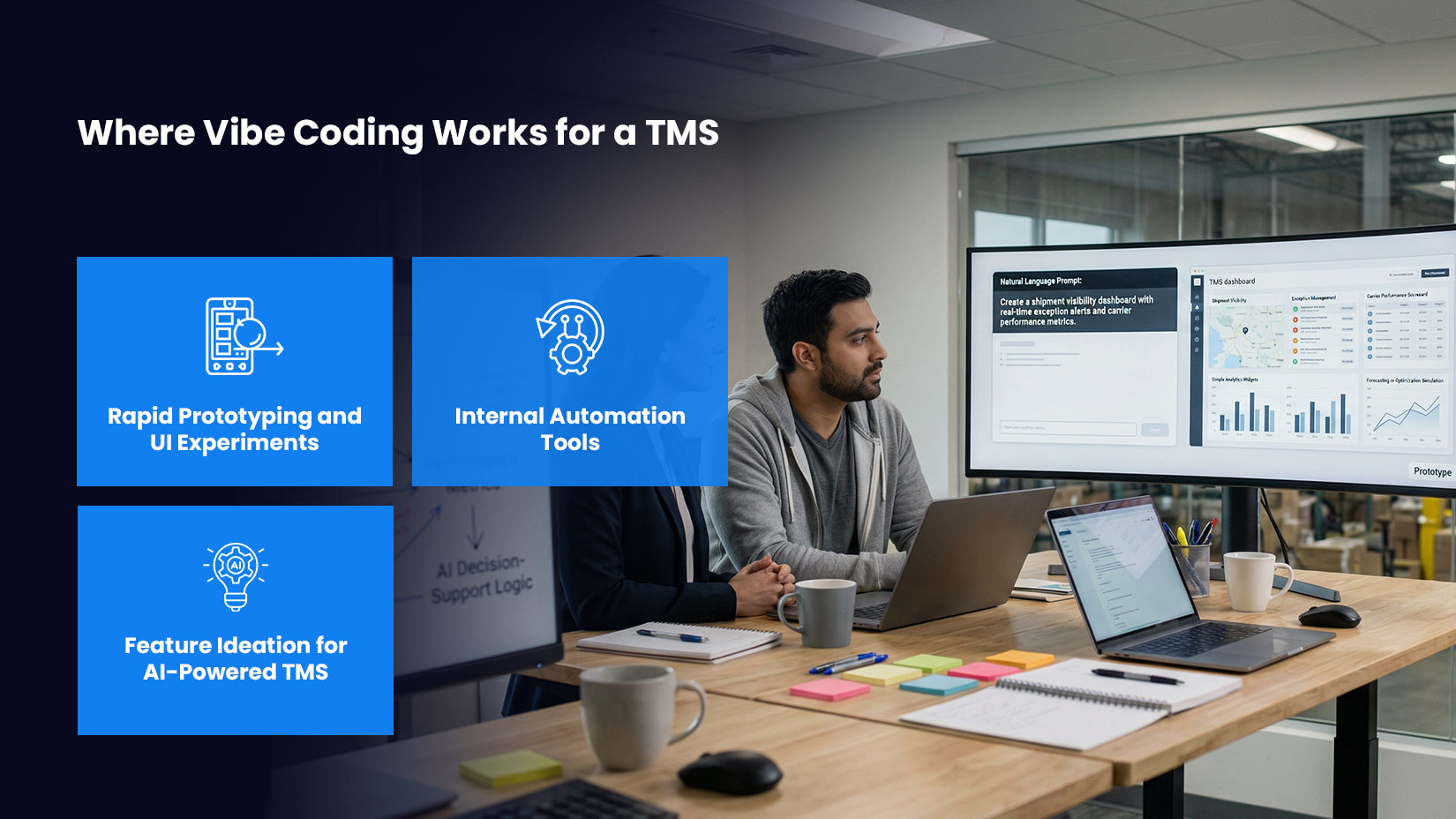
Let’s be fair. Vibe coding does have valid use cases inside a Transportation Management System ecosystem.
1. Rapid Prototyping and UI Experiments:
Need to test a new shipment visibility dashboard or exception management screen? Vibe coding can accelerate design and validation before committing to full-scale development.
2. Internal Automation Tools:
Lightweight tools like carrier performance scorecards or ad-hoc reporting layers can be built quickly using AI-assisted development.
3. Feature Ideation for AI-Powered TMS:
For teams building an AI powered transportation management system, vibe coding can help simulate optimization logic, forecasting models, or decision-support tools at an early stage.
In these scenarios, vibe coding acts as a catalyst, not the foundation.
Where Vibe Coding Breaks Down Fast
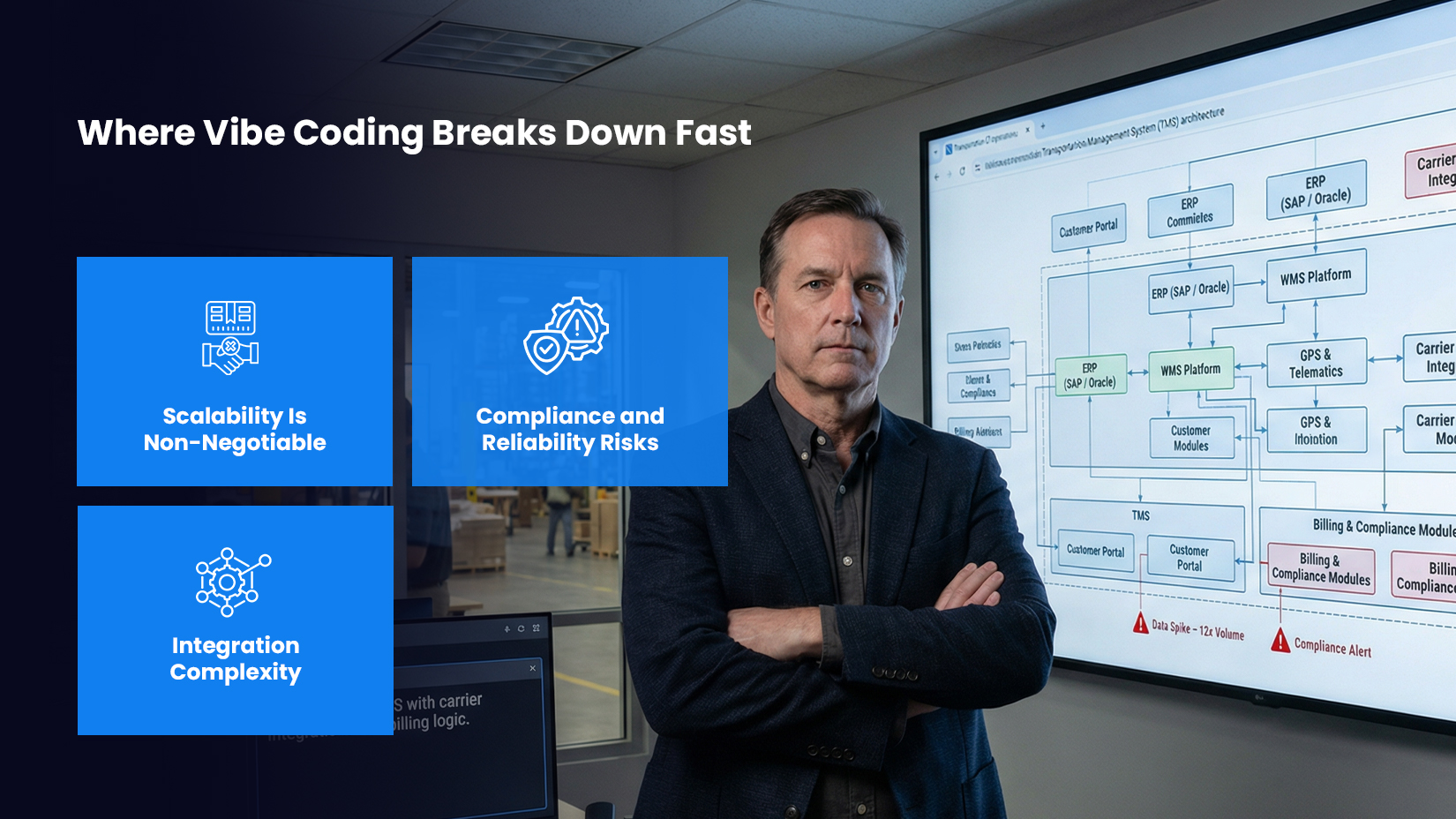
This is where reality hits.
1. Scalability Is Non-Negotiable:
An enterprise Transportation Management System processes millions of data points daily. AI-generated code often lacks the architectural rigor needed for performance at scale.
A McKinsey study found that logistics platforms operating at scale must handle 10–100x data spikes during peak seasons. Vibe-coded systems rarely account for this upfront.
2. Compliance and Reliability Risks:
Transportation management is governed by regional regulations, carrier contracts, tax rules, and audit requirements. A minor logic flaw can result in:
- Incorrect freight billing
- Regulatory penalties
- SLA breaches
AI-generated workflows may “work,” but they don’t guarantee compliance or repeatable reliability.
3. Integration Complexity:
A real-world transportation management solution integrates with:
- ERP systems (SAP, Oracle)
- WMS platforms
- GPS and telematic providers
- Carrier networks
- Customer-facing portals
These integrations require deep domain logic. Vibe coding struggles when dependencies multiply.
AI-Powered TMS ≠ Vibe-Coded TMS
Here’s a critical distinction many teams miss.
An AI powered TMS is not a TMS built casually with AI. It’s a system where AI is deliberately embedded to enhance decision-making.
Examples include:
- Predictive ETAs using historical and live data
- Dynamic route optimization based on traffic and weather
- Automated carrier allocation using performance and cost signals
- Demand forecasting to pre-plan capacity
According to Deloitte, AI-driven transportation management software can reduce freight costs by 5-15% and improve OTIF by up to 20%.
That level of impact requires structured models, curated data pipelines, and governance. Not prompt-based improvisation.
The Hidden Cost of Vibe Coding a Transportation Management System
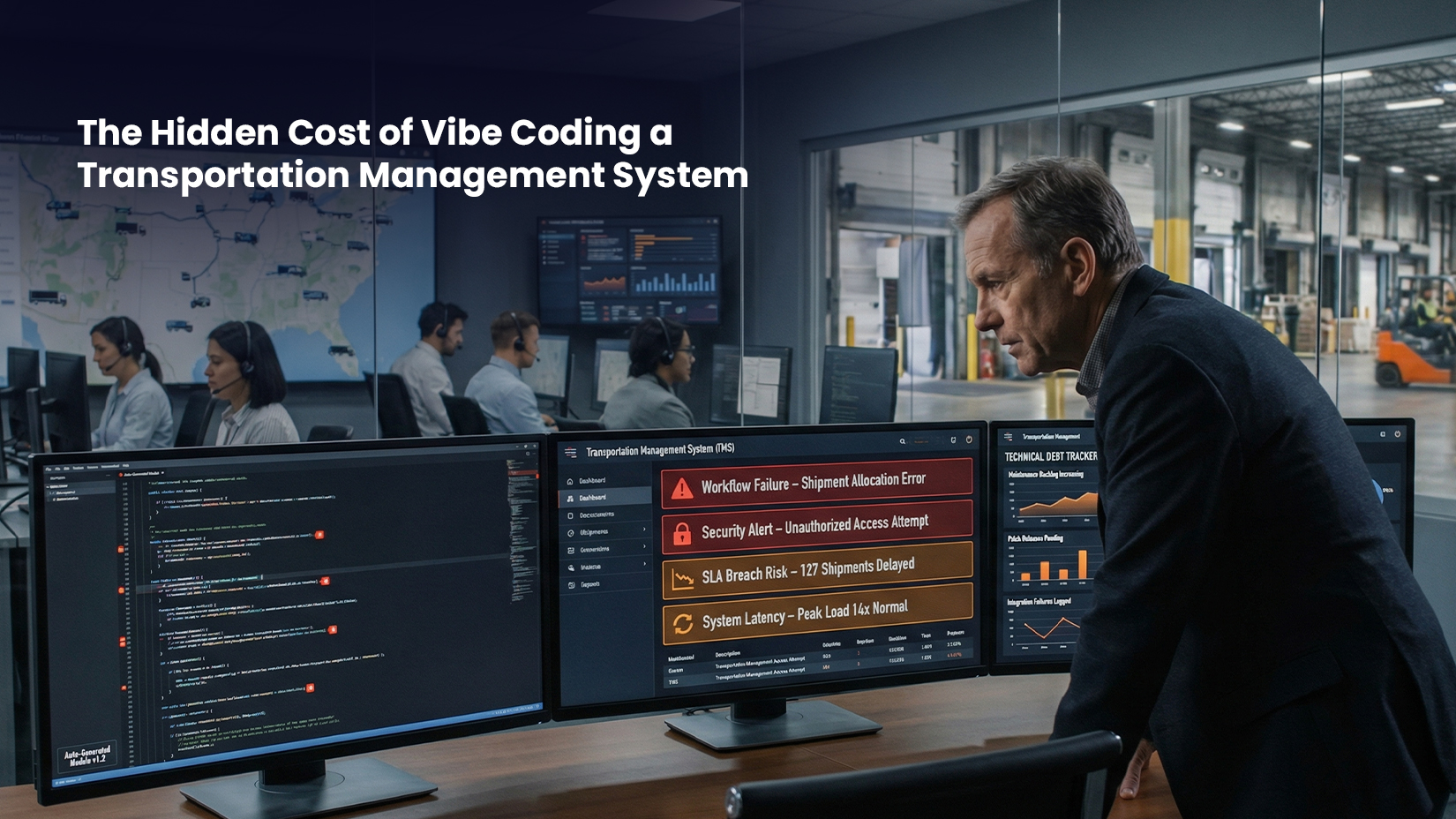
Vibe coding feels cheaper at the start. But over time, costs surface in less obvious ways:
1. Maintenance Debt:
AI-generated code is often difficult to debug, document, and maintain as systems scale. What works in early stages can quickly become fragile, slowing enhancements and increasing technical debt.
2. Security Gaps:
Transportation data includes sensitive customer, shipment, and location information. Inadequate security controls can expose systems to data breaches and compliance risks.
3. Operational Downtime:
One failed workflow can delay hundreds of shipments, disrupt SLAs, and impact customer trust.
IBM estimates that the average cost of supply chain disruption is $184 million per year for large enterprises. A fragile TMS architecture magnifies that risk.
When Should You Not Vibe Code a TMS?
You should avoid vibe coding as the core approach if:
- You operate at enterprise or multi-region scale, where shipment volumes, carrier networks, and regional regulations introduce significant operational complexity.
- Your transportation management involves complex pricing, contracts, or compliance requirements that demand accuracy, auditability, and consistency.
- You promise real-time visibility to customers, where system latency or failures directly impact service levels and brand trust.
- Transportation costs materially impact your P&L, making optimization, reliability, and control business-critical.
In these cases, a robust, purpose-built transportation management system is not optional. It’s strategic infrastructure.
The Smarter Middle Ground
The future isn’t anti-AI. It’s anti-shortcuts.
The most successful logistics organizations combine:
- A stable, enterprise-grade Transportation Management System
- Modular, AI-powered enhancements
- Controlled use of AI-assisted development for speed, not structure
This is how leading transportation management software providers build platforms today, AI where it adds intelligence, not where it replaces engineering discipline.
Final Verdict: Should You Really Vibe Code a TMS?
Vibe coding a Transportation Management System may look appealing for experimentation and rapid ideation, but transportation management is not an area where shortcuts pay off. At scale, success depends on reliability, compliance, and the ability to optimize costs and performance consistently.
That’s why leading enterprises choose LogiNext, a proven, AI powered Transportation Management System built to handle real-world logistics complexity. With advanced automation, intelligent optimization, and enterprise-grade scalability, LogiNext enables businesses to move beyond experimentation and operate transportation as a strategic advantage.
If your goal is to scale faster, reduce transportation costs, and deliver reliable visibility, it’s time to move from vibe coding to a purpose-built solution. Explore LogiNext and see how intelligent transportation management actually works.
 |  |  |




@LogiNext