



How On Demand Delivery Software Is Reshaping Supply Chain Efficiency
Supply chains are no longer designed around warehouses. They are designed around customers. Speed, visibility, and flexibility now define success, not just cost efficiency. In this environment, On Demand Delivery has moved from a convenience feature to a strategic necessity.
What was once limited to food delivery and ride-hailing has evolved into a core logistics capability. Today, enterprises across retail, manufacturing, healthcare, and e-commerce rely on the software to meet rising service expectations while maintaining operational control. The result is a fundamental shift in how supply chain management works.
This article explores how on demand delivery is reshaping supply chain efficiency. Also, why traditional models fall short, and how modern delivery management software enables faster, smarter, and more resilient logistics operations.
The Rise of On Demand Delivery in Modern Supply Chains
Customer expectations have changed permanently. Same-day and next-day delivery are no longer premium offerings. They are table stakes.
According to McKinsey, 90% of consumers now expect fast and flexible delivery options, and nearly 50% are willing to switch brands after a poor delivery experience. This pressure flows upstream into supply chains, forcing organizations to rethink planning, fulfillment, and execution.
It addresses this shift by enabling real-time fulfillment based on actual demand rather than fixed schedules. Instead of batching orders or relying on static routes, companies can dispatch dynamically, allocate capacity instantly, and respond to disruptions as they happen.
This shift directly impacts supply chain management, making it more adaptive and customer-centric.
Why Traditional Supply Chain Models Struggle
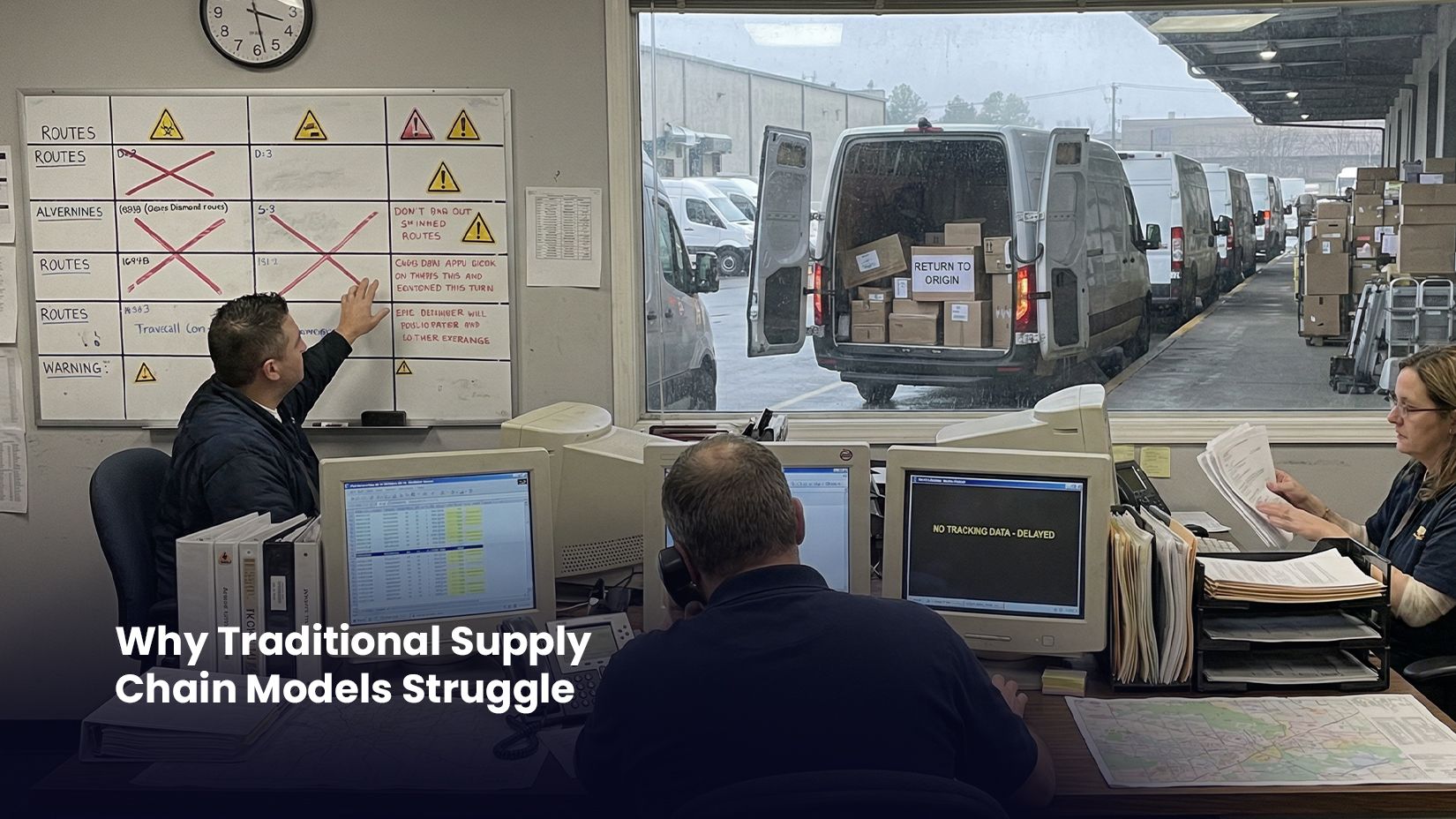
Legacy delivery models were built for predictability. They assume stable demand, fixed routes, and long planning cycles. That assumption no longer holds. Common challenges include:
- Rigid delivery schedules that cannot adjust to demand spikes.
- Poor visibility across last-mile operations.
- Manual dispatching and route planning.
- High delivery failures and return-to-origin rates.
These inefficiencies increase costs and erode customer trust. In contrast, on demand delivery management focuses on agility, automation, and real-time decision-making.
Without modern on demand delivery software, supply chains remain reactive instead of proactive.
What Is On Demand Delivery Software?
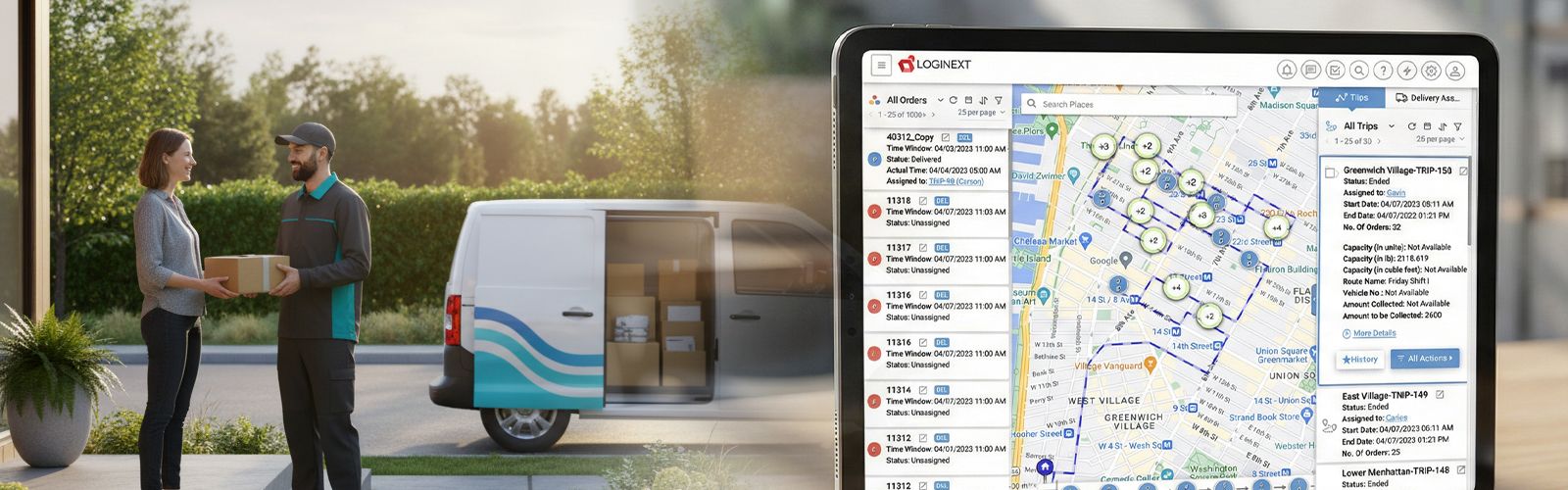
It is a digital platform that enables businesses to fulfill orders in real time. It connects order management systems, fleet operations, drivers, and customers on a single interface. Key capabilities include:
- Dynamic order allocation
- Automated dispatching
- Real-time route optimization
- Live tracking and ETA predictions
- Exception management and alerts
When implemented correctly, the software becomes a control tower for last-mile and mid-mile operations, significantly improving supply chain efficiency.
How On Demand Delivery Improves Supply Chain Efficiency
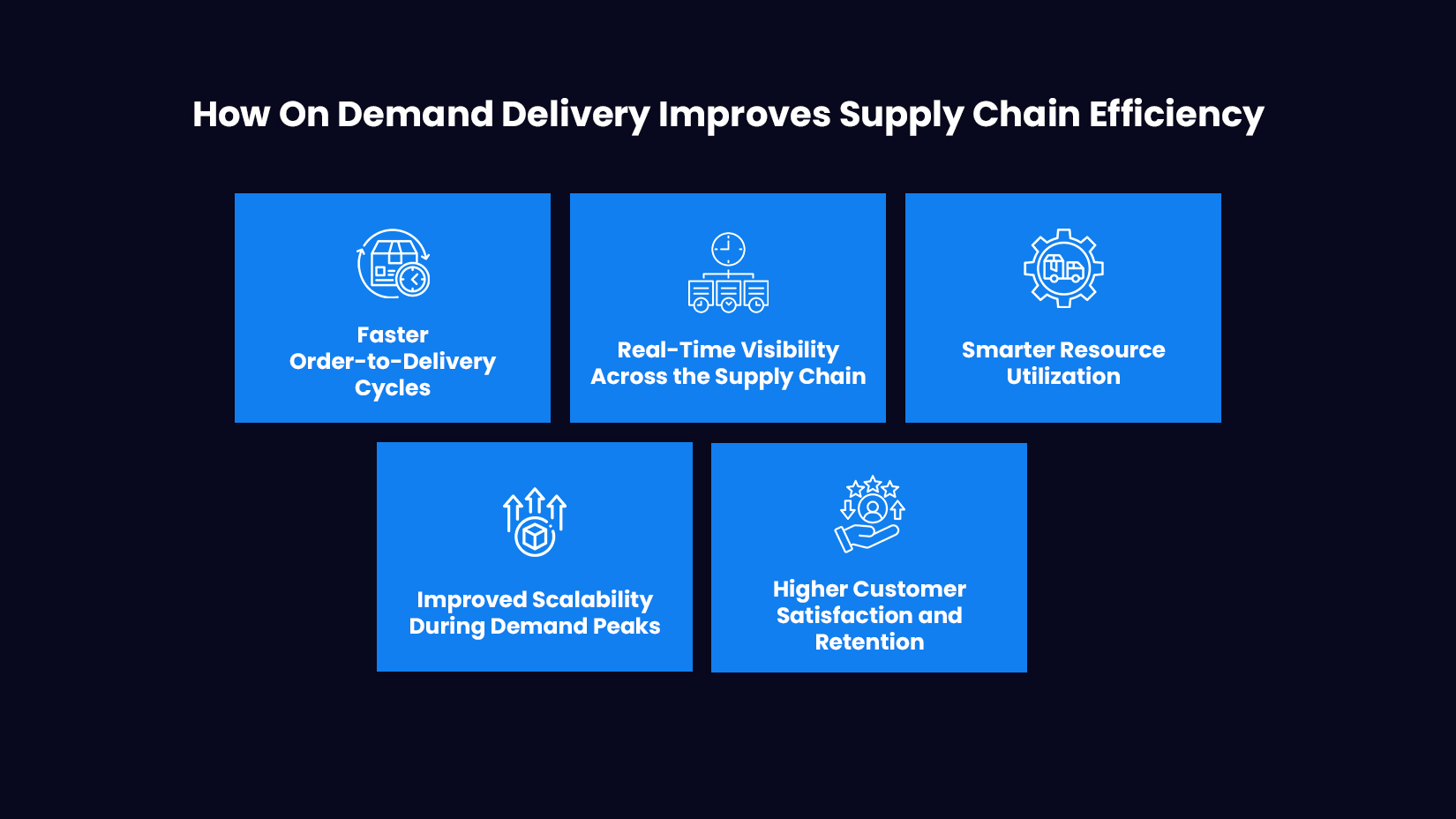
1. Faster Order-to-Delivery Cycles:
Speed is the most visible advantage of it. Orders are assigned instantly based on location, vehicle availability, and delivery priority.
A Deloitte study found that companies using real-time dispatching reduced delivery cycle times by up to 30%. Shorter cycles improve inventory turnover and reduce working capital pressure.
This directly strengthens supply chain management by tightening the link between demand and fulfillment.
2. Real-Time Visibility Across the Supply Chain:
Visibility is the backbone of efficient operations. On demand delivery management provides live tracking of orders, vehicles, and delivery status. Operations teams can:
- Monitor delays before they escalate.
- Reroute deliveries during traffic disruptions.
- Proactively inform customers of ETA changes.
According to Gartner, organizations with end-to-end delivery visibility experience 20–25% fewer delivery exceptions. That translates into lower costs and higher service reliability.
3. Smarter Resource Utilization:
Traditional delivery models often underutilize fleets. Vehicles wait idle or follow inefficient routes.
On demand delivery software uses AI-driven routing and load optimization to maximize asset usage. Orders are clustered intelligently, and routes are recalculated in real time. This reduces:
- Fuel consumption
- Empty miles
- Driver overtime
In large networks, optimized the software can lower last-mile delivery costs by up to 25%.
4. Improved Scalability During Demand Peaks:
Seasonal spikes, flash sales, and regional surges are difficult to manage with static systems.
It enables elastic scaling. Businesses can onboard third-party carriers, crowdsourced fleets, or temporary drivers without disrupting operations.
This flexibility is critical for modern supply chain management, where volatility is the norm rather than the exception.
5. Higher Customer Satisfaction and Retention:
Delivery experience is now a key brand differentiator. Customers expect transparency, control, and speed. With on demand delivery management, customers receive:
- Live tracking links
- Accurate ETAs
- Real-time notifications
PwC reports that 73% of consumers say delivery experience influences repeat purchases. Efficient delivery directly drives loyalty and lifetime value.
The Role of Data and AI in On Demand Delivery
Modern software is powered by data. Machine learning models analyze traffic patterns, historical demand, and driver performance to make smarter decisions.
AI enables:
- Predictive ETAs
- Demand forecasting
- Automated exception handling
Over time, these systems continuously improve. This data-driven approach transforms supply chain management from reactive execution to predictive orchestration.
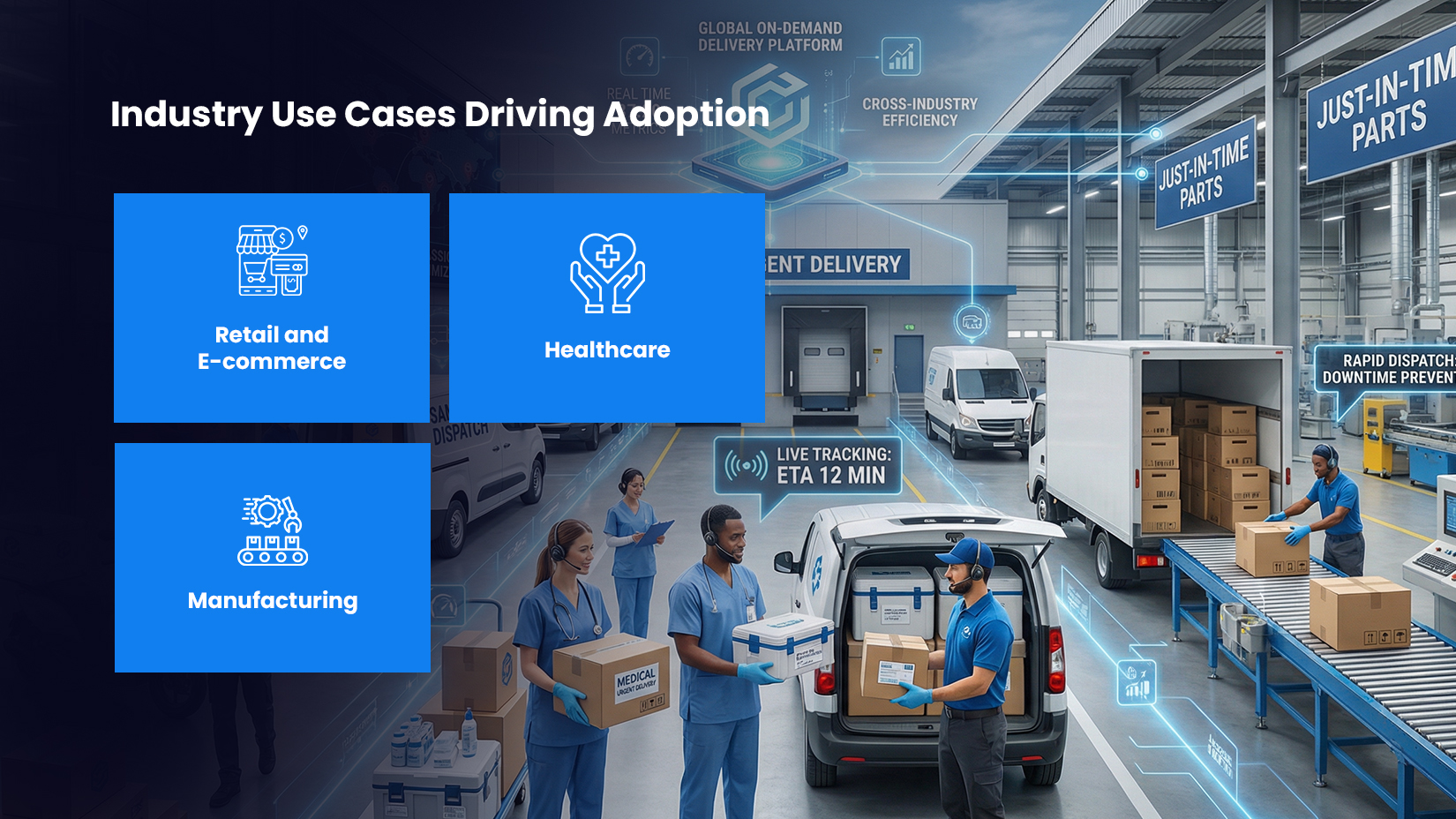
Industry Use Cases Driving Adoption
Retail and E-commerce
Retailers use On Demand Delivery to support same-day fulfillment from stores and micro-fulfillment centers.
Healthcare
Hospitals rely on on demand delivery management software for time-critical deliveries of medicines, samples, and equipment.
Manufacturing
Manufacturers use on demand delivery management to support just-in-time inventory and reduce production downtime.
Across industries, the outcome is the same: faster fulfillment and stronger supply chain resilience.
Key Considerations When Adopting On Demand Delivery Software
To unlock full value, organizations must align technology with process and strategy. Key factors include:
- Integration with ERP and WMS systems
- Scalability across regions and volumes
- Advanced analytics and reporting
- Support for multiple delivery models
Choosing the right on demand delivery software is not just a technology decision. It is a long-term supply chain strategy.
Conclusion
On Demand Delivery is no longer a tactical upgrade; it is a strategic requirement for modern supply chains. By adopting intelligent on demand delivery software, businesses can improve speed, visibility, and control while strengthening end-to-end supply chain management.
With advanced on demand delivery management software, organizations move from reactive execution to real-time, data-driven delivery operations.
LogiNext enables this shift. Its AI-powered on demand delivery management platform helps enterprises optimize dispatch, gain real-time visibility, and deliver consistently at scale. Ready to build a faster, smarter supply chain? LogiNext is where on-demand efficiency begins.
76

|

|

|




@LogiNext