





3 Critical Risks of AI in Ecommerce: A Guide for Modern Delivery Leaders
Artificial intelligence is no longer experimental in ecommerce. It is deep inside ecommerce delivery software, as it shapes how orders are routed, how ETAs are calculated, and how customers experience fulfillment. From demand forecasting to real-time dispatching, AI powered ecommerce delivery software has become a competitive necessity.
But here’s the uncomfortable truth: AI doesn’t eliminate risk. It redistributes it.
Logistics in e-commerce delivery grow increasingly complex and customer expectations tighten. Thereby, blind trust in AI quietly introduces operational, financial, and reputational risks. This is especially true when e-commerce delivery software powered by AI is deployed. Deployed without the right controls, data discipline, or human oversight.
The following article breaks down the three major risks of AI in ecommerce delivery. Why they matter, and how businesses can mitigate them while still scaling fast.
Risk 1: Algorithmic Decisions Without Context
AI is great at pattern recognition. It struggles with nuance.
Most e-commerce delivery software powered with AI is dependent on historical data. This is needed to optimize routes, allocate capacity, and predict delivery times. In stable conditions, this works well. Conditions rarely are stable in real-world logistics.
Where the Risk Appears
AI models often fail to interpret:
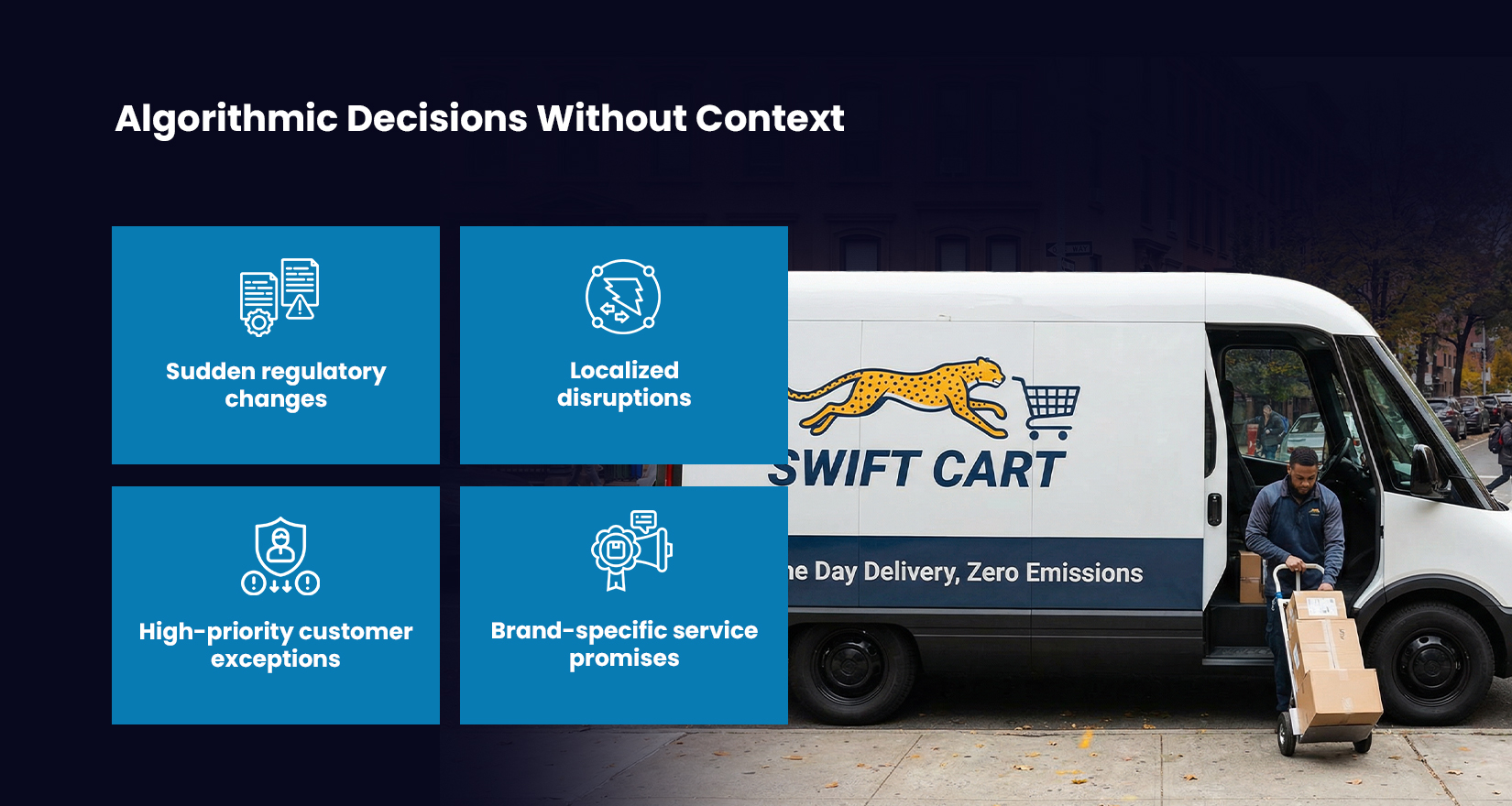
- Suddenly changed regulation.
- Localized disruptions: strikes, protests, weather anomalies.
- High-priority customer exceptions.
- Brand-specific service promises.
For example, an AI-powered e-commerce delivery software may re-route shipments to minimize cost, yet unwittingly violate SLAs for premium customers. The algorithm is correct. Technically. The business outcome is not.
According to McKinsey, 60–70% of all AI initiatives fail to return business value. This is because of misalignment between algorithmic output and operational realities.
Why This Matters in Ecommerce Delivery Logistics
E-commerce delivery is not only about efficiency but also about trust.
When e-commerce delivery solutions rely solely on automated decisions, they are prone to privileging optimization metrics over customer experience. A late delivery caused by an AI-driven decision feels like a broken promise, not a technical error.
How to Mitigate the Risk
- Combine AI recommendations with rule-based overrides.
- Empower human-in-the-loop decision-making mechanisms.
- Customize AI logic based on service tiers and customer segments.
AI should assist dispatchers and not replace judgment altogether. The best ecommerce delivery software uses AI as a co-pilot rather than an autopilot.
Risk 2: Poor Data Quality Leading to False Intelligence
The performance of artificial intelligence (AI) is only as good as the quality of data that it is trained on.
The majority of eCommerce delivery logistics utilizes data from order management systems (OMS, e.g. inventory management). Plus from fleet telematics, carrier networks, API data from various sources. If the data that is being used by AI is fragmented or inaccurate, there is a risk of significant errors accumulating rapidly through automated operations.
Common Data Issues
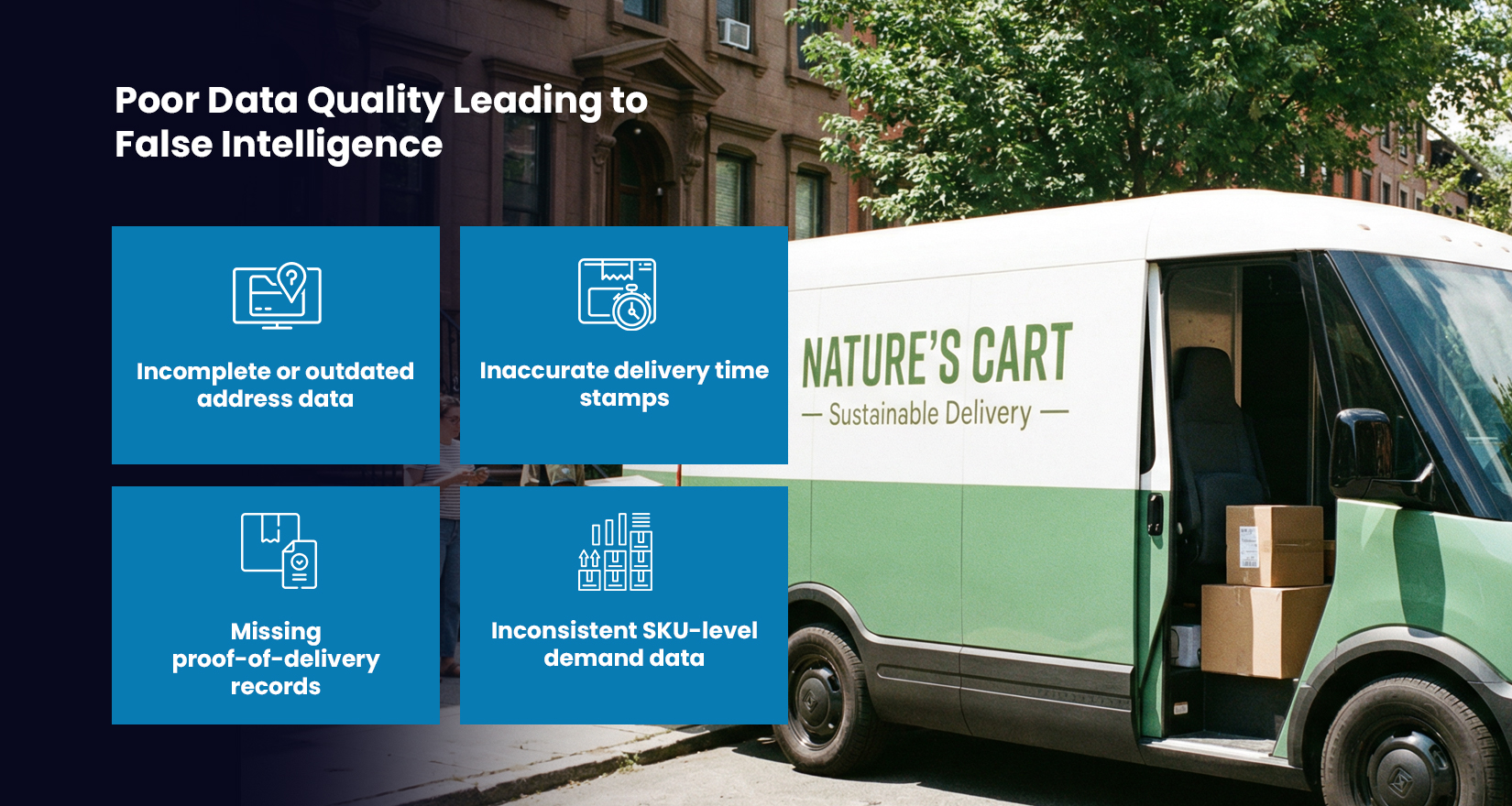
- Incomplete or outdated address data.
- Inaccurate delivery time stamps.
- Missing proof-of-delivery records.
- Inconsistent SKU-level demand data.
According to Gartner, on average, each company loses approximately $12.9 million per year due to poor data quality. The cost takes the form of deliveries that didn’t take place, increased reattempted deliveries, and higher customer loss.
Why AI Makes This Risk Bigger
Traditional systems fail locally. AI fails globally.
When AI powered ecommerce delivery software learns from flawed data, it reinforces incorrect patterns. One bad assumption can cascade across thousands of deliveries in a single day.
For example, if historical data underestimates delivery time in certain pin codes, AI will continue promising unrealistic ETAs. The result is operational stress and eroding customer confidence.
How to Mitigate the Risk
- Normalized data inputs across systems.
- Constantly audit training data.
- Use anomaly detection to flag suspicious outputs.
- Retrain models frequently using real-world feedback.
Strong data governance is not an option anymore, its the foundation for reliable delivery solutions.
Risk 3: Over-Automation at the Cost of Flexibility
Speed has a way of tempting users through increased efficiency as a result of the use of Automation Solutions.
Ecommerce delivery software today offers no-touch delivery automation, which includes automatically dispatching, routing, and handling exceptions. Having systems that automate these tasks may work well when the flow of orders is predictable. However, if there is a spike in orders or a disruption in the flow of orders, highly-automated systems become a major limit to flexibility.
The Flexibility Gap
AI models are optimized for known scenarios. Ecommerce is full of unknowns:
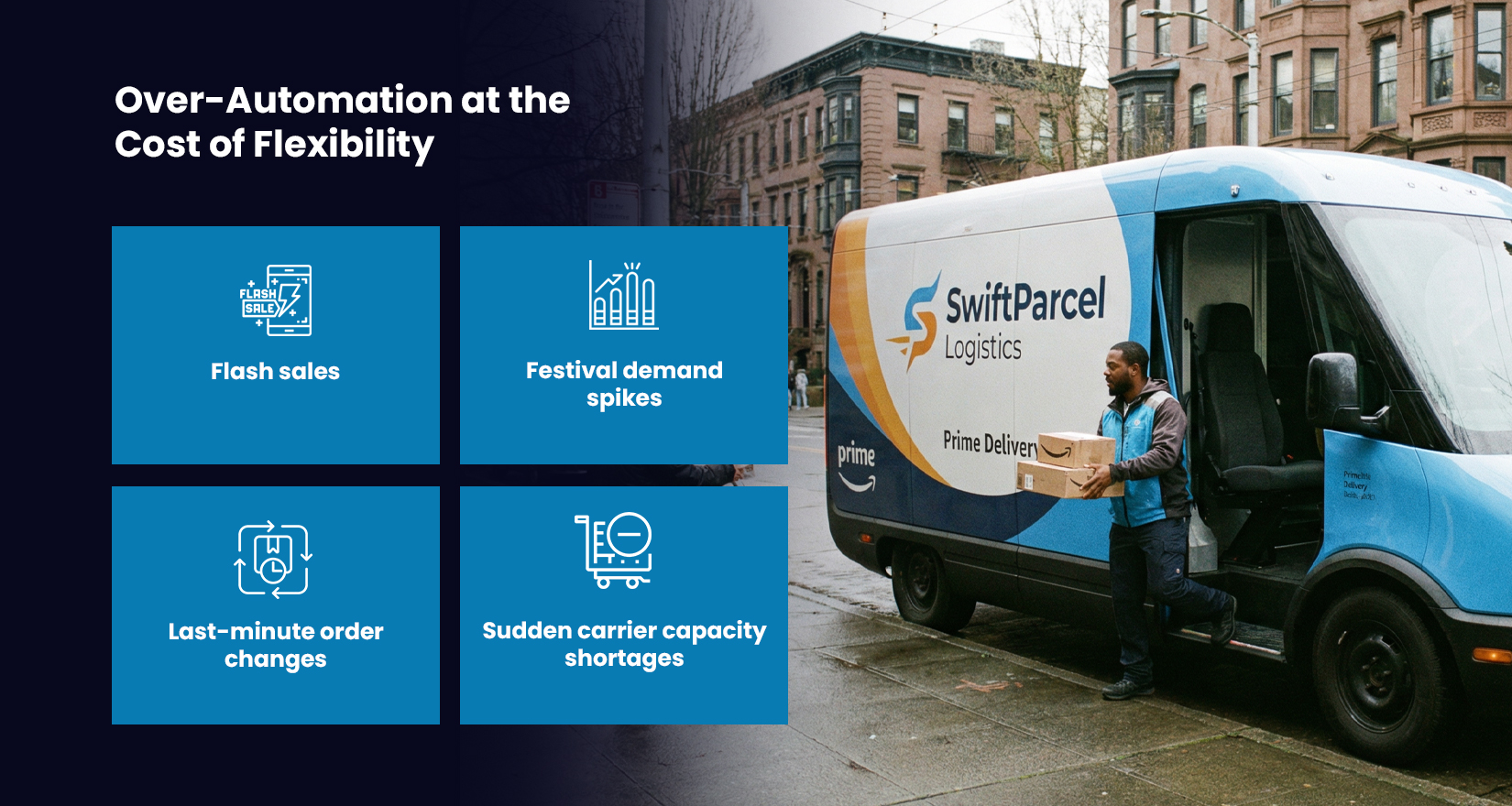
- Flash sales.
- Festive demand spikes.
- Last-minute order changes.
- Sudden carrier capacity shortages.
According to Salesforce.com, 73% of consumers expect retailers to understand the individual needs of customers. This is even when there is a disruption in the system. Unfortunately, e-commerce delivery systems that are automated do not always provide for the flexibility of responding to unforeseen situations.
Impact on Ecommerce Delivery Logistics
Over-automation can lead to:
- Delayed responses to exceptions.
- Missed manual interventions.
- Inability to prioritize high-value orders.
- Reduced control peak seasons.
High-pressure moments are when the delivery operation needs to have access to complete visibility and control over the operation rather than leaving the decision-making to a closed-loop system.
How to Mitigate the Risk
- Design AI workflows with manual checkpoints.
- Enable real-time intervention for operations teams.
- Balance automation with configurable businesses rule.
By designing AI-powered e-commerce delivery software to enhance agility and flexibility rather than restrict operations into rigid flows, companies can achieve the best possible results.
Balancing Innovation With Responsibility
Artificial Intelligence (AI) is not the enemy, but rather, an enemy we created by not having appropriate control over it.
If implemented responsibly, eCommerce delivery software powered by AI will reduce costs. Also, improve Estimate Time of Arrival (ETA) accuracy, create scalable operations, and introduce new ideas in sustainable design. The biggest change created by these efficiencies is the new risk that will also come with utilizing the AI technology.
What Smart Ecommerce Leaders Do Differently
- Treat AI as a strategic capability, not a shortcut.
- Invest in clean, reliable data foundations.
- Maintain transparency in algorithmic decisions.
- Align AI metrics with customer experience goals.
Ecommerce delivery logistics continue to develop and grow. Those companies that incorporate automation into their delivery logistics systems and therefore integrate accountability and automation will succeed over those companies that only chase after speed.
Conclusion
AI is changing how eCommerce delivery solutions work, but it is not the end of all delivery problems. The issue with algorithmic blind spots, bad data, and excessive automation of delivery systems can create a threat to your success if left unchecked.
Ultimately, only those organizations that are intentional when using AI in their delivery logistics will be successful. AI was created to enhance speed and efficiency in eCommerce delivery systems. However, what is important is how the organization is using AI to create successful eCommerce delivery systems.
So, using AI in logistics is not just a choice but a mandate. To help your company, the best decision is to book the demo with LogiNext’s AI powered logistics software. Click on the red button to know more.
80

|

|

|




@LogiNext