Visibility ends at the handover
Once a load leaves your dock, tracking depends on whatever each partner chooses to send. The office finds out about a late stop from the customer instead of the board.

What happens when every logistics partner reports a different version of the day?
Most Vienna operations run their own vans alongside several outsourced partners. Each one sends its own updates on its own schedule, so the office learns about a missed window after the customer does.
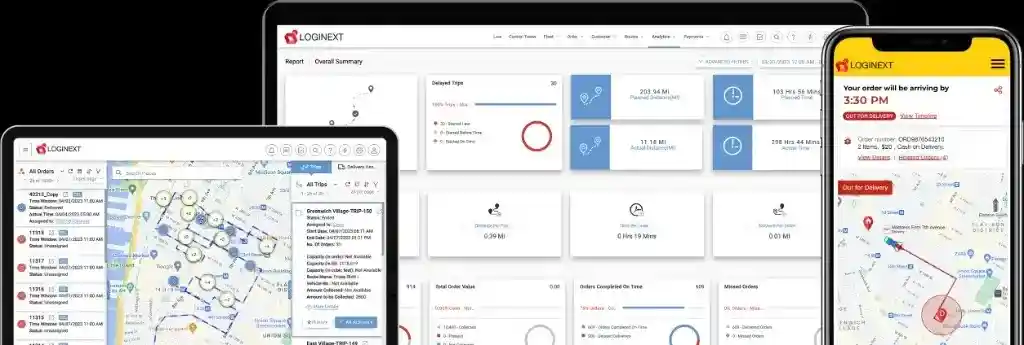
Live previewKPI control surface
Own fleet and partner stops on one live board — tap a metric or node to trace the pathway.
Live stops · partner capacity · proof of delivery
Where does control slip when deliveries run through outside partners?
Where control slipsOnce a load leaves your dock, tracking depends on whatever each partner chooses to send. The office finds out about a late stop from the customer instead of the board.
Volumes get allocated to partners on a fixed split rather than who has room today. One partner runs over while another finishes early.
Without a shared record of planned versus actual, missed windows are argued over in email months later instead of caught the same day.
Ingest: Orders, partner capacity, and service rules flow in from ERP and order systems before the day starts.
Allocate: Each order goes to the fleet or partner that can actually make the window, not to a fixed monthly split.
Dispatch: Drivers and partner crews get the sequence and ETAs on the app, with updates as conditions change.
Execute: Every stop is tracked live and proof of delivery is captured in the same record, whoever made the drop.
Review: Planned versus actual is replayed by partner, so service conversations start from shared numbers.
One shared board keeps in-house teams and outside partners working from the same version of the day.
| Metric | Baseline | With LogiNext | Improvement |
|---|---|---|---|
| On-time delivery | Each partner reports on its own schedule | 97% on-time against agreed windows | Live tracking across partners |
| Delivery speed | Volume split on a fixed allocation | 28% faster deliveries | Work follows real capacity |
| Cost per stop | Duplicate trips on overlapping routes | 20% lower delivery cost | Consolidated allocation |
| Coordination effort | Email chasing and spreadsheet reconciliation | 26% less manual coordination work | One shared record |
| Capability | Email and Spreadsheets | LogiNext Shared Board |
|---|---|---|
| Partner visibility | Status arrives when each partner sends it | Every stop tracked live in one place |
| Allocation | Fixed split agreed in advance | Orders follow whoever has real capacity |
| Window protection | Misses surface after the customer calls | At risk stops flagged while there is still time |
| Proof and billing | Proof scattered across partner systems | Proof of delivery in one shared record |
| Service reviews | Disputed months later over email | Planned versus actual reported by partner |
Challenge: Partner vehicles arrive against a schedule the dock never agreed to.
How LogiNext handles it: Book collection slots against real arrival times and load in route order.
Outcome: Tighter dock turns and less waiting at the bay.
Challenge: Return legs run empty because partners plan trips in isolation.
How LogiNext handles it: Match loads across the whole partner pool instead of one contract at a time.
Outcome: Fuller vehicles and lower cost per journey.
Challenge: Customers get no arrival window once a partner takes the stop.
How LogiNext handles it: Send the same tracking link and arrival alerts regardless of who delivers.
Outcome: Higher first attempt success and fewer redeliveries.
Challenge: Collections run as separate trips on streets already being served.
How LogiNext handles it: Sequence collections into routes that are already going past the door.
Outcome: Fewer trips and faster stock recovery.
Everyone works from the same version of the day.
Explore Third party logistics optimization, Transportation management system, Supply chain visibility software, Fleet management software for deeper product detail.
No one wants to ask every partner to replace their systems. LogiNext connects through APIs so each side keeps the stack it already runs:
Orders flow in, stops and proof flow back, and finance reconciles partner invoices against the same records your planners work from.
Go deeper on the tools Vienna teams use to run deliveries across multiple partners.
Bring your partner mix, service rules, and the windows you have committed to. We will show how allocation, tracking, proof of delivery, and partner reporting sit on one board, using your operating day rather than a slide deck.
Partner stops sit on the same board as your own fleet. Every order is tracked live from allocation through to proof of delivery, so the office sees a late stop while there is still time to act instead of hearing about it from the customer.
No. LogiNext connects through APIs to ERP platforms such as SAP and Oracle, warehouse and order management systems, and GPS feeds. Each partner keeps the stack it already runs while orders, stops, and proof flow into one shared record.
Allocation follows real capacity and the delivery window each order has to hit, rather than a fixed monthly split. If a partner is running full, the next order goes to whoever can still make the window.
Yes. Planned versus actual is recorded for every stop and reported by partner, so service reviews and invoice checks start from the same numbers instead of an email thread months after the fact.