
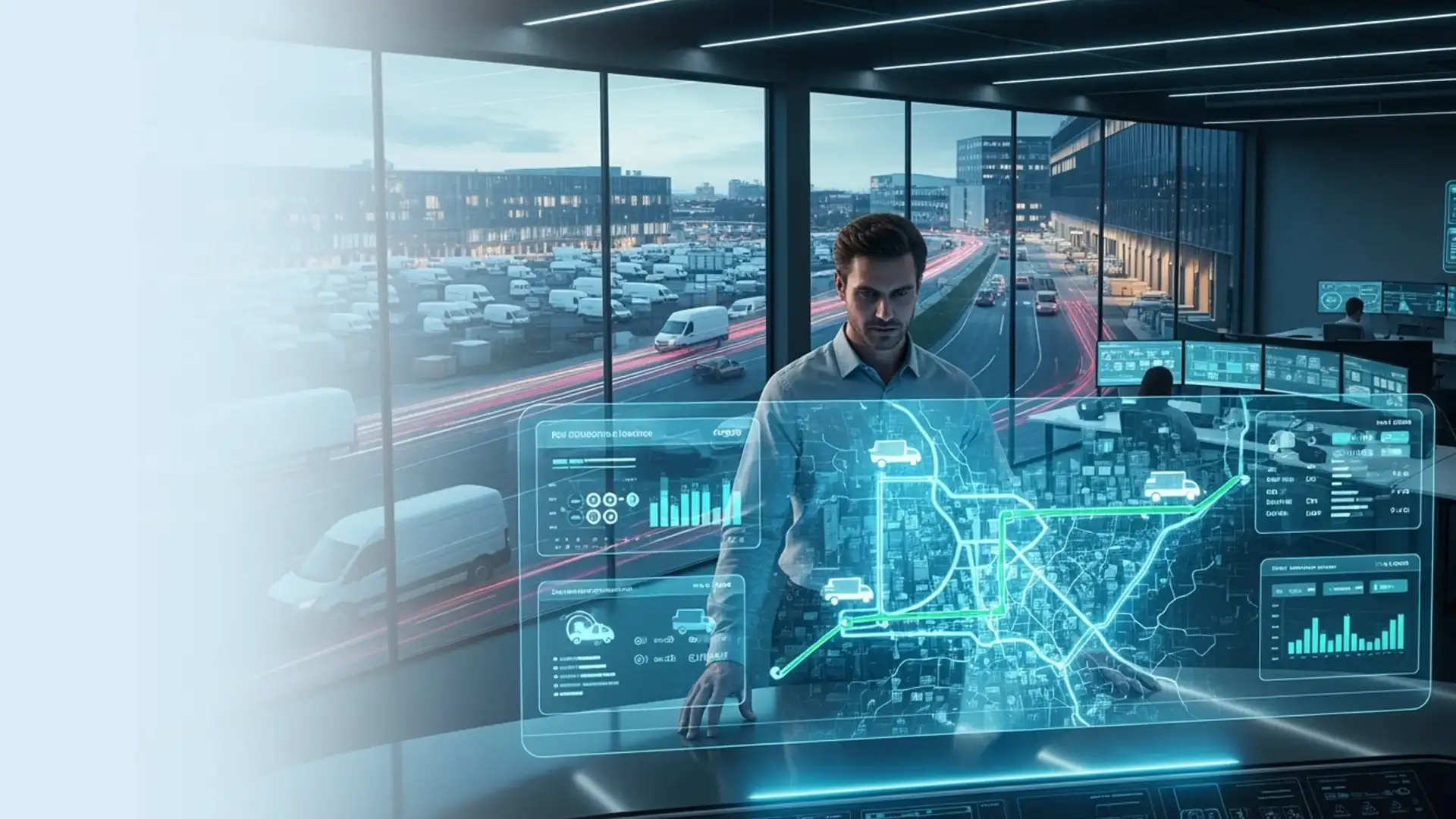
Orchestrate Global Freight: The Future of Logistics Transportation Services
For modern global enterprises, managing multimodal supply chains has become an intricate balancing act between velocity, compliance, and margin preservation. Relying on disconnected logistics transportation services or legacy communication tools introduces staggering operational friction.
As shipment networks expand across borders and urban centers, the absence of centralized, real-time intelligence results in massive cost leakages, uncoordinated carrier execution, and compromised consumer relationships.
How can global supply chain leaders maintain absolute cost governance while scaling distribution coverage? Standard planning spreadsheets and fixed delivery schedules are fundamentally incapable of responding to fluid network variables.
LogiNext introduces a unified operational intelligence layer driven by advanced AI orchestration. By transitioning to an AI-native model, enterprise leaders substitute passive tracking logs with a predictive framework that transforms raw logistics transportation services into a highly adaptive, self-optimizing cost advantage.
Freight network friction
The Hidden Capital Leakage in Legacy Freight Networks
Why are traditional frameworks failing to optimize your logistics transportation services?
The moment freight transitions from primary manufacturing hubs to localized distribution networks, deep execution gaps begin to compromise margin protection:
The Asset Underutilization Crisis
Inefficient stop sequencing and poor load configuration lead to empty vehicle space, resulting in a 15% drop in fleet asset utilization.
15% fleet utilization lossThe Manual Processing Ceiling
Traditional operations often depend entirely on the classical logistics coordinator definition—where a human operator spends hours manually matching loads, texting drivers, and compiling siloed spreadsheets.
Manual coordinator ceilingThe Telematics Information Gap
Operating without structural data continuity leaves enterprise managers in a total blind spot regarding true transit productivity and real-time carrier performance.
Telematics blind spotErratic Final-Mile Cost Expansion
Failing to implement automated, dynamic route optimization at scale forces vehicles to log heavy, unnecessary detour mileage.
Final-mile cost expansion
How AI-Native Logistics Transportation Services Function
LogiNext replaces manual dispatch processes with a recursive AI decision engine that streamlines global transport workflows across five automated AI workflows:
Unified Data Ingestion:
Aggregating data streams instantly from your enterprise ERP systems, WMS platforms, and carrier APIs into a central neural network.
AI Spatial Enrichment:
Cleaning unformatted address logs, transforming raw data into high-precision spatial vectors, and cross-referencing commercial vehicle road restrictions.
The AI Decision Engine:
Executing thousands of complex multi-stop simulations via machine learning algorithms to determine ideal driver pairings, load distributions, and transit paths.
Workflow Orchestration:
Transferring responsive digital manifests straight to carrier fleets via AI-powered mobile interfaces to keep warehouse and delivery teams perfectly synchronized.
Continuous Learning Loop:
Processing real-world transit telemetry back into core engines to automatically enhance next-day arrival times and courier baseline performance variables.
Enterprise Value: Integrating an AI-native model into your operations enables your logistics teams to completely automate dispatch and routing decisions, shrinking daily logistics administration work by up to 35%.
Free fleet diagnostic
Operational Audit: Is Your Fleet Logistically Margin-Ready?
High-density transportation networks demand precise technical architecture. Run an automatic diagnostic check on your freight workflows to see how advanced automation secures your operational margins.
- Fleet asset utilization
- Coordinator manual load matching
- Transit telematics gaps
Measurable KPI Impact
Deploying comprehensive enterprise logistics automation across your network delivers immediate, verifiable operational improvements based on global brand implementations:
SLA Achievement (On-Time Drops)
15–25% Reduction in Delays
Freight and Courier Overhead
10–20% Cost Optimization
Fulfillment Visibility Index
20–40% Visibility Improvement
Planner Administration Volume
25–35% Reduction in Manual Work
Evaluation: Legacy Infrastructure vs. AI-Powered LogiNext
As you evaluate your technical architecture, review if your system operates as a passive ledger or an active AI orchestrator for your global logistics transportation services ecosystem:
Legacy infrastructure
- Scalability: Constrained by rigid batch thresholds.
- Decision-Making: Legacy relies on the rigid logistics coordinator definition where data is processed manually.
- Visibility: Legacy provides delayed or milestone-based pings.
- Exception Handling: Legacy processes failures re-actively.
AI-Powered LogiNext
- Scalability: LogiNext is AI-native and elastic, managing infinite simultaneous regional runs.
- Decision-Making: LogiNext is AI-driven, computing variables in milliseconds.
- Visibility: LogiNext delivers live fleet tracking with active predictive telemetry.
- Exception Handling: LogiNext relies on predictive tracking to solve disruptions before they reach the consumer.
Enterprise Use Cases: Precision and Network Velocity
Warehouse Operations
Terminal processing bottlenecks at sorting docks halting fast truck turnarounds.
AI Solution: Dynamic gate and dock scheduling continuously updated by real-time predictive ETAs from incoming carriers.
Outcome: 20% faster package sortation and minimized terminal vehicle queue delays.
Transportation & Line Haul
Disconnected inter-hub shuttles throwing off urban fulfillment schedules.
AI Solution: Deep predictive logistics analytics to synchronize primary line haul arrivals with secondary courier shifts.
Outcome: 12% reduction in long-haul freight overhead expenses.
Last-Mile Delivery
High delivery failure rates for on-demand networks in dense city sectors.
AI Solution: Continuous, dynamic AI re-routing built on local transit patterns and active traffic constraints.
Outcome: 98%+ on-time performance across dense distribution points.
Reverse Logistics & Returns
High handling overhead and erratic returns management.
AI Solution: Intelligent return-to-origin sequencing matching delivery vectors with scheduled pickups.
Outcome: 30% reduction in final-mile reverse logistics costs.
The AI Decision Layer
The defining core of LogiNext is its capability to predict disruptions before they occur through advanced pattern recognition. By embedding automated AI alerts directly into your logistics transportation services operational grids, the engine continuously tracks path execution against target completion windows. If an asset experiences unexpected delays, the self-learning optimization layer re-sequences or re-allocates adjacent orders autonomously to protect service levels.
Seamless Enterprise Interoperability
Your logistics automation architecture must communicate seamlessly with your current technical ecosystem. LogiNext ensures total AI interoperability out of the box:
Core Systems
Secure, low-latency connectors for standard accounting, POS, and supply chain applications (AI-enhanced ERP/TMS/WMS).
IoT Hardware Infrastructure
Hardware-agnostic telemetry ingestion for total real-time fleet visibility.
Fulfillment Channels
Direct integrations with custom storefronts, regional e-commerce hubs, and third-party delivery platforms.

Future-Proof Your Logistics Strategy
Fulfillment networks will encounter increasingly complex shipping patterns. Adopting an intuitive, AI-native approach to your fulfillment engine ensures your business balances scale with margin security.
Frequently Asked Questions
What are enterprise logistics transportation services?
Enterprise logistics transportation services encompass the strategic management, execution, and technological optimization of moving physical goods via road, rail, air, or ocean across global supply chains.
How does the traditional logistics coordinator definition change under an AI model?
The manual logistics coordinator definition involves a human operator manually routing orders, whereas an AI-driven framework shifts their role to supervising automated machine learning dispatch exceptions.
How can an organization optimize logistics operations with AI across global transportation systems?
Organizations can optimize logistics operations with AI by deploying centralized platforms that ingest variable fleet telemetry, analyze transit constraints, and automatically assign the most profitable driver vectors.
Can modern logistics transportation services work to reduce last-mile delivery costs?
Yes, by executing dynamic courier batching and continuous route optimization at scale, the architecture groups adjacent parcel drops together, allowing platforms to significantly reduce last-mile delivery costs by 10–20%.
How do predictive logistics analytics protect high-volume freight pipelines?
By monitoring live vehicle parameters against historical zone datasets, predictive logistics analytics flag potential transit delays hours before they occur, allowing systems to push proactive modifications directly to active drivers.
Featured snippet blocks
Logistics transportation services intelligence
Structured answers for search visibility and evaluation of global freight orchestration.
What are logistics transportation services?
- The physical networks and corporate processes engineered to plan, execute, and control the movement of goods between hubs and customers.
- The combined deployment of software, vehicle assets, and carrier channels to ensure on-time product availability.
- In enterprise supply chains, it is an AI-native ecosystem configured to drop manual planning overhead and maximize fleet utilization levels.
How do automated logistics transportation services work?
- 1AI Ingestion: Regional orders, active carrier states, and vehicle cargo sizes drop straight into a processing neural network.
- 2AI Optimization: Advanced machine learning algorithms evaluate zone limits to create highly condensed delivery runs.
- 3Predictive Monitoring: The platform evaluates route metrics via live GPS telemetry, updating fleet supervisors automatically using custom AI alerts.
- 4AI Orchestration: Couriers run through dense city grids via automated driver applications, feeding live delivery verification tokens to home terminals.
- 5Autonomous Refinement: Completed transit trip logs cycle back into the core platform matrix to automatically increase next-day routing accuracy.