





How to Improve On-Time Delivery and OTIF Performance in Enterprise Logistics
On-time delivery has become one of the most important competitive advantages in logistics. Customers expect every order to arrive exactly when promised, while retailers increasingly measure suppliers by their OTIF performance. A delayed shipment doesn’t just disappoint a customer. It leads to higher costs, missed SLAs, and weaker business relationships.
Customers rarely ask why a delivery was late. They simply remember that it was.
That is why OTIF (On-Time In-Full) has become a critical KPI for modern supply chains. Improving OTIF is no longer about asking drivers to move faster. It requires intelligent planning, automated dispatch, real-time visibility, and continuous performance monitoring.
This guide explains how to improve on-time delivery, increase OTIF performance, and how LogiNext helps enterprises consistently achieve delivery excellence.
What Is OTIF?
OTIF (On-Time In-Full) measures whether an order reaches the customer exactly as promised. To qualify, the shipment must arrive within the committed delivery window while containing every item in the correct quantity and condition.
The formula is simple:
OTIF = Orders Delivered On Time and In Full ÷ Total Orders × 100
Unlike a standard delivery metric, OTIF evaluates the complete customer experience. Delivering on time without the complete order still counts as a failure. Likewise, delivering a complete order after the promised time impacts OTIF performance.
For retailers, manufacturers, distributors, FMCG companies, and healthcare providers, OTIF has become a key indicator of operational excellence. It directly influences supplier scorecards, customer satisfaction, and contract renewals.
Why On-Time Delivery and OTIF Matter
Customer expectations have changed dramatically over the past few years. Faster delivery has become the norm, but consistency is what builds trust. According to PwC, 73% of consumers say customer experience influences their purchasing decisions, making delivery reliability a major competitive advantage.
Poor on-time delivery creates a ripple effect across operations. Delayed shipments increase customer support inquiries, generate failed delivery attempts, reduce fleet productivity, and often lead to retailer compliance penalties. As delivery networks expand, even a small decline in OTIF can translate into thousands of delayed orders and significant operational costs.
For logistics leaders, improving on-time delivery is no longer just about meeting customer expectations. It is about protecting profitability while maintaining service quality at scale.
What Good OTIF Performance Looks Like
While benchmarks vary by industry, high-performing logistics organizations typically aim for the following metrics:
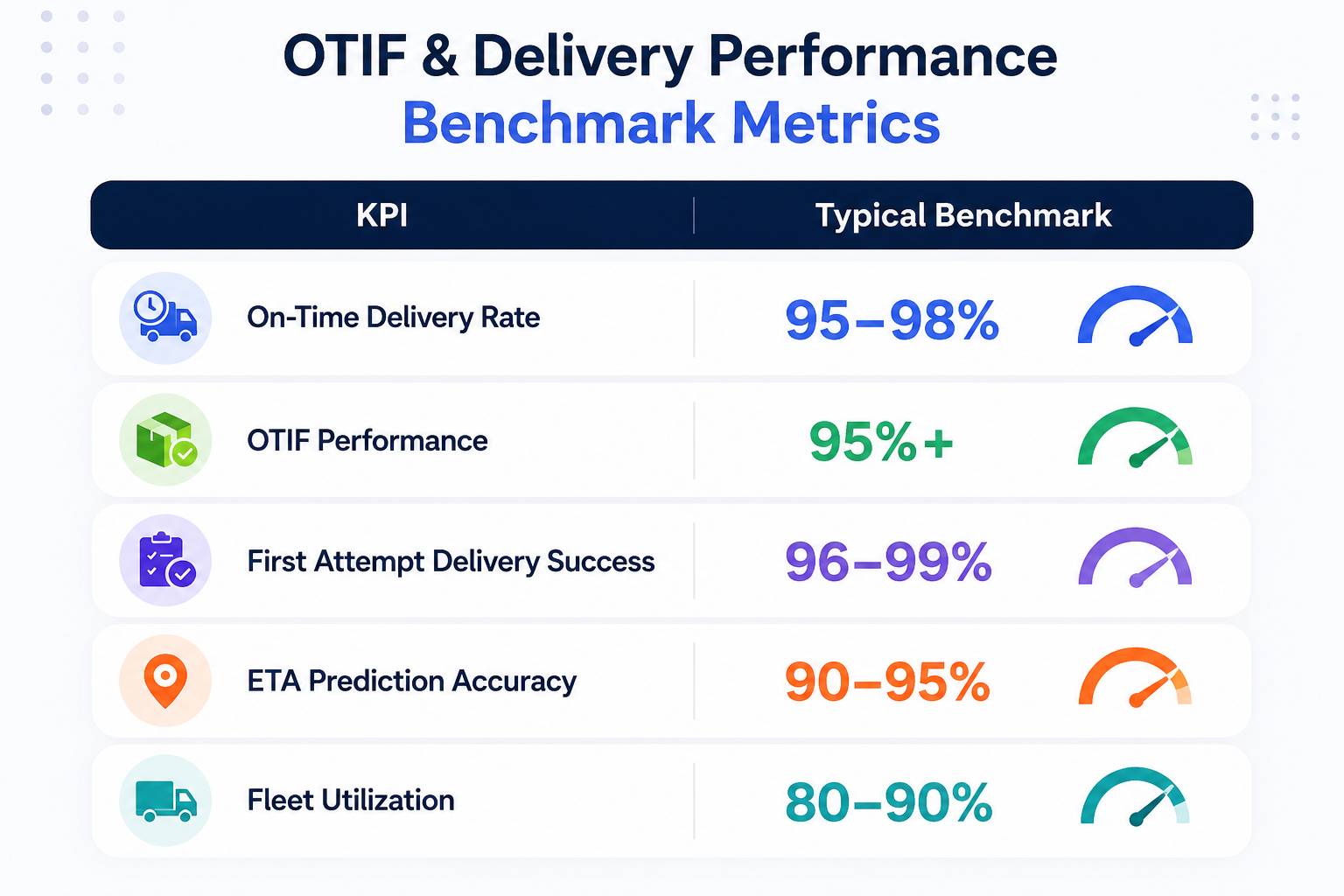
Leading enterprises often target 97–99% OTIF, but maintaining those numbers becomes increasingly challenging as delivery volumes grow and networks become more complex. The goal is not just to achieve a high benchmark once, but to sustain it consistently across every route, region, and customer.
Why OTIF Performance Declines
Most delivery delays are not caused by a single major issue. Instead, they result from multiple operational inefficiencies that accumulate throughout the day.
v
Poor route planning is one of the biggest contributors. Static routes cannot adapt to changing traffic conditions, last-minute orders, customer time windows, or vehicle capacity constraints. A small delay during the first delivery often snowballs into missed delivery windows later in the route.
Limited operational visibility creates another challenge. When dispatchers discover delays only after customers have noticed them, there are few recovery options available. Manual dispatching compounds the problem by slowing assignment decisions and making dynamic reallocations nearly impossible during busy periods.
Warehouse delays also affect on-time in-full performance. Even perfectly planned routes cannot recover lost time if vehicles leave the distribution center late because of slow picking, incorrect packing, or loading bottlenecks.
Six Proven Ways to Improve On-Time Delivery
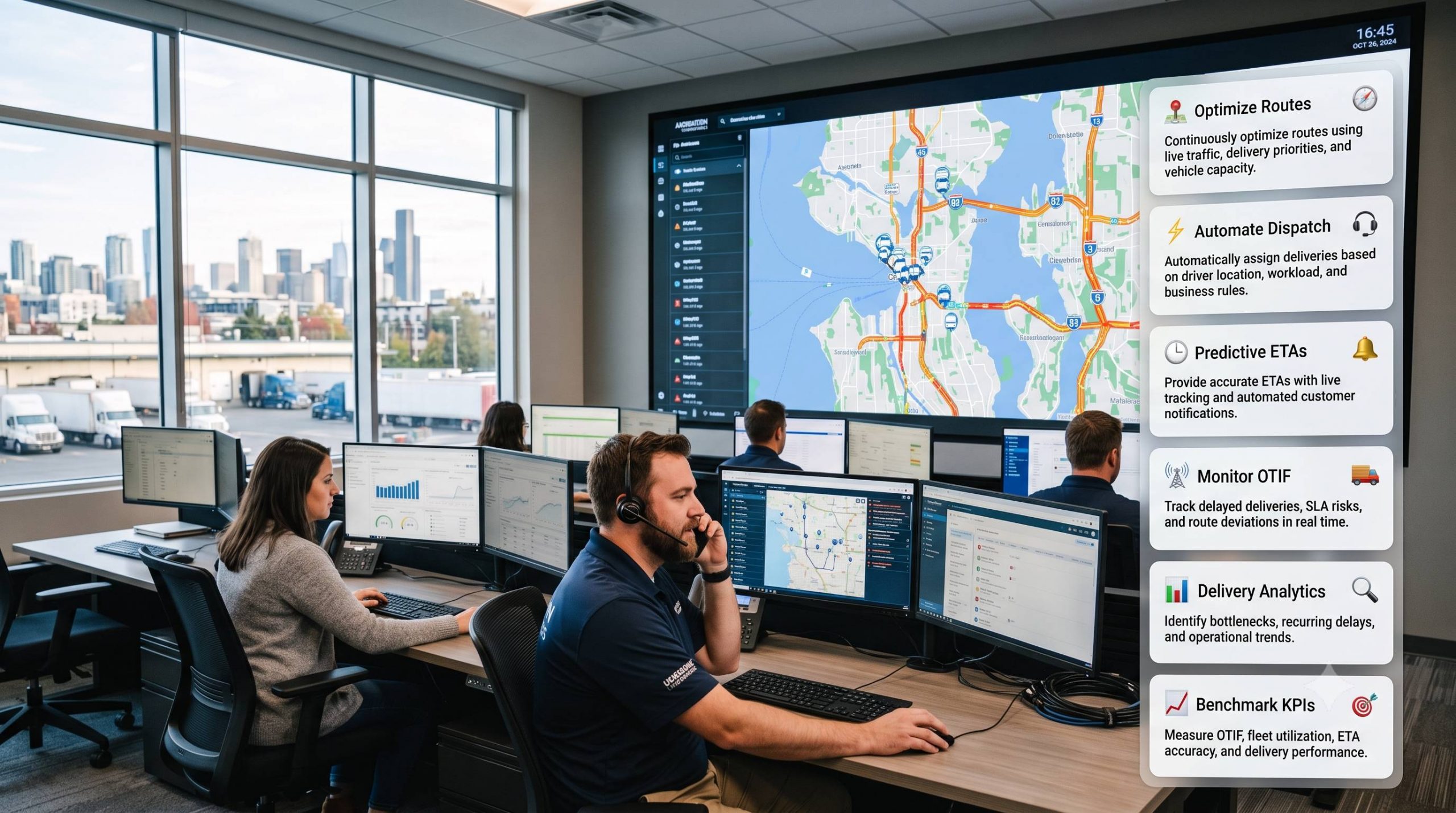
1. Optimize Routes Dynamically:
Planning routes only once before dispatch is no longer sufficient. A modern on-time delivery solution continuously optimizes routes using live traffic, delivery priorities, customer time windows, and vehicle capacity. This helps prevent delays instead of simply reacting to them.
2. Automate Dispatch:
Manual dispatching slows operations as delivery volumes grow. On-time delivery software automatically assigns deliveries based on driver location, workload, vehicle type, and business rules, allowing dispatchers to focus on exceptions rather than routine assignments.
3. Provide Accurate ETAs:
Customers are more forgiving when expectations are managed. Predictive ETAs, live tracking, and automated notifications reduce “Where is my order?” inquiries while improving customer confidence and first-attempt delivery success.
4. Monitor OTIF in Real Time:
Weekly reports explain yesterday’s problems. Real-time dashboards prevent today’s. By monitoring delayed routes, SLA risks, and route deviations as they happen, operations teams can reroute drivers or update customers before service levels are impacted.
5. Use Delivery Analytics:
Analytics help identify recurring issues such as delayed routes, warehouse bottlenecks, underperforming delivery zones, and repeated failed deliveries. Fixing these root causes improves both OTIF and operational efficiency over time.
6. Benchmark the Right KPIs:
Leading organizations measure more than completed deliveries. Tracking OTIF, on-time delivery, ETA accuracy, first-attempt success, route adherence, fleet utilization, and delivery costs provides a complete picture of operational performance and highlights opportunities for improvement.
How LogiNext Helps Improve On-Time Delivery

Improving on-time delivery requires connected planning, execution, and analytics. LogiNext brings these capabilities together on a single platform.
1. AI-Powered Route Optimization:
Generate optimized routes using real-time traffic, vehicle capacity, customer time windows, and order priorities. Dynamic rerouting helps maximize OTIF while reducing travel time.
2. Intelligent Dispatch Automation:
Automatically assign orders to the best available driver based on configurable business rules. This reduces manual effort and improves fleet utilization.
3. Predictive ETAs and Real-Time Visibility:
LogiNext combines live GPS data, traffic intelligence, and historical delivery patterns to provide accurate ETAs and complete fleet visibility. Operations teams can identify delays early and take corrective action before customer commitments are missed.
4. Exception Management:
Automated alerts notify dispatchers of route deviations, delayed departures, SLA risks, and failed delivery attempts, enabling faster issue resolution.
5. Delivery Analytics and Benchmarking:
Track OTIF, on-time in-full, ETA accuracy, route efficiency, fleet utilization, and SLA compliance through customizable dashboards. Compare performance across regions, warehouses, carriers, and drivers to identify continuous improvement opportunities.
Essential KPIs for On-Time Delivery Success
Measuring completed deliveries alone provides an incomplete picture of logistics performance. Leading organizations monitor a broader set of KPIs that reveal how efficiently their delivery network operates and where improvements are needed.
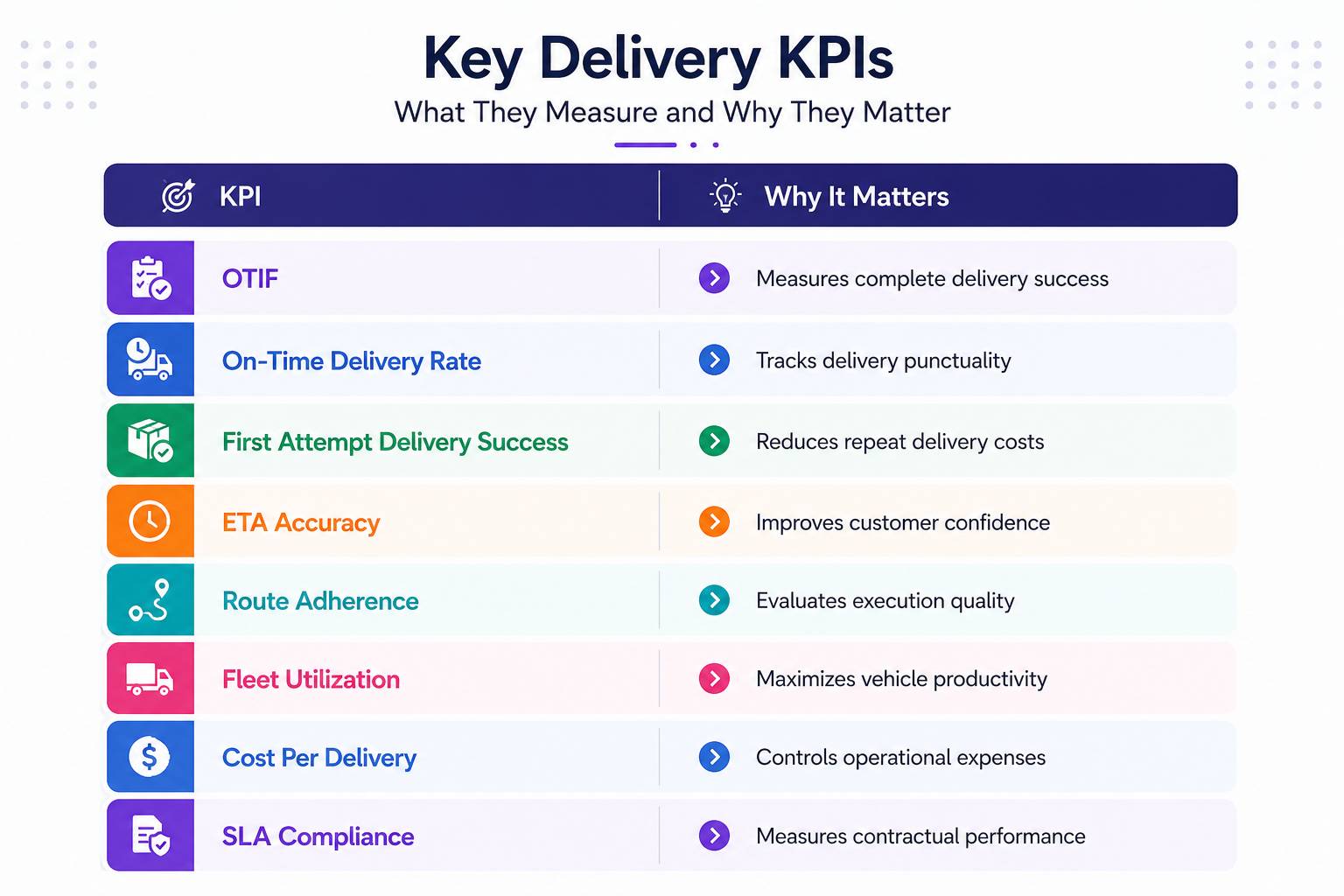
Together, these metrics provide a comprehensive view of delivery performance and help logistics leaders make informed operational decisions.
Conclusion
Customers remember missed promises more than successful deliveries. That is why improving on-time delivery and OTIF has become a strategic priority for every enterprise logistics operation.
With AI-powered route optimization, automated dispatch, predictive ETAs, real-time visibility, and advanced analytics, LogiNext helps businesses improve on-time delivery, increase on-time in-full performance, and consistently meet delivery commitments at scale.
Ready to improve your OTIF performance? Schedule a demo with LogiNext and discover how intelligent logistics orchestration can help you deliver on time, every time.
“” 19
 |  |  |




@LogiNext