




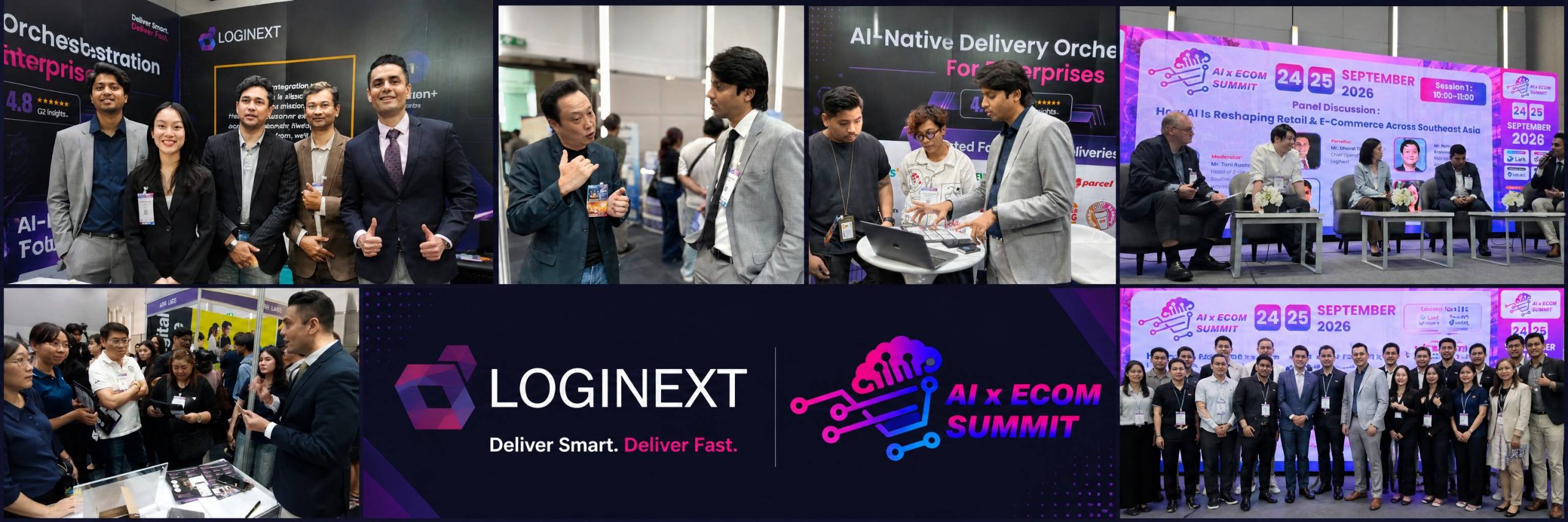
LogiNext at AIxEcom Summit 2026: AI & Supply Chain Insights
At AIxEcom Summit 2026 in Bangkok, LogiNext joined retail, e-commerce, technology, and supply chain leaders for two days of conversations about how AI is changing the way businesses operate across Southeast Asia. The discussions quickly moved beyond what AI can predict to what it can actually help businesses do.
Held on September 24-25 at BITEC, Bangkok, the summit brought together leaders exploring AI adoption, autonomous commerce, fulfillment, and the growing complexity of enterprise operations. Dhaval Thanki, Chief Operating Officer at LogiNext, represented the company as a featured panellist and moderator across two sessions.
At the LogiNext booth, those big-picture conversations became much more practical. Leaders from retail, QSR, postal services, manufacturing, chemicals, and Third Party Logistics shared the operational challenges behind their AI ambitions. Across 28 Marketing Qualified Leads, several themes kept coming up: legacy technology, manual processes, fragmented operations, and the difficulty of managing scale.
Bangkok Had a Lot to Say About Where AI is Heading
The conversations on stage offered a clear view of how the region is thinking about AI. Businesses are moving beyond using AI simply to analyze historical data or forecast what might happen next. Increasingly, the focus is on using intelligence to support decisions and respond to changing operational conditions.
From Prediction to Action
This came through strongly during the Day 1 panel, “How AI Is Reshaping Retail & E-Commerce Across Southeast Asia.” Dhaval Thanki joined leaders from CP Axtra, Havas Thailand, Amity Solutions, and Central Department Store Group to discuss how AI is influencing retail and e-commerce across the region.
The conversation touched on the shift from predictive analytics toward more intelligent and increasingly autonomous decision-making. For businesses operating across fast-changing markets, the ability to respond to demand, capacity, and customer expectations is becoming just as important as predicting them.
The Day 2 panel, “Autonomous Fulfillment & Last-Mile Optimization in Southeast Asia,” took that conversation closer to execution. Moderated by Dhaval Thanki, the session brought together DHL Supply Chain and logistics expert Wattanai Lertpipopmetha. This was to explore what greater autonomy could mean for fulfillment and transportation operations.
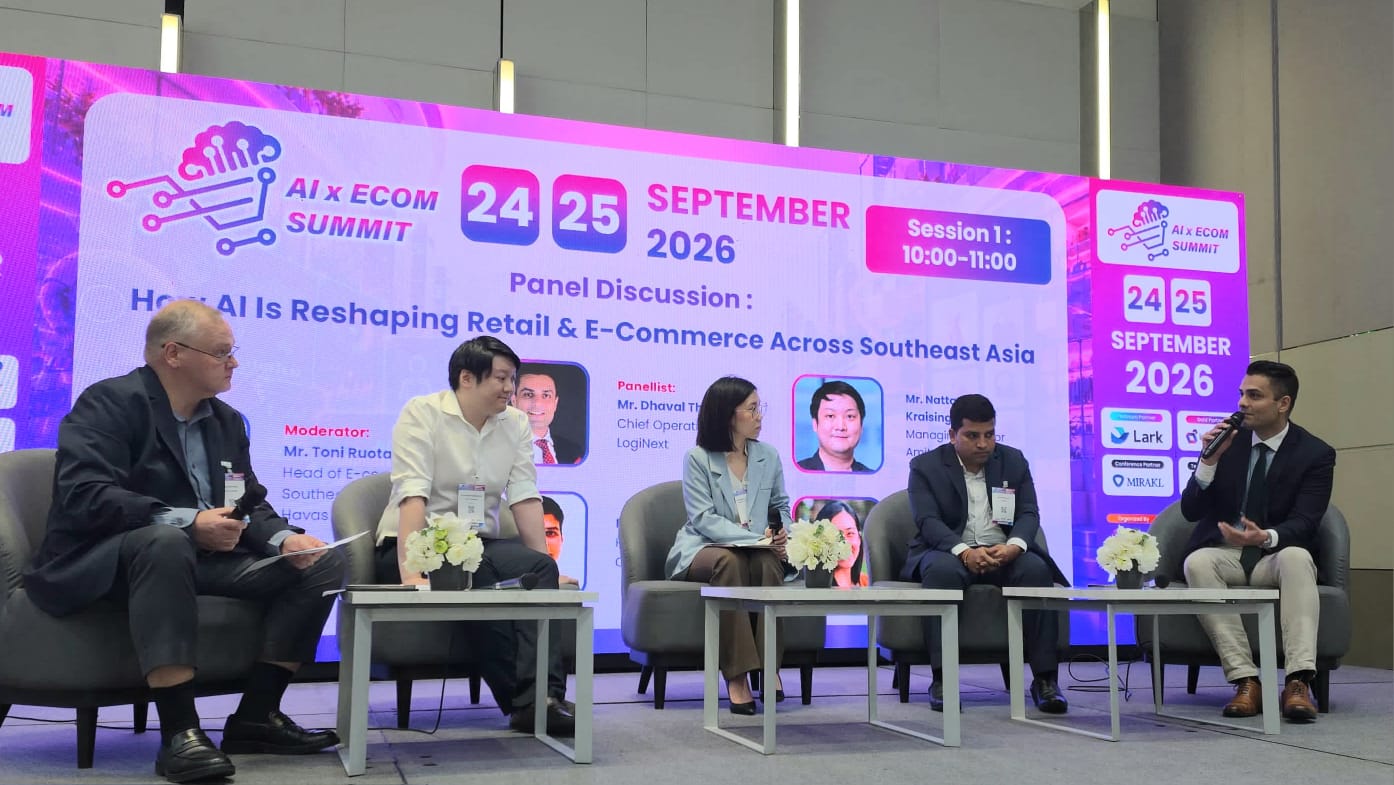
Across both panels, one idea stood out. AI becomes considerably more useful when it is connected to the systems and processes responsible for putting decisions into action.
Then the Booth Conversations Got Very Real
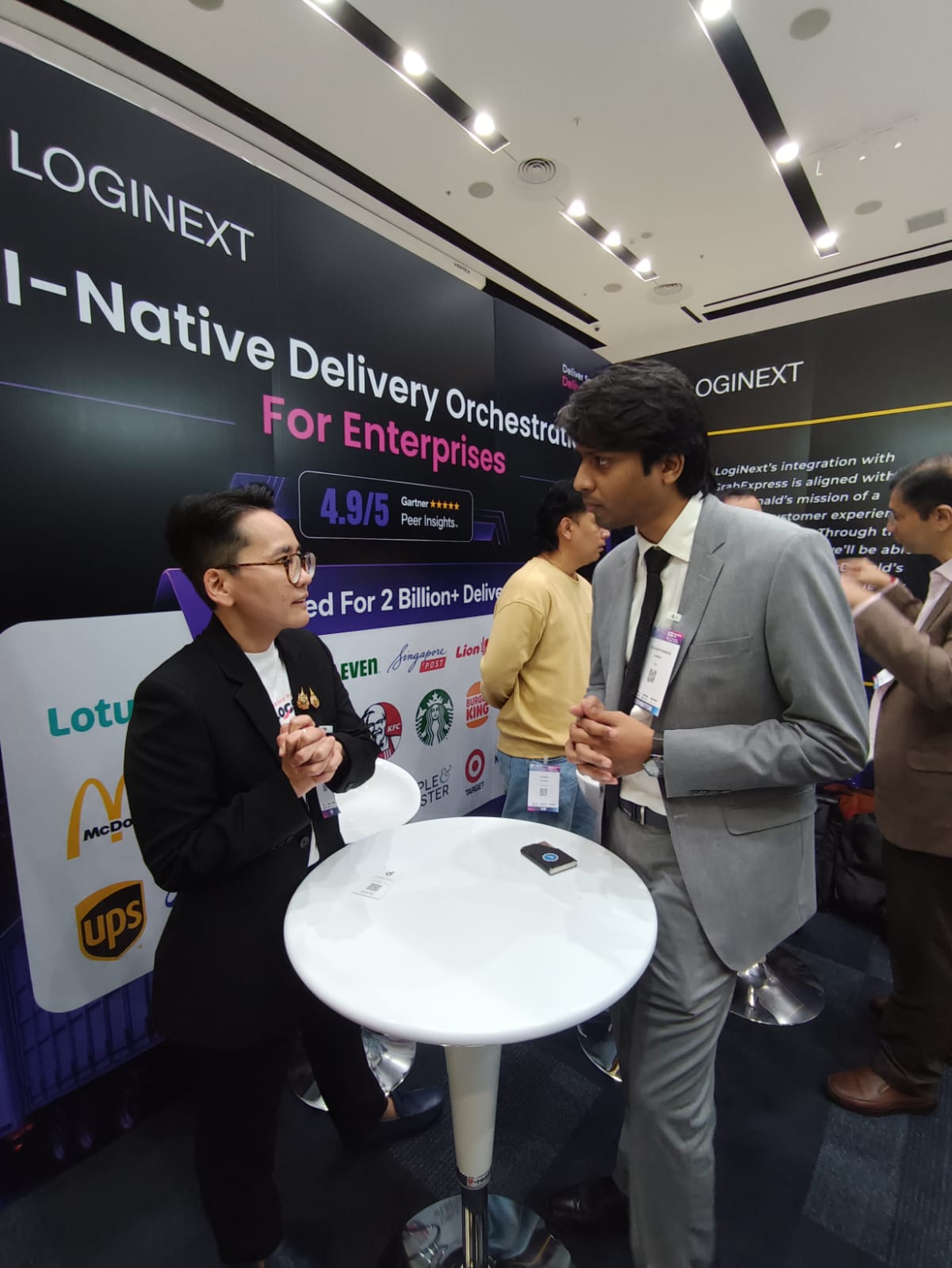
If the panels showed where the industry wants to go, conversations at the LogiNext booth showed what businesses are dealing with today.
Legacy systems were one of the most common pain points. Thailand Post, which handles more than 10,000 monthly transactions, is exploring ways to modernize its transportation management environment, including stronger analytics and API integrations.
Pinsub Group, with around 100 dedicated cement transport trucks across Thailand, was looking at improving fleet visibility and digitizing order allocation. The underlying need was straightforward: replace disconnected processes with a clearer, more centralized way of managing operations.
Manual Processes Do Not Scale Quietly
Outsourced operations brought another set of challenges. Yum Restaurants International, operates KFC Thailand through four franchise partners and around 400 stores. They discussed the difficulties of manual store-level dispatching by Third Party Logistics providers. The business is exploring more centralized orchestration and electronic proof of delivery.
MK Group and Ai-Ai-Ai Co., together represent more than 600 stores and restaurant outlets. They, were also looking beyond basic GPS tracking toward broader logistics management capabilities.
The pattern was hard to miss. As businesses add stores, vehicles, orders, and partners, manual coordination does not simply become inconvenient. It becomes harder to control.
Scale Changes the Problem
Retailers brought the same challenge from a different angle. CP Axtra manages more than 70,000 monthly orders with around 1,000 riders and discussed dynamic routing and dispatching.
Nice Group Holding, MC Group, and MR. D.I.Y. also highlighted the complexity of managing distribution across extensive store networks. MR. D.I.Y. alone operates more than 1,200 stores.
For businesses at this scale, the challenge is no longer just moving an order from one point to another. It is coordinating thousands of decisions across a network without allowing complexity to slow everything down.
Industrial businesses had their own version of the same problem. SHERA Public Company and Carry Chemicals discussed the need to automate dispatching and improve delivery tracking across bulk construction and industrial material distribution.
Enterprise Logistics Added Another Layer to the Conversation
The discussions with major logistics providers showed that complexity does not disappear when businesses have sophisticated operations. In many cases, it simply takes a different form.
DHL Supply Chain is managing around 100,000 monthly trips across 600 electric vehicles and 250 third-party carrier vehicles. This is while evaluating a transportation management system to replace legacy tools. CEVA Logistics discussed operations involving more than 100 daily trucks across major projects in Thailand, alongside the need for SKU- and crate-level track-and-trace across middle-mile and final-mile movements.
Bigger Networks Need Better Coordination
Ikano, which handles around 10,000 daily deliveries, is exploring options to replace its existing transportation management system. Unilever Thai Trading and Mainfreight Logistics discussed Third Party Logistics and Fourth Party Logistics management integration, as well as the need for better mid-mile tracking.
The businesses were different, but the underlying challenge was remarkably similar. Planning, fleets, carriers, facilities, orders, and fulfillment cannot always be managed as separate pieces when every part affects the others.
That is where the conversation around AI starts to become less about adding another technology layer and more about connecting the ones businesses already depend on.
The Real Opportunity Is Connecting Intelligence to Execution
The conversations in Bangkok reinforced a point that can sometimes get lost in the excitement around AI. Businesses do not need more information for its own sake. They need intelligence that helps them make decisions and act on them.
This is where AI-powered orchestration becomes increasingly relevant. When planning, dispatching, transportation, fulfillment, fleets, carriers, and execution are connected, businesses can respond to changing conditions without relying entirely on static plans or manual intervention.
The goal is not automation for automation’s sake. It is creating an operation that can adapt as the real-world situation changes.
This is Where LogiNext Fits Into the Picture
The challenges discussed at AIxEcom Summit 2026 closely align with the direction LogiNext is building toward. Bringing AI, intelligent orchestration, automation, and visibility together to help enterprises manage complex logistics operations.
Its capabilities span automated route planning and dynamic dispatching, hybrid fleet and Third Party Logistics orchestration, end-to-end visibility, and API integrations that connect existing systems and partners.
For the businesses we met in Bangkok, these capabilities map directly to many of the challenges they described, from managing outsourced fleets and large store networks to replacing legacy systems and coordinating high-volume operations.
More importantly, the conversations reinforced why AI needs to be part of the operational workflow rather than sitting separately from it.
Also Read: LogiNext Exception Management: From Issue to Resolution
Two Days in Bangkok, One Bigger Takeaway
AIxEcom Summit 2026 made one thing clear: AI in supply chain and logistics is moving beyond prediction and into action. As businesses deal with growing complexity, fragmented systems, and rising customer expectations, the ability to connect intelligence with execution will become increasingly important.
That is the direction LogiNext is building toward. Bringing AI, intelligent orchestration, automation, and visibility together to help enterprises simplify complex logistics operations.
Want to see what AI-powered orchestration could do for your business? Explore LogiNext and discover how smarter technology can help your operations become more connected, responsive, and efficient.
3
 |  |  |




@LogiNext