




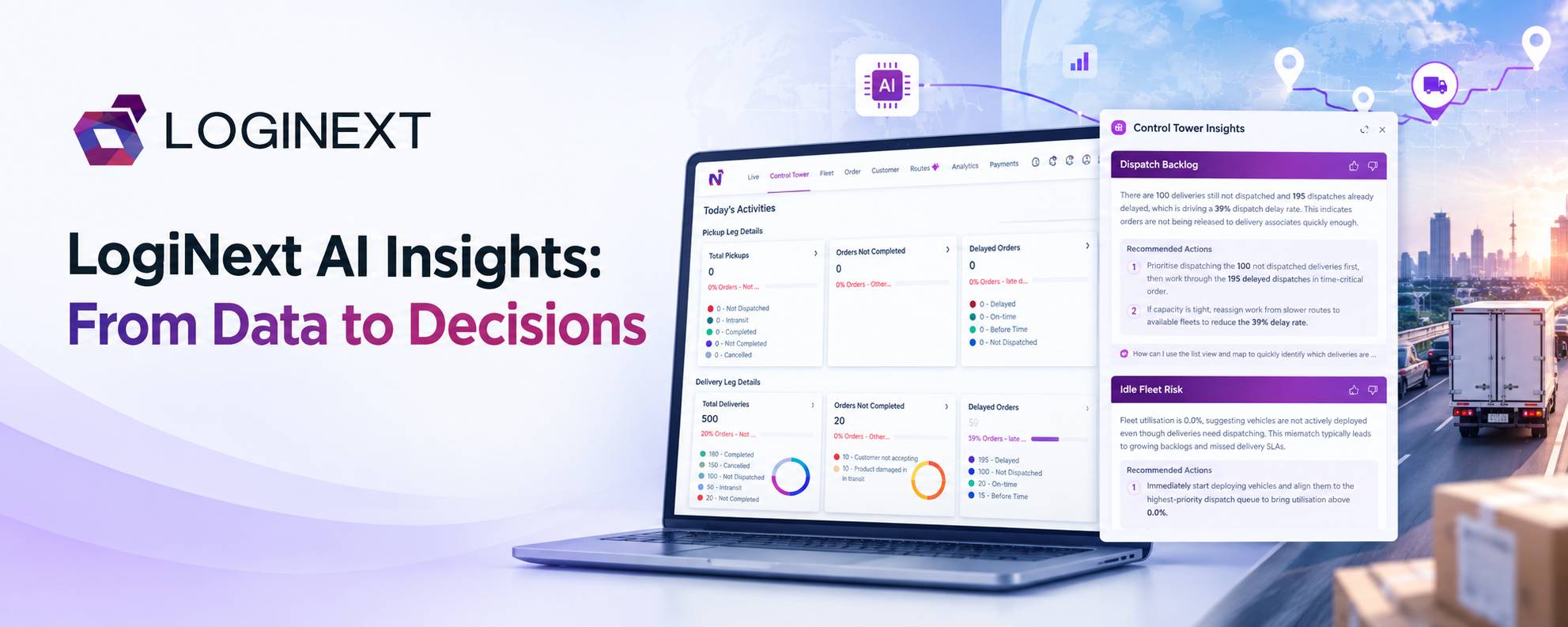
LogiNext AI Insights: From Data to Decisions
Logistics teams don’t have a data problem. They have a “what do I do with all this data?” problem. That’s where AI Insights comes in. Built into LogiNext Analytics, AI Insights analyzes the data in the analytics view you’re working with and surfaces meaningful patterns, gaps, deviations, inefficiencies, and opportunities for improvement.
That matters because modern logistics operations generate data at a dizzying pace. Orders, delivery performance, service times, assignments, payments, customer interactions, and operational activity all leave behind valuable signals. Finding those signals manually, however, can take time that operations teams don’t have.
With AI Insights, LogiNext adds an intelligence layer to its Analytics environment. Thereby, helping teams move from simply seeing what happened to understanding what deserves attention and where to optimize.
Key Takeaways
- AI Insights analyzes data within LogiNext Analytics and generates actionable observations and recommendations.
- Insights reflect the selected Date & Time Range and applicable filters.
- Analytics data is available for the past three years.
- AI Insights can surface patterns, deviations, inefficiencies, gaps, bottlenecks, and optimization opportunities.
- Its applications span the broader Analytics environment, with the specific insights depending on the data being analyzed.
- The real value is moving from data visibility to faster, more informed operational decisions.
Why More Logistics Data Doesn’t Always Mean Better Decisions
Analytics dashboards are excellent at showing numbers. But numbers don’t always explain themselves.
A dashboard might show that assignment performance dropped, service times increased, or customer engagement changed. The next question is the one that usually takes human effort: Why did it happen, and what should we look at next?
This is becoming increasingly important as AI adoption moves from experimentation into everyday operations. McKinsey’s 2026 State of Digital Logistics Survey found that nearly 90% of surveyed shippers had adopted at least one transportation AI use case, while 88% said their transportation AI and digital tools had met or exceeded expectations.
The opportunity, then, isn’t simply to add another AI feature to the technology stack. It’s to put AI closer to the decisions teams are already making. That’s the role AI Insights plays in LogiNext.
What Are AI Insights in LogiNext?
AI Insights is an in-app capability within LogiNext Analytics that analyzes the data in the selected analytics view and generates actionable observations and recommendations.
It can identify:
- Trends and patterns
- Deviations from expected or planned performance
- Operational inefficiencies
- Compliance gaps
- Problem areas and bottlenecks
- Opportunities for optimization
- Recommendations for improving operational performance
The important part is context.
AI Insights doesn’t simply generate generic advice about logistics. It works with the analytics data you’re looking at, making the resulting insights relevant to the selected operational context.
Think of it as the difference between opening a spreadsheet with 50 columns and having someone point to the three numbers that actually deserve your attention.
How AI Insights Turns Analytics Into Action
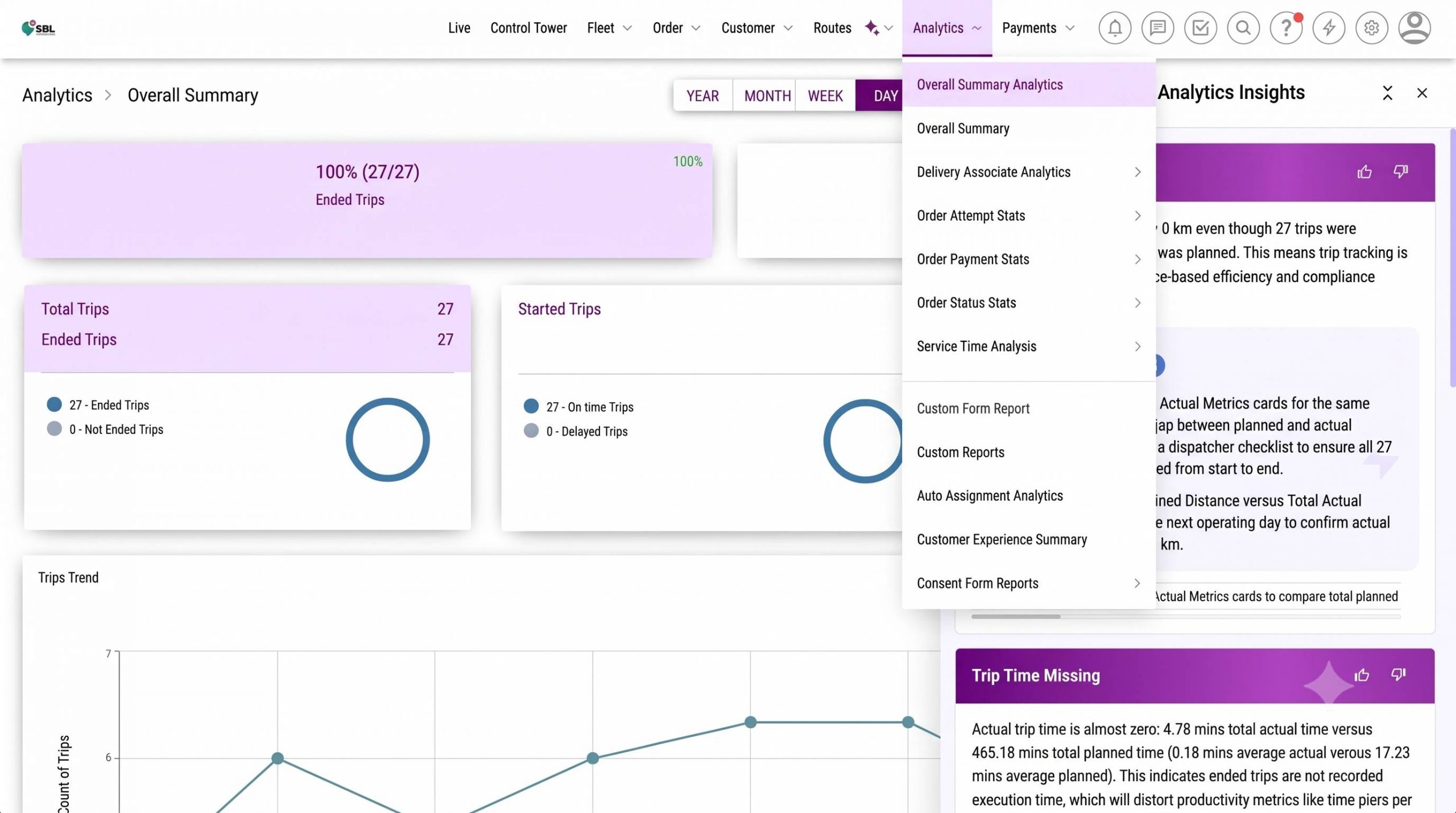
Using AI Insights starts with the data already available in LogiNext Analytics.
1. Start With the Right Time Range:
Users select the Date & Time Range they want to analyze. Analytics data is available for up to the past three years, giving teams a substantial historical window for analysis.
2. Narrow the Operational Context:
Depending on the analytics view, users can apply relevant filters such as Hubs, Shippers, days of the week, time slots, skill sets, and other available parameters.
Some views also provide different levels of granularity, such as Day, Week, Month, or Year, allowing teams to examine performance from different perspectives.
3. Let AI Insights Analyze the Selected Data:
Once the context is defined, AI Insights analyzes the underlying analytics data to identify meaningful patterns, gaps, deviations, and areas that may require attention.
4. Move From Observation to Optimization:
The output isn’t just another chart. AI Insights provides actionable observations and recommendations that can help teams understand where performance can be improved.
The workflow is simple:
Select the context → analyze the data → identify what matters → act on the opportunity.
From Analytics Dashboards to the Control Tower
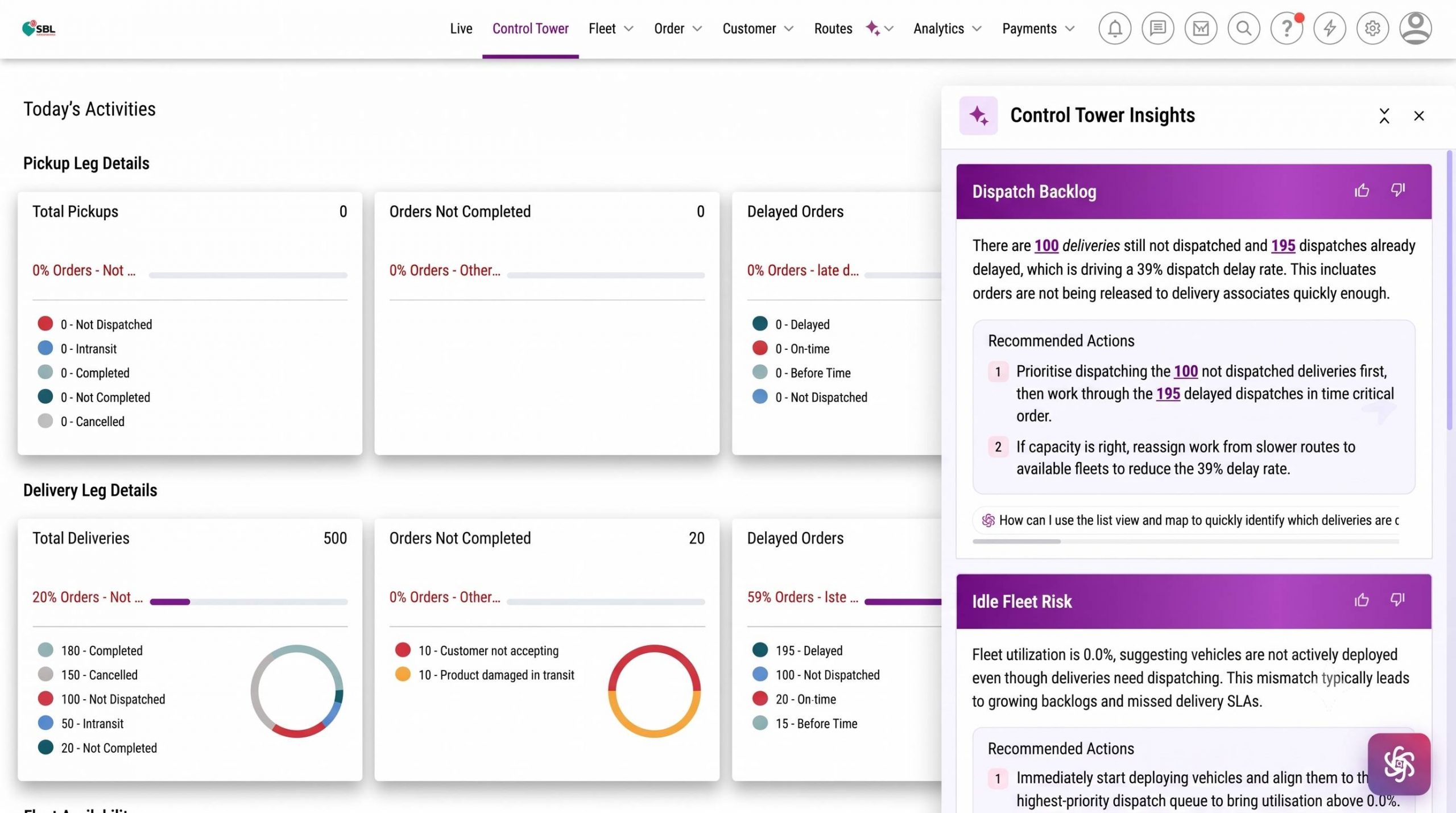
Analytics gives teams detailed visibility into specific aspects of operations. A Control Tower brings that visibility together to provide a broader view of what is happening across the operation.
That broader view creates another useful context for AI Insights.
Instead of requiring teams to scan multiple operational signals and determine where something looks unusual, AI Insights can help identify areas that deserve attention within the available Control Tower data. It can surface patterns, deviations, and operational areas that may require further investigation.
This becomes particularly useful when teams are monitoring a large and dynamic operation. The challenge is not always finding the data. It is knowing which part of the data matters right now.
The relationship is simple: Control Tower provides visibility. AI Insights helps teams interpret that visibility.
For example, teams may use the Control Tower to monitor the state of ongoing operations while AI Insights helps bring attention to patterns or areas that warrant a closer look. This gives users a more focused starting point for investigation instead of requiring them to manually scan every operational signal.
AI Insights helps teams identify areas requiring attention across Control Tower operations.
What Can AI Insights Uncover Across LogiNext Analytics?
The strength of AI Insights comes from its ability to work across the broader Analytics environment rather than being tied to a single report.
For example, in Auto Assignment Analytics, AI Insights can identify patterns in assigned versus unassigned orders, highlight reasons behind assignment failures, and suggest ways to improve assignment efficiency.
In Customer Experience Summary, it can analyze engagement across channels such as email, SMS, WhatsApp, tracking links, and IVR to surface changes in interaction patterns and potential customer-experience gaps.
In Overall Summary Analytics, AI Insights can help identify planned-versus-actual deviations, inefficiencies, compliance gaps, operational bottlenecks, and optimization opportunities.
And in Service Time Analysis, it can highlight variations between planned and actual service times and point toward opportunities to improve service efficiency.
The same principle extends across the wider Analytics environment: the insight changes with the data and context being analyzed.
Why an Intelligence Layer Matters in Logistics?
Traditional analytics answers an important question: What happened?
AI-powered analytics can take that a step further by helping answer:
- What changed?
- Where is the problem?
- What pattern is emerging?
- What might need attention?
- Where is there an opportunity to improve?
That shift matters because logistics decisions are rarely isolated. A change in service time can affect utilization. Assignment inefficiencies can affect delivery performance. Customer communication gaps can affect experience.
McKinsey’s recent research makes a similar point: companies are getting more value from AI when they move analysis closer to operational decisions and make the implications of cost, service, utilization, and risk more visible.
Deloitte’s 2026 India AI report also found that 48% of surveyed Indian enterprises reported at-scale AI adoption in supply chain, showing how quickly AI is moving into operational functions rather than remaining an experimental technology.
For logistics teams, that means the question is shifting from “Should we use AI?” to “Where can AI help us make better decisions?”
Making Analytics More Useful for Everyday Operations
The value of it is not in adding another layer of information. It is in making the information teams already have more useful.
When operational data spans multiple dashboards, metrics, and time periods, teams need a faster way to identify what deserves a closer look. AI Insights helps bring those signals forward, giving users a starting point for investigation instead of leaving them to manually connect every data point.
That can make everyday analysis more focused. Teams can spend less time searching for unusual patterns and more time understanding the underlying issue, evaluating recommendations, and deciding what action makes sense for their operation.
For businesses using AI-powered logistics software, this creates a more practical role for AI: not replacing operational judgment, but helping teams apply it with better context.
With LogiNext AI Insights, analytics becomes more than a place to view performance. It becomes a starting point for asking better questions, finding potential improvements, and making more informed operational decisions.
Also Read: LogiNext Exception Management: From Issue to Resolution
Frequently Asked Questions
1. What is AI Insights?
AI Insights is a LogiNext capability that analyzes analytics data and generates actionable observations and recommendations. This is to help teams identify trends, gaps, inefficiencies, and optimization opportunities.
2. What data does AI Insights analyze?
AI Insights analyzes the data available in the selected Analytics view based on the user’s chosen Date & Time Range and applicable filters.
3. Does AI Insights work across different Analytics dashboards?
Yes. It is designed to work across the broader LogiNext Analytics environment. The insights generated depend on the specific analytics data and context being analyzed.
4. How far back can I analyze data with AI Insights?
LogiNext Analytics provides access to data from the past three years. It works with the date range selected within that available data.
5. Does AI Insights automatically fix operational problems?
AI Insights identifies relevant patterns, problem areas, and optimization opportunities and provides recommendations. It is designed to support better decisions rather than imply that every recommendation is automatically executed.
Conclusion: Make Your Logistics Data Work Harder
Analytics gives logistics teams visibility. AI Insights helps turn that visibility into direction.
By analyzing the data already available across LogiNext Analytics, helps teams spot meaningful patterns, identify areas that need attention, and uncover opportunities to improve operations. Instead of manually searching through every metric, teams can start with the signals that matter most.
And as AI adoption across supply chains continues to accelerate, that ability to connect analytics with operational decisions will only become more valuable.
Want to see what AI-powered intelligence can do for your logistics operations? Explore LogiNext and discover how its AI-native platform can help your team turn operational data into smarter decisions.
2
 |  |  |




@LogiNext